
| USDA Organic oversight | U.S. Department of Agriculture, National Organic Program |
| ENERGY STAR administrator | U.S. Environmental Protection Agency |
| NSF certification scope | Water treatment, food equipment, dietary supplements, and more |
| "Dermatologist Tested" — regulated? | No — no standard definition or required methodology |
| "Eco-friendly" — regulated? | No — unregulated term in most product categories |
| FTC Green Guides | Guidance only — not a certification or enforcement label (U.S. Federal Trade Commission) |
Why Certifications Exist — and Who's Actually Checking
Certification labels serve a straightforward purpose: they're supposed to tell you that an independent party has verified a product meets a defined standard. The catch is that "independent" and "verified" mean very different things depending on who issues the label.
Some certifications are administered by federal agencies with legal authority — USDA Organic and ENERGY STAR being the clearest examples. Others are issued by nonprofit organizations with rigorous third-party auditing. And some are essentially self-declared, with no external verification at all.
Before trusting a seal, the most useful question to ask is: who owns this certification, and what do they actually require for it? That question cuts through a lot of marketing noise quickly. For a broader look at how regulated claims differ from unregulated ones, see what product labels are actually required by U.S. law.
| USDA Organic oversight | U.S. Department of Agriculture, National Organic Program |
| ENERGY STAR administrator | U.S. Environmental Protection Agency |
| NSF certification scope | Water treatment, food equipment, dietary supplements, and more |
| "Dermatologist Tested" — regulated? | No — no standard definition or required methodology |
| "Eco-friendly" — regulated? | No — unregulated term in most product categories |
| FTC Green Guides | Guidance only — not a certification or enforcement label (U.S. Federal Trade Commission) |
Common Certifications Decoded
Here's what several widely-seen certifications actually verify — and where their limits are.
USDA Organic
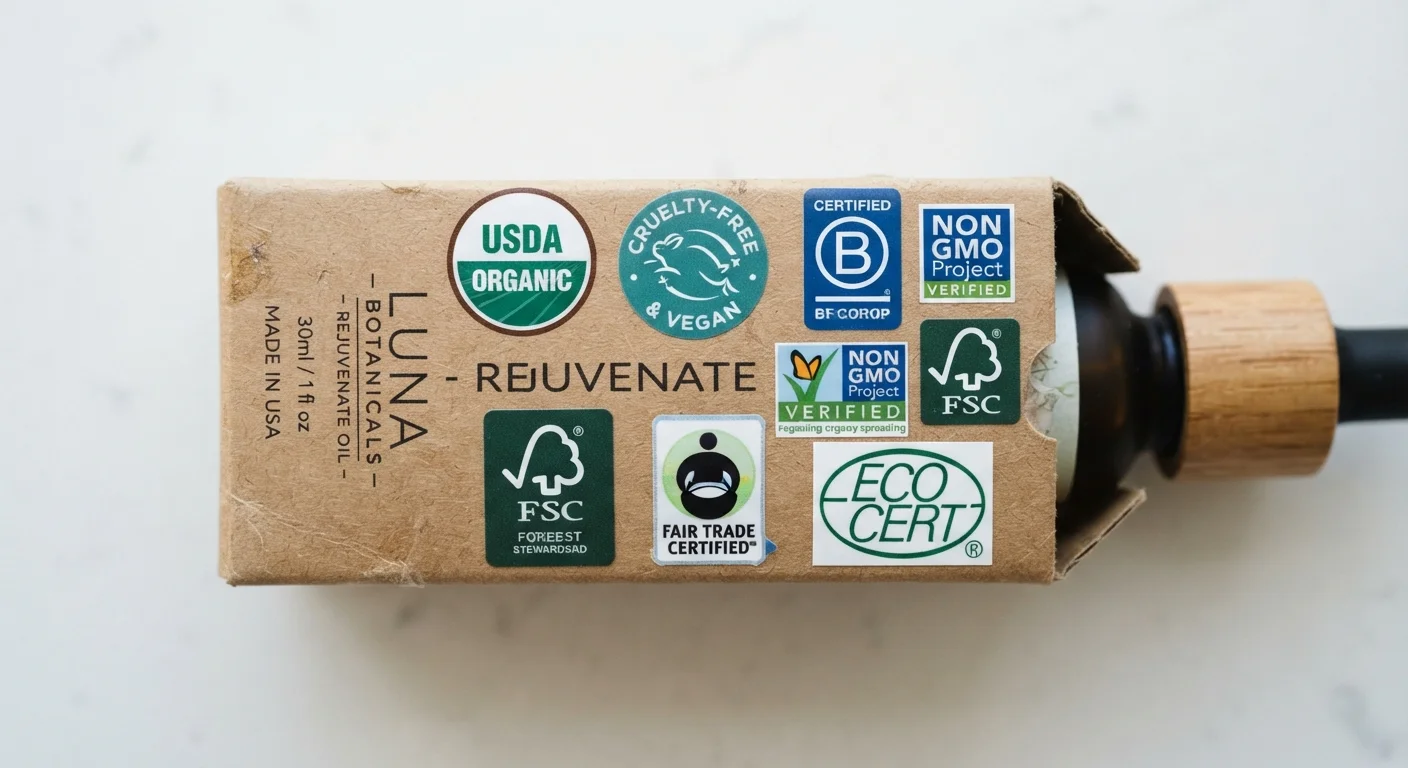
Governed by the U.S. Department of Agriculture's National Organic Program, this certification requires that crops be grown without most synthetic pesticides or fertilizers, and that livestock be raised under specific welfare and feed conditions. Third-party certifying agents conduct annual on-site inspections. This is one of the most substantive food certifications available — but it covers how something is grown, not necessarily its nutritional value or taste. For how Organic compares to Non-GMO and Regenerative labels, see how these agricultural claims differ.
ENERGY STAR
Administered by the U.S. Environmental Protection Agency, ENERGY STAR certifies that appliances and electronics meet specific energy-efficiency thresholds. Testing is conducted by EPA-recognized labs, and products are subject to market surveillance. It's a reliable indicator of efficiency relative to comparable products in the same category — not a guarantee of overall product quality.
NSF Certification
NSF International is an independent public health and safety organization. Its certifications appear across water filters, dietary supplements, and food equipment. NSF testing evaluates whether a product actually contains what it claims and doesn't contain harmful levels of contaminants. This is considered one of the more rigorous consumer-facing certifications in its applicable categories.
Fair Trade Certified
Fair Trade USA and Fairtrade International certify that products — commonly coffee, cocoa, and apparel — meet standards for worker pay, labor conditions, and community investment. Audits are conducted by third parties. The standards are meaningful, though they vary between the two organizations and by product category.
Non-GMO Project Verified
This label indicates a product has been evaluated for the presence of genetically modified organisms and meets the Non-GMO Project's threshold standards. It's a nonprofit-run program with third-party verification — but it's worth noting that U.S. regulatory agencies have not established that GMO foods pose health risks. The label reflects a production choice, not a safety determination. See what agricultural buzzwords really mean on a package for related context.
Third-party certification
Verification of a product or practice conducted by an organization independent of both the manufacturer and the consumer. Third-party certification is generally more credible than self-declared claims because the certifier has no direct financial stake in the outcome.
Self-declared claim
A label or statement made by the manufacturer without external verification. Terms like "eco-friendly" or "natural" are typically self-declared, meaning there is no independent body confirming the claim.
Market surveillance
Ongoing post-certification monitoring where a certifying body randomly tests certified products on the open market to ensure they continue to meet the required standards.
Threshold standard
A defined limit or minimum level that a product must meet or fall below to qualify for certification — for example, a maximum allowable concentration of a contaminant, or a minimum energy-efficiency ratio.
Green Guides (FTC)
Guidance issued by the U.S. Federal Trade Commission to help marketers avoid making deceptive environmental claims. They are not a certification program and do not grant or verify any label — they outline principles for truthful environmental marketing.
Labels That Carry Less Verification Than They Imply
Several common seals are more marketing device than meaningful standard.
"Dermatologist Tested" is a prime example. This phrase has no regulated definition — it could mean one dermatologist looked at the product once, with no requirement to disclose the methodology, sample size, or outcome. For a full breakdown, see why "Dermatologist Tested" doesn't mean what you think.
"Eco-friendly," "Sustainable," and "Green" are entirely unregulated terms in most product categories. Marketers can apply them freely. The FTC's Green Guides provide guidance to companies on avoiding deceptive environmental claims, but they're not a certification program. When you see these terms on packaging, look for an actual named certification behind them. For more on this distinction, see greenwashing vs. genuine sustainability claims.
"Clinically Proven" similarly lacks a standardized definition. It may reference an in-house study, a small unpublished trial, or a well-designed independent study — with no way to tell which from the label alone.
A useful reference: the third-party certifications worth paying attention to explains how to distinguish seals with real accountability from decorative ones. And for general label literacy, reading a product label without getting lost in the fine print is a practical starting point.