

Key Takeaways
Required Product Labels
Required product labels are disclosures that U.S. federal or state law mandates manufacturers include on their packaging. Unlike optional marketing claims, these labels are enforced by government agencies and must meet specific legal standards. Failing to include them can result in fines, recalls, or other regulatory action.
Different agencies govern labeling for different product categories: the FDA covers food, drugs, and cosmetics; the FTC oversees textiles and appliances; the CPSC handles consumer product safety disclosures; and the USDA regulates meat and poultry labels.
Why the Distinction Between Required and Voluntary Labels Matters
Walk down any grocery or hardware aisle and you'll see dozens of labels competing for your attention. Some are there because federal law demands it. Others exist solely because a marketing team decided they'd move product. The practical challenge for consumers: the packaging doesn't always make clear which is which.
Understanding the difference has real stakes. A mandatory label — like a Nutrition Facts panel or a textile fiber content tag — reflects a legal obligation backed by regulatory enforcement. A voluntary claim — like "wholesome," "artisan," or "premium" — reflects nothing more than the manufacturer's self-assessment. Treating both with the same level of trust is a mistake that affects purchasing decisions every day.
For a broader look at how consumer protections work, see consumer rights you already have under federal law.
Regulatory Jurisdiction Varies by Product Type
No single agency governs all product labels in the U.S. The FDA, USDA, FTC, CPSC, EPA, and DOE each have jurisdiction over different product categories — and sometimes overlap. A cleaning product, for example, may be subject to both EPA and CPSC requirements depending on its ingredients and intended use. When in doubt about a specific product's labeling rules, the relevant agency's website is the most reliable primary source.
Federally Mandated Labels by Product Category
Food and Beverages (FDA & USDA)
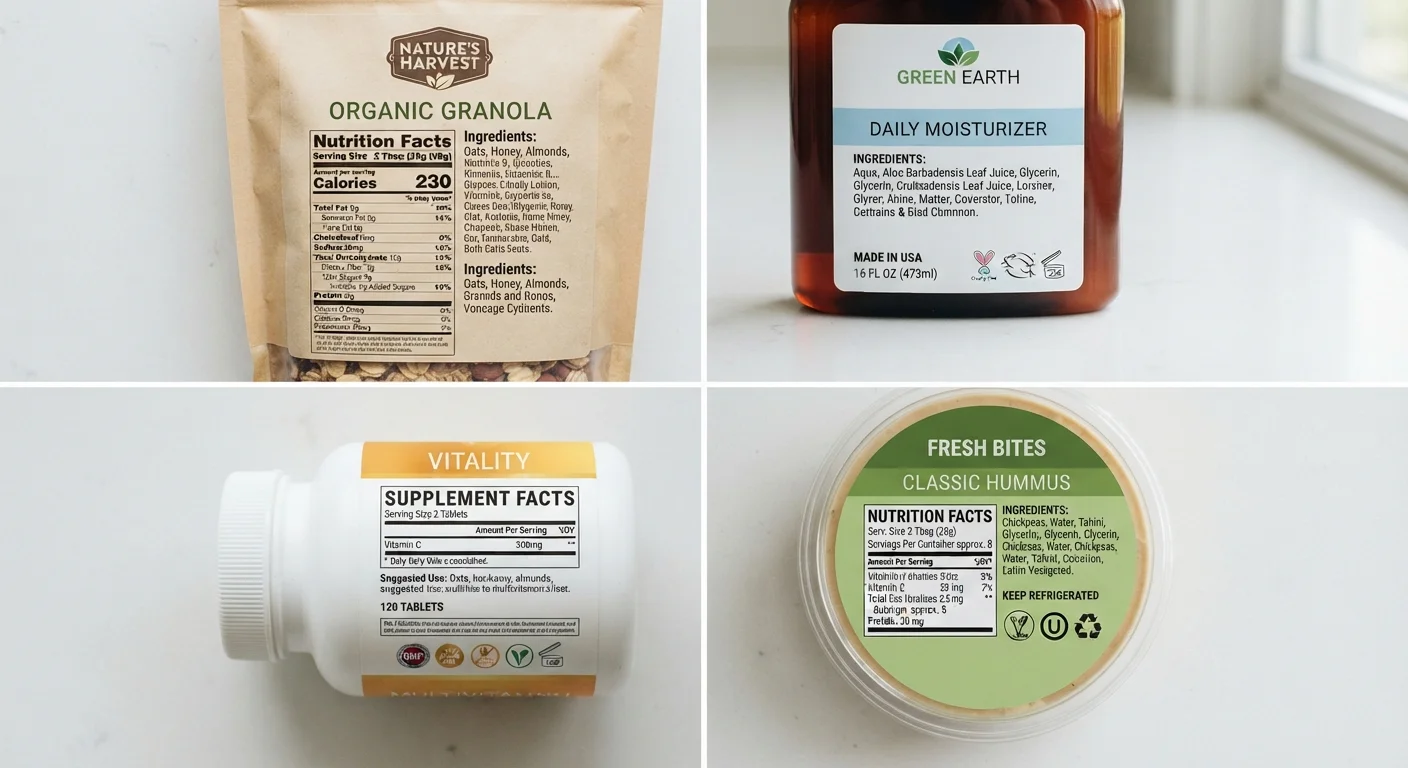
For most packaged foods, federal law requires: a Nutrition Facts panel, an ingredient list in descending order by weight, allergen disclosures (covering the nine major allergens including milk, eggs, peanuts, tree nuts, wheat, soy, fish, shellfish, and sesame), net quantity of contents, and the manufacturer's name and address. Foods regulated by the USDA — mainly meat, poultry, and processed egg products — face additional labeling requirements including safe-handling instructions.
Drugs and Dietary Supplements (FDA)
Over-the-counter drugs must carry a Drug Facts label specifying active ingredients, uses, warnings, and dosage directions. Dietary supplements require a Supplement Facts panel and must not make drug-style claims (claims that a product treats or cures a disease). Structure/function claims — such as "supports immune health" — are permitted but must include a disclaimer that the FDA has not evaluated the statement.
Clothing and Textiles (FTC)
Garments sold in the U.S. must permanently disclose fiber content, country of origin, and the manufacturer or importer's identity. Care labeling — with specific symbols or instructions for washing, drying, bleaching, and ironing — is also mandatory under FTC rules and must remain legible for the garment's expected lifespan.
Appliances and Electronics (FTC / DOE)
The FTC's EnergyGuide label is required on major appliances like refrigerators, washing machines, and water heaters. It provides estimated annual energy consumption and operating cost, calculated using standardized government testing methods — not manufacturer estimates.
9
Major food allergens requiring mandatory disclosure
The FASTER Act of 2021 added sesame as the ninth major allergen requiring mandatory labeling on U.S. food products, effective January 1, 2023.
~50,000
Distinct chemicals in commerce with no required labeling
According to the EPA's Toxic Substances Control Act inventory, tens of thousands of chemicals are in commercial use, many without consumer-facing disclosure requirements on finished products.
2016
Year the updated Nutrition Facts panel was finalized
The FDA finalized its updated Nutrition Facts panel rules in 2016, requiring changes such as added sugars disclosure and updated serving size standards; most manufacturers were required to comply by 2020.
Claims That Sound Official But Aren't Legally Defined
Some of the most prominent phrases on packaging carry no regulatory definition in most product categories. This doesn't make them illegal — the FTC still requires they be truthful and substantiated — but it does mean there's no government body verifying the claim before the product hits shelves.
- "Natural" — No formal FDA definition for general food products; no CPSC definition for household goods.
- "Clean" — Entirely unregulated as a label claim across virtually all product categories.
- "Non-toxic" — Has no standardized legal threshold for most consumer products.
- "Premium" or "Artisan" — Purely descriptive marketing language with no regulatory backing.
For a deeper look at how these buzzwords function in practice, see what "natural," "clean," and "pure" actually mean on a package.
Check the Ingredient List First
When evaluating any packaged product, the ingredient list is one of the most reliable, legally required disclosures available to you. Unlike front-of-pack claims, ingredient lists must follow standardized rules — descending order by weight for foods, full disclosure for drug products. If a front-of-pack claim isn't supported by what you see in the ingredient list, that's worth noting.
Certifications: Third-Party Verification vs. Self-Certification
A separate category sits between legally required labels and pure marketing claims: third-party certifications. These are voluntary programs — such as USDA Organic, ENERGY STAR, or NSF certifications — where an independent organization verifies that a product meets defined criteria before allowing use of the certification mark.
Not all certifications are equal. Some require rigorous audits and ongoing compliance testing. Others are self-certification programs where manufacturers simply declare compliance with a standard they wrote themselves. The label alone doesn't reveal which type you're looking at.
Decoding common quality labels and certifications can help you evaluate which marks carry genuine independent verification.
Similarly, country-of-origin claims — "Made in USA," "Assembled in," "Product of" — each have specific FTC or USDA definitions. See what country-of-origin labels actually cover for the distinctions.
“Consumers often assume that if something appears on a label, someone has verified it. In practice, a significant portion of label language — particularly on the front of the package — is self-generated marketing that faces no pre-market regulatory review.”
— Consumer Reports Policy & Action Team, Consumer advocacy and product testing organization
A Practical Reading Strategy
When evaluating any product label, a useful mental framework is to ask three questions: Is this information required by law? Is it verified by an independent party? Or is it a self-made claim with no external accountability?
Mandatory disclosures — Nutrition Facts, ingredient lists, fiber content tags, Drug Facts panels — are your most reliable anchors. Third-party certifications vary in rigor but at least involve an external check. Unverified marketing language should be treated as opinion, not fact.
For a practical walkthrough of how to read labels across different product types, reading a product label without getting lost in the fine print is a useful companion resource. And if you want to understand your rights when a product doesn't deliver on its claims, return policies and what retailers are actually obligated to do explains what protections are already on your side.
This article is for general informational purposes only and does not constitute legal or regulatory advice. Labeling requirements are subject to change and may vary by product type, jurisdiction, and specific circumstances. Consult regulatory agency resources or a qualified professional for guidance specific to your situation.