

Key Takeaways
Why These Words Are Everywhere—and What They Actually Promise
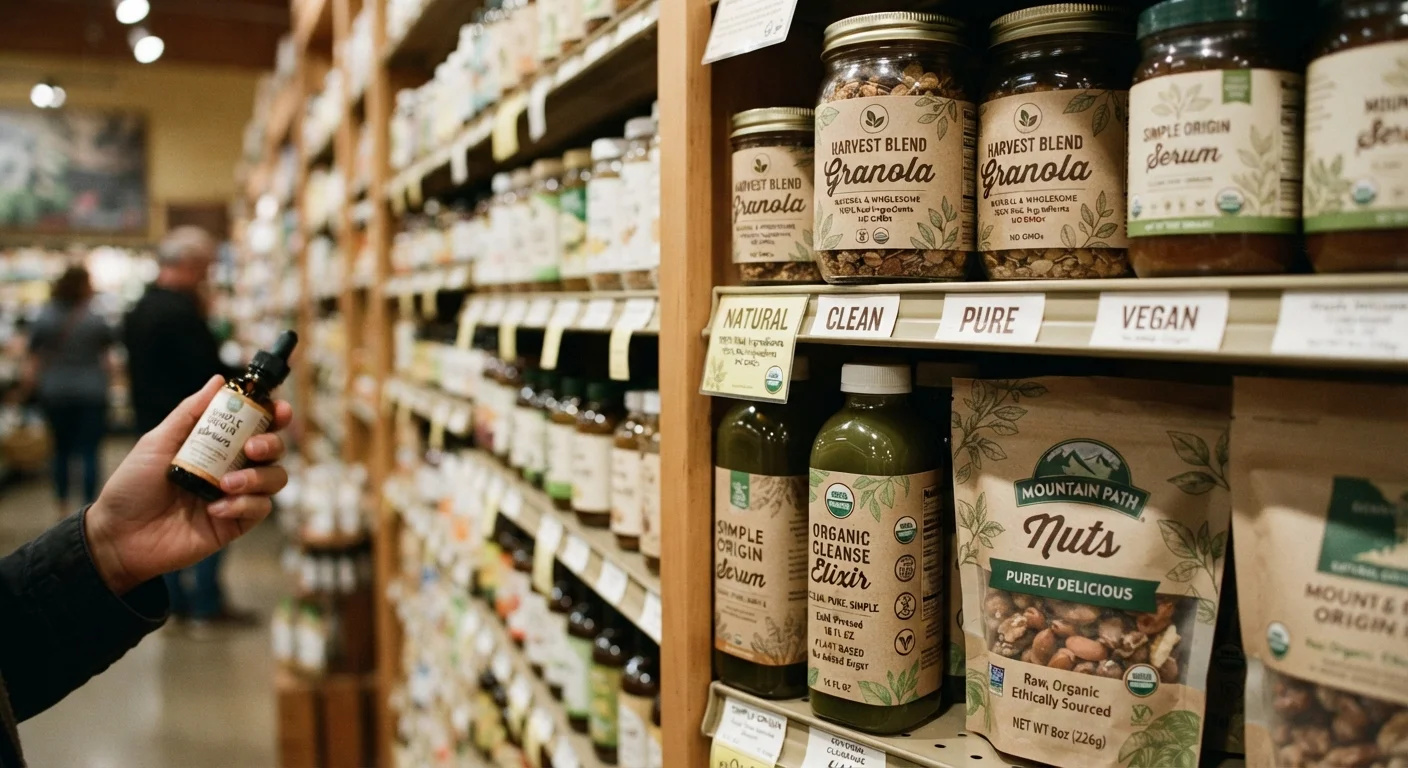
Walk through any grocery, pharmacy, or home goods store and you'll see the same words repeated on dozens of products: natural, clean, pure. They appear on shampoo, laundry detergent, snack bars, baby wipes, and protein powders. They feel reassuring—and that's precisely the point.
What most shoppers don't realize is that for the vast majority of product categories, none of these terms carry a federally standardized legal definition. A manufacturer can print "pure" on almost any label without meeting a specific ingredient or safety threshold. The Federal Trade Commission (FTC) and the Food and Drug Administration (FDA) regulate certain claims, but the rules are narrow, inconsistently enforced, and product-category-dependent.
Understanding this gap between perceived meaning and regulatory reality is the first step to shopping more deliberately. See our guide to legally required product labels for a full breakdown of which claims actually carry legal weight.
Myth
"Natural" means the product is free from synthetic or artificial ingredients.
Fact
"Natural" has no single binding legal definition for most product categories, so manufacturers apply it with significant latitude.
The FDA has stated that it considers "natural" to mean nothing artificial or synthetic has been included or added that would not normally be expected to be in the product—but this is a working policy, not a legally enforceable standard, and it applies narrowly to food. For cosmetics and household products, there is no federal definition at all. A "natural" shampoo may contain synthetic preservatives, surfactants, or fragrances alongside plant-derived ingredients. The word signals a positioning choice, not a formulation guarantee. If sourcing matters to you, look for certified agricultural claims that have published standards behind them.
Myth
"Clean" beauty or cleaning products are held to a stricter safety standard than conventional ones.
Fact
"Clean" is an entirely self-defined marketing term with no regulatory meaning in any U.S. product category.
Retailers and brands each maintain their own "clean" ingredient lists, which differ significantly from one another. What one retailer bans as "unclean," another may allow. There is no federal agency that certifies a product as "clean," and no independent body audits most "clean" claims before they appear on shelves. This doesn't mean every product marketed as clean is unsafe—some brands apply genuinely rigorous internal standards—but the label itself provides no assurance. Compare formulations directly rather than relying on the designation. Related: how to distinguish real sustainability commitments from surface-level branding.
Myth
"Pure" indicates a product contains a single, unadulterated ingredient or formula.
Fact
"Pure" is an unregulated descriptor that can be applied to any product, including complex multi-ingredient formulas.
"Pure" evokes simplicity and freedom from contamination, but it carries no legal threshold in most contexts. A "pure" essential oil, for example, might still be diluted or adulterated unless it carries a recognized quality certification from a third-party lab. A "pure" protein powder can contain multiple additives, sweeteners, or fillers. In some cases, brands use "pure" to mean "free from one specific ingredient category" they've chosen to highlight—without disclosing what else is present. Always cross-reference the term against the actual ingredient declaration on the label.
Myth
Products without these buzzwords are more likely to contain harmful ingredients.
Fact
The presence or absence of marketing terms like "natural" or "clean" has no direct relationship to a product's safety profile.
Safety is determined by specific ingredients and their concentrations—not by what words appear on the front of the package. Many products that make no wellness claims are formulated to the same or higher safety standards as those that prominently feature buzzwords. Conversely, some naturally derived substances can cause allergic reactions or irritation, while some synthetic ingredients have extensive safety records. The FDA and FTC require that products be safe and that claims not be deceptive, but those rules don't hinge on whether a company uses feel-good language. For a deeper look at how specific label claims stack up, see why "dermatologist tested" also doesn't mean what most people assume.
Myth
"Natural" on a food label means the product is organic or minimally processed.
Fact
"Natural" and "organic" are entirely separate claims on food packaging, governed by different rules.
USDA Organic certification is one of the most tightly defined food labels in the U.S., requiring specific farming practices, prohibited substances lists, and third-party verification. "Natural" on food carries none of these requirements. A product labeled "natural" may be highly processed, contain added sugars, and be produced using conventional agricultural methods. The two terms are frequently conflated by consumers, which research suggests is intentional from a marketing standpoint. If certified farming standards matter to your purchase, look for the USDA Organic seal or review how organic, Non-GMO, and regenerative claims differ.
How to Make These Labels Work for You Instead of Against You
The practical takeaway isn't to distrust every product that uses these words—it's to stop letting them do the work your own research should do.
~80%
Consumers who prefer "natural" labeled products
Survey research consistently finds that a large majority of U.S. consumers report preferring products labeled "natural," yet most cannot accurately define what the term means on a label.
0
Federal legal definitions for "clean" beauty
As of the most recent FDA guidance reviews, the term "clean" has no regulatory definition for cosmetics or personal care products under U.S. federal law.
Varies
Retailer "clean" ingredient banlists
Major U.S. retailers maintain their own "clean" standards, each banning a different set of ingredients—meaning a product can be "clean" at one store and not qualify at another.
Check the ingredient list first. Ingredient lists are legally regulated in ways that front-of-package claims are not. Ingredients must be listed in descending order by weight, so you can immediately see what makes up the bulk of a product. If "natural extracts" appear near the bottom, they're present in trace amounts regardless of how prominently the word "natural" appears on the front. Our ingredient list decoding guide explains the rules behind ordering, aliases, and hidden additives.
Look for third-party certifications instead. Labels like USDA Organic, NSF Certified, or EWG Verified represent independent verification against published standards—not self-declared marketing. These carry accountability that buzzwords don't. Some certifications carry real accountability; others are decorative. Knowing the difference matters.
Be especially skeptical in personal care and household products. Cosmetics and household cleaners face lighter federal oversight than food. The word "clean" on a face wash or "pure" on a candle has virtually no regulatory backstop. For household cleaners specifically, "non-toxic" labels face similar definitional gaps.
Don't Assume "Natural" Means Allergy-Safe
Many naturally derived ingredients—including essential oils, botanical extracts, and nut-based emollients—are common allergens. A product marketed as "natural" or "pure" can still trigger significant skin, respiratory, or digestive reactions in sensitive individuals. If you have known allergies or sensitivities, reviewing the full ingredient list and consulting a healthcare provider is more reliable than relying on front-of-package claims.
When brands use these terms genuinely, they typically back them up with specifics—ingredient transparency, published formulation standards, or recognized third-party seals. Vague claims with no supporting detail are a reasonable signal to dig deeper before deciding.
This article is for general informational purposes only and does not constitute medical, legal, or financial advice. Consult qualified professionals for decisions affecting your health or safety.