

Key Takeaways
Option A
Greenwashing
The marketing tactic that mimics sustainability without delivering it.
Best for: Recognizing when environmental language is being used to sell products rather than reflect genuine practices.
Option B
Genuine Sustainability Claims
Verifiable commitments backed by standards, data, and accountability.
Best for: Consumers who want purchases to reflect real environmental or social impact, not just good packaging.
If you want to support companies with verified environmental practices
Genuine Sustainability Claims
Look for third-party certifications and specific, quantified commitments — these signal accountability rather than aspiration.
If you're trying to avoid being misled by packaging design
Greenwashing awareness
Understanding greenwashing tactics helps you ask the right questions before any purchase, regardless of how eco-friendly a product looks.
If you're researching product labels and certifications more broadly
Genuine Sustainability Claims
Pairing greenwashing literacy with knowledge of legitimate certifications gives you a complete framework for evaluating any product.
What Greenwashing Actually Looks Like
Greenwashing is the practice of using environmental language, imagery, or claims to suggest a product or company is more sustainable than it actually is. It's not always intentional deception — sometimes it reflects a company's ambition outrunning its actual practices — but the result is the same: consumers make purchasing decisions based on incomplete or misleading information.
Common greenwashing signals include:
- Vague language: Terms like "eco-friendly," "natural," "green," or "sustainable" with no supporting detail. These words are not legally defined in most contexts and carry no automatic standard.
- Irrelevant claims: Labeling a product "CFC-free" when CFCs have been banned for decades. Technically true, practically meaningless.
- Hidden trade-offs: Highlighting one positive attribute (recycled packaging) while ignoring larger impacts (energy-intensive manufacturing).
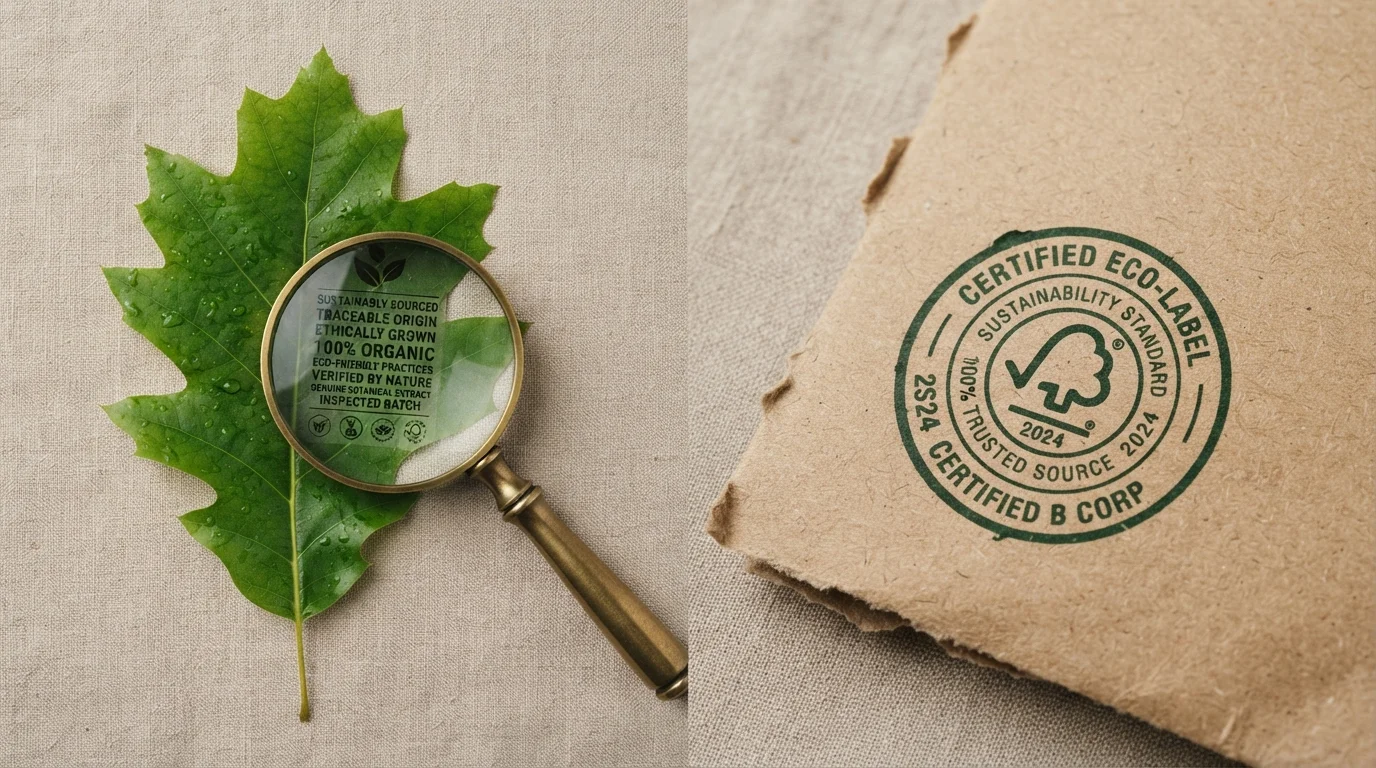
- Unverified imagery: Green leaves, earthy colors, and nature photography that imply sustainability without any substantiating claim.
- False certifications: Made-up seals or logos that look official but have no independent verification behind them.
The U.S. Federal Trade Commission's Green Guides offer a regulatory framework for evaluating these kinds of claims, outlining what qualifies as substantiated and what constitutes deceptive marketing. Understanding those standards is a practical starting point for any skeptical consumer. For a broader look at how consumer labels work — or don't — see our guide to common quality labels and certifications.
| Criterion | Greenwashing | Genuine Sustainability Claims |
|---|---|---|
| Language used | Vague: "eco-friendly," "green," "natural" | Specific: quantified metrics and defined scope |
| Verification | Self-declared or unverifiable | Third-party audited with published standards |
| Scope transparency | Entire brand implied; details omitted | Clearly defined product, facility, or practice |
| Accountability mechanism | None — no external body to answer to | Certification body, regulatory framework, or public reporting |
| Imagery and design | Heavy use of green/nature visuals without substance | Recognized seals tied to audited criteria |
| Trade-off disclosure | Highlights positives; hides negatives | Acknowledges full product or supply chain impact |
What Makes a Sustainability Claim Credible
Genuine sustainability claims share a few defining characteristics: they are specific, verifiable, and proportionate to the actual scope of the company's operations. Rather than saying "we care about the planet," a credible claim might state a measurable reduction in carbon emissions, a documented supply chain standard, or certification from a recognized independent body.
42%
Online green claims found potentially misleading
A 2021 European Commission screening found that 42% of online environmental claims were exaggerated, false, or deceptive.
1 in 3
Green claims lacking substantiation
The same EU review found roughly one-third of green claims provided no supporting evidence at all.
Key markers of credibility include:
- Third-party certification: Organizations like the Forest Stewardship Council (FSC), B Lab, or ENERGY STAR require companies to meet defined, audited criteria. These seals have accountability structures behind them. See our overview of third-party certifications worth attention for a breakdown of which ones carry real weight.
- Quantified commitments: "We reduced water usage by 30% since 2019" is more meaningful than "we're committed to water conservation."
- Scope transparency: Claims that clearly define what they cover — a specific product line, a manufacturing facility, a supply chain tier — rather than implying company-wide transformation.
- Publicly accessible reporting: Sustainability reports with methodology, baseline data, and progress metrics signal that a company is willing to be held accountable over time.
It's also worth distinguishing between environmental claims and broader sustainability claims, which can include labor practices and community impact. Labels like "non-toxic" operate in a similarly murky space — our article on what "non-toxic" labels really mean explains how to read those claims more critically.
How to Evaluate Claims at the Point of Purchase
Most shoppers don't have time to research every product's supply chain. A practical three-question framework helps cut through noise quickly:
- What exactly is being claimed? If the claim is specific ("made with 75% post-consumer recycled content"), it's easier to evaluate than "sustainably made."
- Who verified it? Self-declared claims carry less weight than those audited by an independent body with published standards.
- Does the claim match the product's full footprint? A "green" product with overnight air-freight shipping and single-use plastic components may be netting out poorly despite one positive attribute.
Agricultural and food claims deserve particular scrutiny. Terms like "organic," "non-GMO," and "regenerative" each reflect different standards and verification requirements — sometimes dramatically so. Our explainer on organic, non-GMO, and regenerative labels covers what each actually requires.
Similarly, buzzwords like "natural," "clean," and "pure" appear on thousands of products without any legal definition behind them. See our article on what these buzzwords really mean on a package for a plain-language breakdown.
Ultimately, informed skepticism is the most durable consumer tool available. No label replaces the habit of asking: what claim is actually being made, and what's backing it up?
The FTC Green Guides: A U.S. Reference Point
The Federal Trade Commission's Guides for the Use of Environmental Marketing Claims — commonly called the Green Guides — provide guidance on what constitutes deceptive environmental marketing under U.S. law. They cover terms like "recyclable," "compostable," "carbon offset," and "made with recycled content." While the Green Guides are not regulations themselves, they inform how the FTC evaluates whether marketing claims could mislead consumers. Checking whether a claim aligns with these guidelines is a useful reality check when evaluating product packaging.