

Key Takeaways
Country of Origin Label
A country of origin label is a marking on a product that indicates where it was made, grown, or substantially transformed. In the United States, these labels are regulated by federal agencies and must meet specific legal standards depending on the product type and the phrasing used. Different phrases — such as "Made in USA," "Assembled in," or "Product of" — carry distinct legal meanings and are not interchangeable.
The Federal Trade Commission (FTC) governs origin claims for most manufactured goods, while the USDA enforces mandatory country of origin labeling (COOL) for certain food categories including muscle cuts of meat, fish, and some fresh produce.
The Legal Weight Behind Common Origin Phrases
Not all origin labels are created equal, and the specific words used on packaging are not arbitrary. Each phrase carries a defined legal meaning — or in some cases, a notable absence of one.
"Made in USA" is the most regulated domestic claim. The FTC's standard requires that the product be "all or virtually all" made in the United States — meaning its components, processing, and labor must be predominantly domestic. A product with a foreign-made engine, circuit board, or primary material typically cannot use this phrase without qualification.
"Assembled in USA" is a qualified claim that acknowledges foreign components. Assembly must genuinely happen on U.S. soil, but the parts themselves may come from anywhere. This phrase is common in industries like electronics and furniture where global supply chains are the norm.
"Made in USA of foreign components" or similar hybrid phrases represent a middle ground. The FTC permits these as long as the domestic and foreign contributions are accurately described. These qualified disclosures are often more informative than an unqualified claim. For a broader look at which product claims carry legal weight, see what product labels are actually required by U.S. law.
~75%
Consumers who prefer U.S.-made products when price is equal
Various consumer surveys have consistently found that a large majority of American shoppers say they prefer domestic products when cost is comparable, though actual purchasing behavior varies.
"All or virtually all"
FTC standard for unqualified "Made in USA" claim
This is the FTC's formal legal threshold — not a percentage but a qualitative standard requiring that no, or negligible, foreign content be present in the finished product.
13 categories
Food commodities covered by USDA mandatory COOL
The USDA's Country of Origin Labeling program mandates disclosure for a defined list of commodities; most processed food products fall outside this requirement.
Food Labels: "Product of" vs. Where It Was Packed
For food, country of origin labeling operates under a separate framework. The USDA's mandatory COOL program requires origin disclosure for certain commodities: muscle cuts of beef, pork, lamb, chicken, goat, fish and shellfish, fresh and frozen fruits and vegetables, peanuts, pecans, macadamia nuts, and ginseng.
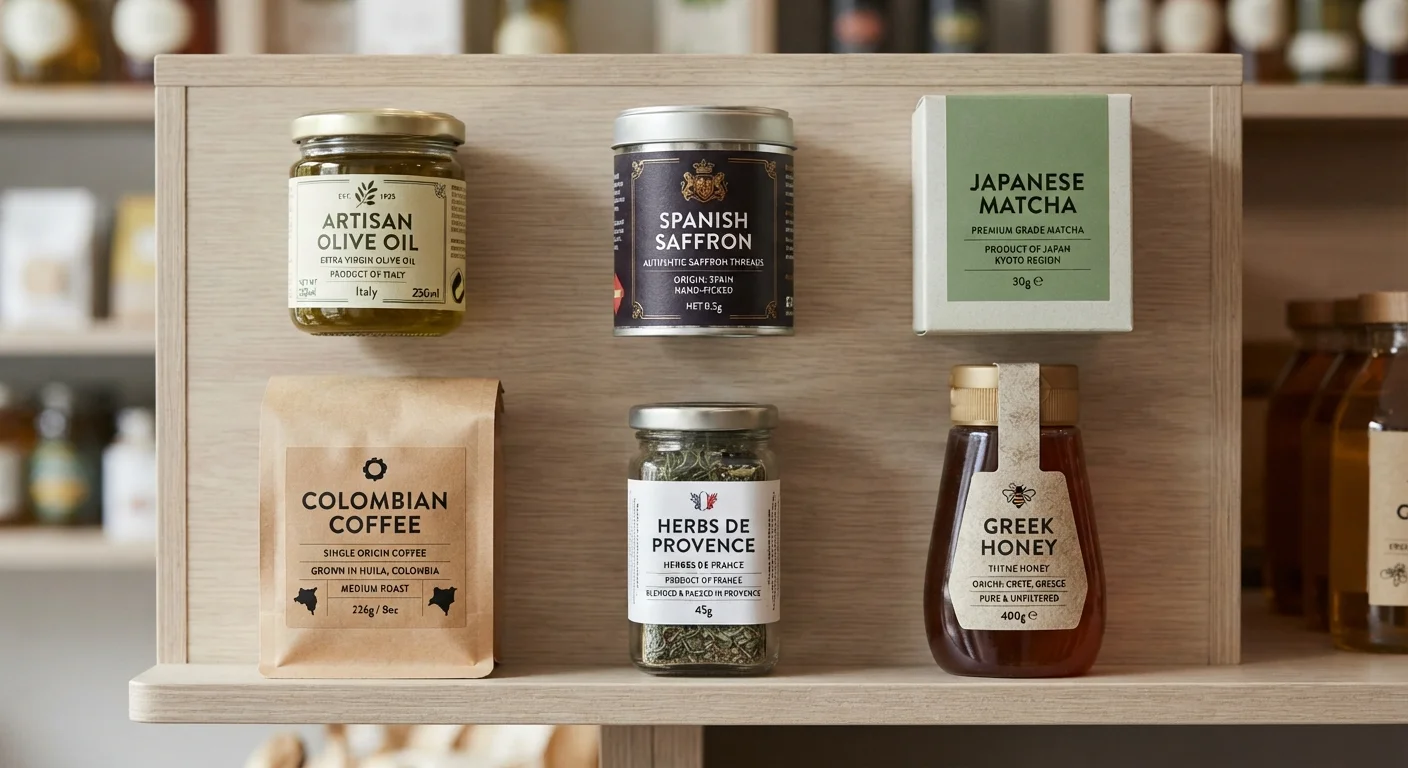
"Product of " on food means the item was grown or raised — and processed — in that country. It is a stronger, more comprehensive claim than simply noting a packing location.
However, processed food items — think canned soups, frozen meals, or packaged snacks — are generally exempt from mandatory COOL requirements. The ingredients inside may come from multiple countries, but the label may only show where the final product was manufactured or packaged. This is one of the most significant gaps consumers should understand.
Check the Ingredient List, Not Just the Origin Claim
For packaged foods, the ingredient list is often more informative than the country of origin label. Ingredients are listed by weight in descending order, so the first few items make up the bulk of the product. If you want to understand where your food actually comes from, the ingredient list combined with any available COOL disclosure gives a fuller picture than the front-panel claim alone.
What Origin Labels Don't Tell You
Country of origin is one data point — not a quality guarantee. A product made domestically may use low-grade materials; a product made abroad may meet rigorous international standards. Origin and quality are separate questions.
Labels also say nothing about:
- Labor conditions — where something was made does not confirm how workers were treated
- Environmental standards — manufacturing regulations vary widely, and a country label doesn't indicate what environmental controls were applied
- Material sourcing — even a "Product of USA" food can use packaging, feed, or inputs that came from elsewhere
If those factors matter to you, look for third-party certifications rather than relying solely on origin claims. Our guide to common quality labels and certifications explains what independent certifications actually verify.
Using Origin Information as One Tool Among Many
Country of origin labels are legitimate and useful — but they work best when combined with other label information rather than treated as a standalone quality signal. The phrase used matters: "Made in USA" carries more domestic-content weight than "Assembled in USA," and "Product of" implies more comprehensive origin than a simple packing location.
When evaluating any product, cross-reference origin claims with certifications, ingredient lists, and third-party testing results where available. Understanding how to read all parts of a product label together is a more reliable approach than focusing on any single phrase. The related guide on reading a product label without getting lost in the fine print covers how to interpret the full label as a whole.
Also worth noting: origin phrasing is just one category of label language that can mislead without technically lying. Terms like "natural" or "pure" face a similar problem — minimal legal definition, significant marketing use. For that angle, see what buzzwords like "natural" and "clean" actually mean on packaging.