

Key Takeaways
Option A
Zero-Based Budgeting
The meticulous, every-dollar-accounted-for method.
Best for: People who want granular control over their spending and are willing to build a detailed plan each month.
Option B
The 50/30/20 Rule
The streamlined, percentage-driven framework.
Best for: People who want a simple, flexible structure without tracking every individual expense category.
If you're trying to eliminate debt or break overspending habits
Zero-Based Budgeting
Assigning every dollar a purpose forces deliberate spending decisions, making it harder for money to quietly disappear into unplanned purchases.
If you have a steady income and want a low-maintenance system
The 50/30/20 Rule
The three-bucket approach requires minimal upkeep and still ensures savings and needs are prioritised without micromanaging each line item.
If your income fluctuates month to month
Zero-Based Budgeting
Rebuilding the budget each month naturally accommodates income changes, while the 50/30/20 rule's fixed percentages can feel awkward on a variable income.
If you're new to budgeting and want a starting framework
The 50/30/20 Rule
Its simplicity makes it an accessible entry point; you can always layer in more detail later as your financial confidence grows.
How Each Method Works
If you're new to budgeting, understanding the mechanics of each approach is the natural first step before choosing one.
Zero-based budgeting starts with your total monthly income and requires you to allocate every dollar to a category — housing, groceries, transportation, savings, entertainment — until the remaining balance reaches zero. That doesn't mean spending everything; savings and investments count as allocations. The discipline is in the intentionality: no dollar sits unassigned.
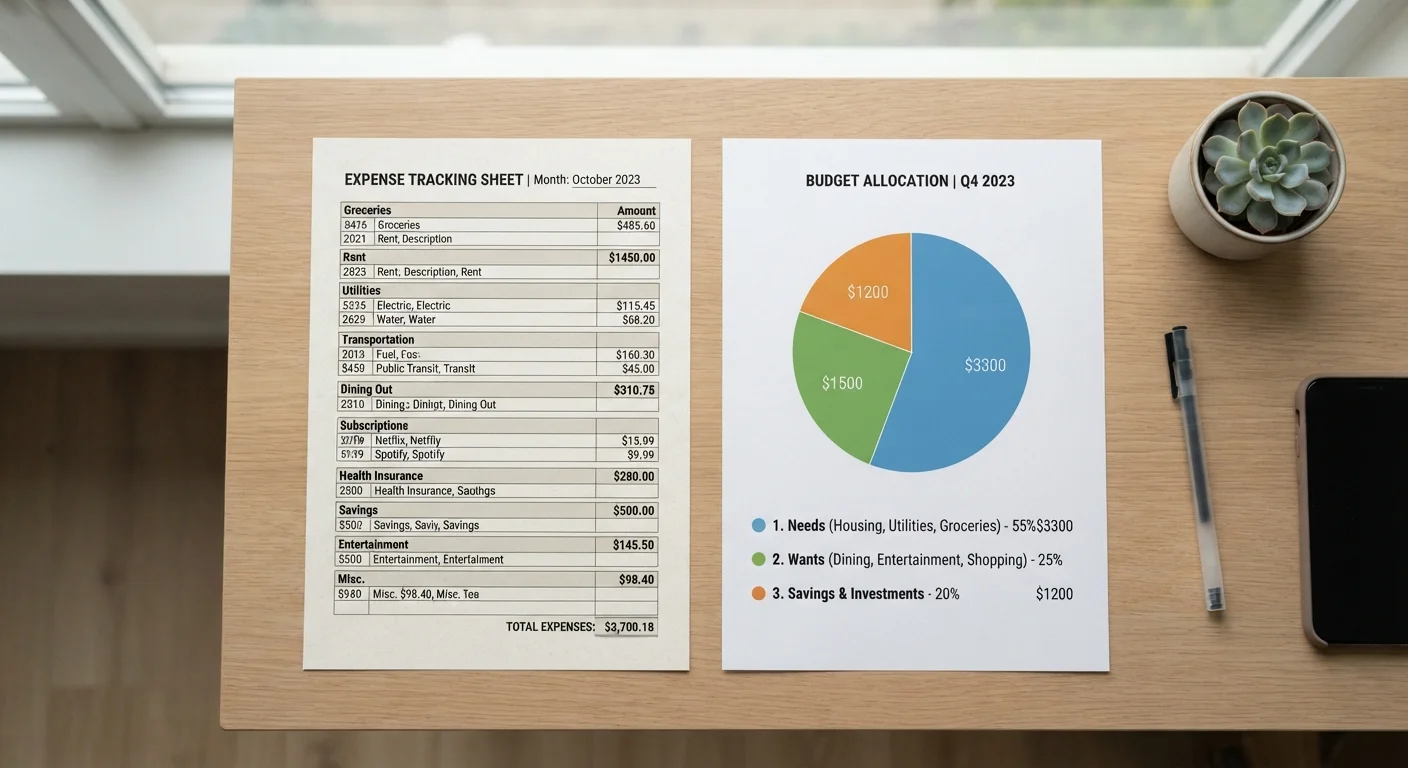
The 50/30/20 rule takes a different approach. Popularised in personal finance literature, it divides your after-tax income into three percentage-based categories: 50% toward needs (rent, utilities, insurance, groceries), 30% toward wants (dining out, subscriptions, hobbies), and 20% toward savings and debt repayment. You don't track individual line items — you track whether each category stays within its band. For a deeper look at this framework, see how the 50/30/20 rule divides income.
| Criterion | Zero-Based Budgeting | 50/30/20 Rule |
|---|---|---|
| Core concept | Every dollar assigned a job | Income split into three percentage bands |
| Setup time | High — requires monthly rebuild | Low — percentages apply automatically |
| Ongoing maintenance | Frequent tracking required | Minimal — check category totals |
| Best income type | Variable or irregular income | Stable, predictable income |
| Spending granularity | High — individual categories | Low — three broad buckets |
| Flexibility | Flexible but deliberate | Flexible within each band |
| Ideal for debt payoff | Strong — forces trade-offs | Moderate — savings band covers it |
| Learning curve | Steeper | Gentle |
The Real Trade-Offs
Both methods work — but they reward different habits and tolerances.
Zero-based budgeting's greatest strength is visibility. Because you categorise every expense before the month begins, you're forced to confront trade-offs directly. Want to spend more on dining? Something else must shrink. This level of precision is particularly valuable when paying down debt or building savings is the top priority. The trade-off is time: creating and reconciling a detailed monthly budget takes consistent effort, and skipping even one month can erode the system's effectiveness.
The 50/30/20 rule's strength is sustainability. Because it doesn't require categorising individual purchases, it's easier to maintain over months and years. However, the broad buckets can mask problem areas — overspending within the "wants" category, for instance, may not become obvious until finances feel tight. It also assumes a relatively stable income; if you earn differently each month, recalculating percentages becomes its own task. You can explore how it compares to other frameworks in our overview of the 50/30/20 rule and its alternatives.
~74%
Americans living paycheck to paycheck
Various consumer surveys consistently show a large share of U.S. adults have little financial buffer, underscoring why a structured budgeting method matters.
20%
Income the 50/30/20 rule directs to savings
The rule's savings-and-debt allocation aligns with commonly cited personal finance guidance for building long-term financial stability.
$0
Unallocated dollars in a zero-based budget
The defining feature of zero-based budgeting is that every income dollar is assigned a category before it is spent.
Putting Either Method Into Practice
Choosing a method is only the beginning. Implementation — and sticking with it — is where most people need practical structure.
For zero-based budgeting, start by listing all expected income for the month, then build expense categories from highest priority (housing, utilities, food) down to discretionary spending. Allocate to savings before leisure. Many people use a spreadsheet or a dedicated budgeting app to manage this process. Revisit and adjust the budget if actual spending diverges from projections.
For the 50/30/20 rule, calculate your monthly after-tax income, then set spending limits at 50%, 30%, and 20% of that figure. The harder task is honestly sorting your expenses — some costs that feel like needs (a premium streaming bundle, a gym membership) may functionally be wants. Being honest about that distinction is key to making the rule meaningful. See our guide to building a monthly budget for a step-by-step walkthrough that applies to either approach.
Regardless of which method you choose, building an emergency fund should feature explicitly in your plan — whether as a named zero-based category or as part of your 20% savings allocation.
Neither Method Has to Be Permanent
Many people start with the 50/30/20 rule to build the budgeting habit, then shift to zero-based budgeting when they want more control or are tackling a specific financial goal. Others combine elements of both — using broad percentage targets as guardrails while tracking a handful of high-spending categories in detail. The right system is the one you'll actually use consistently.
This article is for general informational and educational purposes only and does not constitute personalised financial advice. Consider speaking with a qualified financial adviser about the approach best suited to your individual circumstances.