

Key Takeaways
Why Retailers Invest in Pricing Psychology
Retailers spend considerable resources understanding how shoppers perceive numbers, value, and scarcity. These efforts translate directly into the price structures you encounter every day — in-store, online, and in catalogs. The goal isn't to deceive outright, but to create conditions where spending more feels rational, even pleasant.
Understanding these conditions is the first step to making purchases that reflect your actual priorities rather than a retailer's revenue strategy. The mistakes below represent the most common ways shoppers interact with pricing tactics — and how to approach each one differently. For a broader look at how digital shopping environments compound these pressures, see how dark patterns in online shopping work against you.
Common Mistakes Shoppers Make With Retail Pricing
The following mistakes aren't signs of carelessness — they're the predictable result of pricing systems designed to exploit well-documented cognitive shortcuts. Recognizing each one gives you a practical tool to counter it.
Treating charm prices ($19.99, $4.97) as meaningfully different from the rounded number they sit just below.
Why it happens: The brain processes the leftmost digit first, so $19.99 registers closer to $19 than $20 — a bias retailers have documented and deliberately exploited for decades.
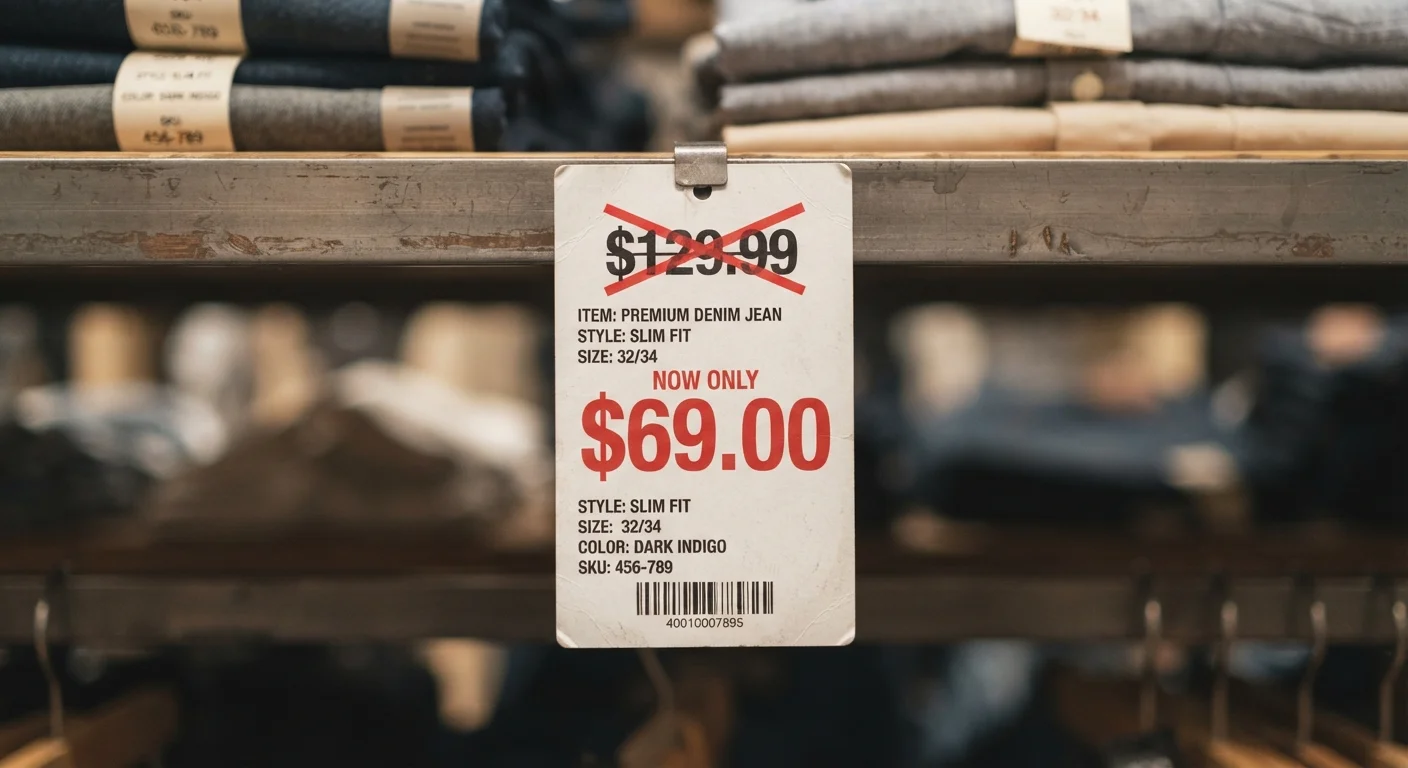
Accepting anchor prices — labeled "original," "compare at," or "MSRP" — as a reliable baseline for judging a deal.
Why it happens: Humans evaluate value relatively, not absolutely. When a high reference price is presented first, any lower number appears proportionally generous, regardless of whether the anchor was ever a real market price.
Buying more than needed because a bundle or multi-pack appears to offer better per-unit value.
Why it happens: Bundle pricing is structured to make buying more feel financially responsible. The per-unit saving is real, but only if you would have purchased that quantity anyway.
Interpreting a higher price as a reliable indicator of better quality.
Why it happens: Price-as-quality is a deeply ingrained heuristic. Without accessible technical information, cost often feels like the safest proxy for performance, durability, or safety.
Spending up to a budget ceiling simply because "there's room" after seeing a higher-priced option first.
Why it happens: Anchor pricing doesn't just affect perception of deals — it expands willingness to spend. Seeing a $300 item before a $180 item makes $180 feel like restraint, even if $100 was the original budget.
If you find yourself influenced by sale prices specifically, the deeper mechanics of how a discount isn't always a real discount are worth understanding before your next major purchase.
Building a Simpler Decision Framework
~60%
Shoppers influenced by anchor prices
Research in behavioral economics consistently finds that a majority of consumers adjust their willingness to pay based on an initial reference price, even when that price is arbitrary.
$0.01
Difference that changes perceived price tier
Studies on left-digit anchoring show that a single cent difference — e.g., $3.00 vs. $2.99 — can meaningfully shift consumer perception of a product's price category.
The most reliable counter to pricing psychology is a pre-shopping framework that doesn't rely on in-store signals. Before entering a store or opening a product page, decide on a maximum spend and the specific need you're filling. This removes anchor prices and bundle framing from the equation, because you're evaluating against your own benchmark — not the retailer's.
For purchases involving ongoing costs, remember that checkout price is only part of the picture. hidden downstream costs — like energy use, consumables, or replacement frequency — can reverse the apparent value of a deal entirely. Similarly, checking unit pricing on the shelf tag takes less than thirty seconds and cuts through misleading package-size comparisons instantly.
Limited-Time Framing Creates Artificial Urgency
Countdown timers and "only X left" indicators are designed to compress your decision window before careful evaluation can occur. Before responding to time pressure, ask whether the urgency is verifiable — or whether the same item will be available tomorrow at a comparable price. More often than not, the deadline is a design element, not a market reality.
Spending decisions made under time pressure or emotional momentum are where pricing tactics do their most effective work. A brief pause — even just walking away for a few minutes — is one of the most evidence-consistent tools available. For a fuller treatment of that mechanism, see why impulse buying happens and how to pause before purchasing.