

| RAM function | Holds active apps in memory for fast switching |
| Storage function | Permanently holds files, apps, photos, and videos |
| IP68 water resistance | Rated for submersion under controlled lab conditions (IEC Standard 60529) |
| Nits for outdoor readability | Typically 1,000+ nits for comfortable direct sunlight viewing |
| Optical vs. digital zoom | Optical preserves quality; digital crops and enlarges |
| Efficiency cores | Handle background tasks to reduce battery drain |
Why Spec Sheets Are Written to Impress, Not Inform
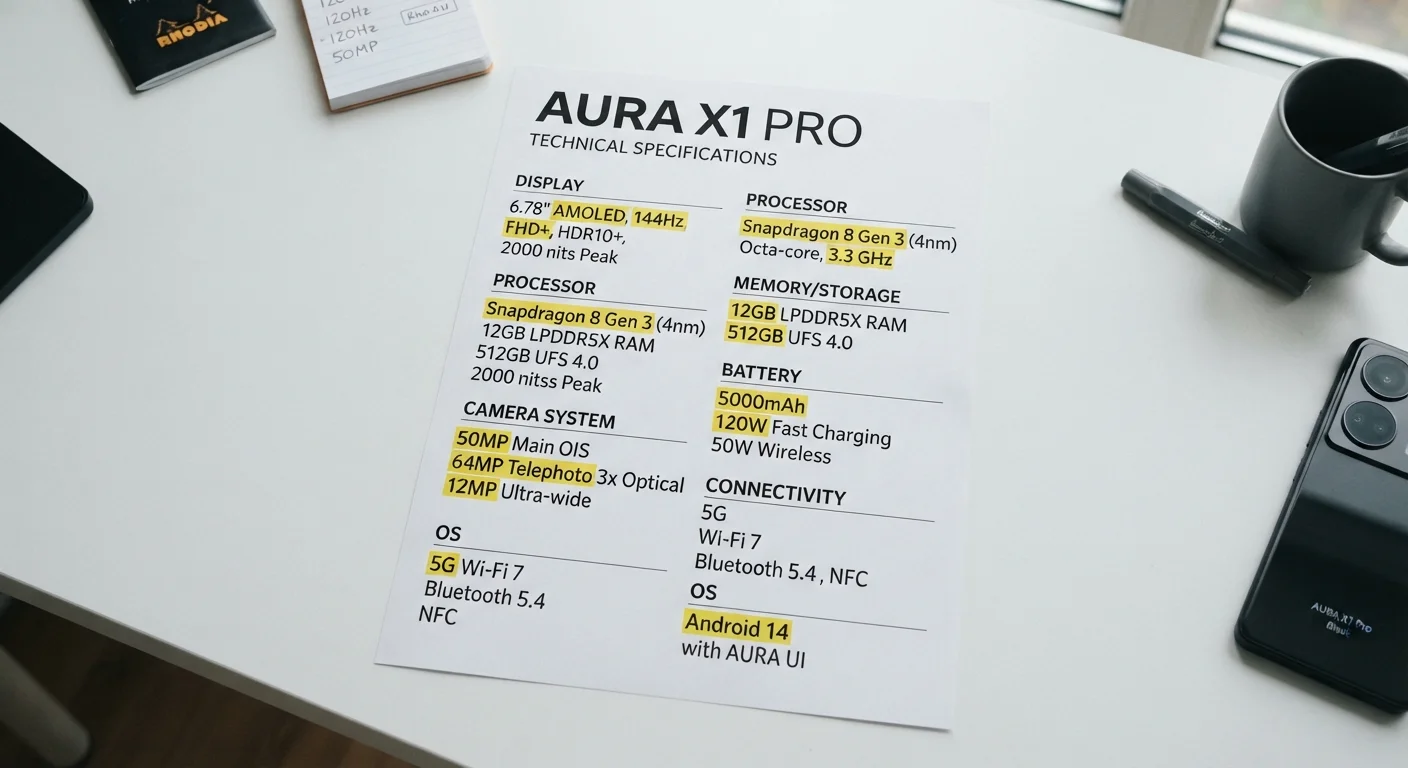
Smartphone packaging is designed by marketing teams, not engineers or educators. The numbers printed on boxes — gigahertz, gigabytes, megapixels, nits — are accurate in isolation, but they're presented without context that would help you judge their real-world impact. A higher number isn't always better, and specs rarely tell the whole story on their own.
This guide unpacks the most common terms so you can read a spec sheet as a starting point for questions, not a verdict. For display-specific terms like refresh rate and panel type, see our display quality guide.
| RAM function | Holds active apps in memory for fast switching |
| Storage function | Permanently holds files, apps, photos, and videos |
| IP68 water resistance | Rated for submersion under controlled lab conditions (IEC Standard 60529) |
| Nits for outdoor readability | Typically 1,000+ nits for comfortable direct sunlight viewing |
| Optical vs. digital zoom | Optical preserves quality; digital crops and enlarges |
| Efficiency cores | Handle background tasks to reduce battery drain |
Processing Power: Chips, Cores, and Clock Speed
GHz (gigahertz) measures how many instruction cycles a processor completes per second. More GHz can mean faster raw performance, but the architecture of the chip — how efficiently it processes each cycle — matters just as much. A chip running at 3.0 GHz on one design may outperform one at 3.5 GHz on an older design.
CPU cores determine how many tasks a processor can handle simultaneously. Most modern smartphones use a mix of high-performance cores for demanding tasks and efficiency cores for background work, which extends battery life. More cores help with multitasking, but day-to-day app use rarely maxes them out.
GHz (Gigahertz)
A measure of processor clock speed — how many instruction cycles per second the chip can complete. Higher GHz can indicate faster processing, but chip architecture heavily influences real-world performance.
RAM (Random Access Memory)
Short-term working memory that holds active apps and data. More RAM allows smoother multitasking. It does not increase storage space for files or photos.
Megapixel (MP)
One million pixels in a camera's captured image. Higher megapixel counts allow for more detail and cropping, but do not by themselves guarantee better photo quality.
Aperture
The size of the lens opening, expressed as an f-number (e.g., f/1.8). A lower number means a wider opening, which allows more light to hit the sensor — useful in low-light conditions.
mAh (Milliampere-Hours)
A unit of battery capacity indicating how much charge the battery can store. Larger mAh values generally support longer battery life, though power efficiency varies by device.
Nits
A unit of display brightness. Higher nit values improve screen readability in bright outdoor conditions. Most screens adjust automatically based on ambient lighting.
IP Rating
A standardized rating (e.g., IP68) describing a device's resistance to dust and water. The first digit rates dust protection; the second rates water resistance, each on a defined scale.
Optical Zoom
A physical lens mechanism that magnifies the subject without cropping the image, preserving image quality. Distinguished from digital zoom, which simply enlarges a portion of the image.
Memory and Storage: RAM vs. Internal Storage
RAM (random access memory) is short-term working memory — it holds the apps and data currently in use. More RAM lets you switch between more apps without them reloading from scratch. For most everyday users, 6–8 GB is functional; heavy multitaskers may benefit from more, but software optimization plays a large role too.
Internal storage (measured in GB or TB) is where your photos, videos, apps, and files live permanently. Unlike RAM, this is the space you'll actively fill. A large video library or habit of downloading offline content will consume storage faster than casual users expect.
Curious how marketing glosses over which specs actually matter? Our article on common smartphone buying assumptions explores where overspending typically happens.
Camera Numbers: Megapixels, Aperture, and Optical Zoom
Megapixels (MP) count the number of pixels the camera sensor captures. A 200 MP camera does not automatically produce better photos than a 50 MP one — sensor size, lens quality, and computational processing all determine image quality. More megapixels increase file sizes and allow for more cropping flexibility, but the ceiling benefit diminishes quickly in practice. For a deeper look, see how mobile cameras actually work.
Aperture (expressed as f/1.8, f/2.4, etc.) describes how wide the lens opens. A lower f-number means a wider opening, which lets in more light and generally improves low-light performance. Optical zoom uses physical lens movement to magnify a subject without losing image data; digital zoom simply crops and enlarges, reducing image quality.
200 MP
Sensor resolution doesn't equal photo quality
High megapixel counts increase file size and cropping flexibility but depend on sensor size and software processing for actual image quality.
IP68
Most common flagship water resistance rating
This rating covers submersion at specified depth and duration under test conditions — real-world exposure may differ.
6–8 GB
RAM range functional for most everyday users
Software optimization significantly affects how much RAM is practically needed for typical smartphone tasks.
Battery, Brightness, and Water Resistance Ratings
mAh (milliampere-hours) measures battery capacity — the total charge the battery can store. A larger mAh rating generally means longer battery life, but power efficiency of the chip and display significantly affect real-world usage. A phone with a large battery and an inefficient processor may not outlast a phone with a smaller battery and a well-optimized chip.
Nits measure display brightness. Outdoor readability typically requires 1,000 nits or more in peak mode; indoor use is comfortable at far lower levels. This is one spec where a higher number translates directly to a better experience in bright conditions.
IP ratings (like IP68) indicate resistance to dust and water. The first digit (6) is dust protection on a 0–6 scale; the second digit (8) is water resistance on a 0–9 scale. IP68 means the device can withstand submersion at depth for a specified time under controlled test conditions — not unlimited water exposure in all real-world scenarios.
The same principle of reading labels carefully applies in other categories too. Our smart speaker explainer breaks down similar spec-language patterns in home audio devices.