

Key Takeaways
Mobile Camera System
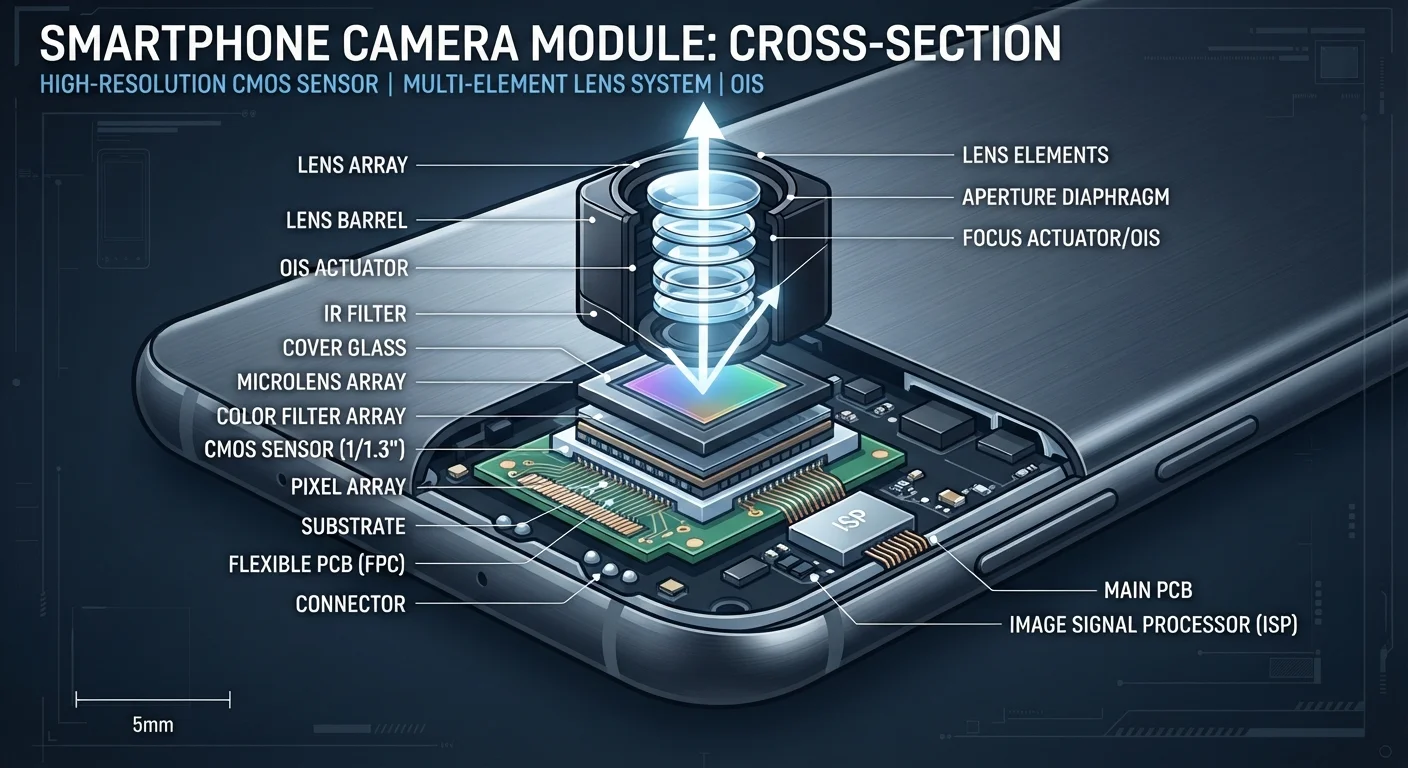
A mobile camera system is the combination of hardware — primarily the image sensor and lens — and software that processes raw light data into the photos you see on screen. Unlike traditional cameras, smartphones rely heavily on computational photography, meaning software algorithms do much of the heavy lifting to produce a final image. The sensor captures light; the software interprets, enhances, and often reconstructs that image in real time.
The image sensor is typically a CMOS (Complementary Metal-Oxide-Semiconductor) chip, and its physical size — measured in fractions of an inch — matters more than its megapixel count for low-light performance.
The Sensor: Where Light Becomes Data
Every smartphone photo begins the same way: light passes through the lens and strikes the image sensor. The sensor is a grid of millions of tiny light-sensitive cells called photosites — and this is where the megapixel conversation actually starts to matter, though not in the way most people think.
Each photosite captures the intensity of light hitting it. More photosites (higher megapixels) means finer detail — in theory. But photosites also have a physical size. When a manufacturer packs 200 million of them onto the same small chip, each individual photosite becomes very small, which means it captures less light. Smaller photosites are more prone to noise, particularly in dim conditions.
This is why sensor size — measured in fractions of an inch, such as 1/1.28" — matters so much. A physically larger sensor can house both more megapixels and larger individual photosites, giving you resolution without sacrificing light-gathering ability. Many mid-range phones skip this detail entirely in their marketing. For a broader look at how hardware specs translate to everyday use, see our guide to decoding smartphone specs.
1/1.28"
Physical sensor size on some flagship phones
Sensor size is measured in fractions of an inch; a larger fraction indicates a physically bigger sensor capable of capturing more light.
~2.0 µm
Typical pixel size after pixel binning
Pixel binning merges smaller photosites to create effective pixel sizes around 2 microns or larger, improving low-light sensitivity.
3–5x
Common optical zoom range on multi-lens phones
Most flagship smartphones offer between 3x and 5x true optical zoom via a dedicated telephoto lens module.
Lenses, Aperture, and What 'Zoom' Really Means
The lens focuses incoming light onto the sensor. On modern smartphones, there are typically two to four separate cameras — a main wide lens, an ultrawide, and one or more telephoto units — each with its own sensor. These work together to simulate a versatile zoom range.
Aperture, expressed as an f-number, determines how wide the lens opening is. An f/1.8 aperture is wider than f/2.4, allowing more light to pass through. Wider apertures help in low light and create background blur (called bokeh). Unlike DSLR cameras, smartphone apertures are fixed — they cannot be adjusted — making aperture a key hardware differentiator worth paying attention to.
Zoom is where specifications frequently mislead buyers. Optical zoom uses dedicated telephoto hardware to magnify the subject before it hits the sensor. Digital zoom simply enlarges and crops the existing image, losing detail in the process. A phone advertising "10x zoom" may only offer 3x optical zoom; the rest is digital upscaling. Understanding this distinction is central to the kind of informed purchasing decision covered in our piece on smartphone marketing assumptions.
Computational Photography: Software as a Camera Feature
Modern smartphone photos are rarely straight captures of what the sensor recorded. Almost every image goes through a processing pipeline — sometimes in milliseconds — that applies noise reduction, sharpening, exposure balancing, and color tuning before you even see a preview.
Several techniques define this era of mobile imaging:
- HDR (High Dynamic Range): The camera takes multiple shots at different exposures and merges them, preserving bright highlights and dark shadows in a single image.
- Night Mode: Multiple frames taken in quick succession are aligned and combined to reduce noise while boosting brightness, without a flash.
- Pixel Binning: Neighboring photosites are merged into a single larger virtual pixel, improving low-light performance at the cost of some resolution.
- AI Scene Recognition: The software identifies what's in the frame — food, landscape, pet, text — and applies tailored adjustments automatically.
Test Cameras in Real Conditions Before Deciding
Spec sheets don't capture how a camera performs in the situations you'll actually encounter — indoor lighting, moving subjects, or twilight. When evaluating any mobile camera, look for real-world sample images taken in low light and in motion. Published reviews that include untouched sample galleries are more reliable than manufacturer-provided images.
This software layer is why two phones with identical sensor specs can produce noticeably different photos. The processing engine — and the engineering behind it — is a genuine differentiator that no spec sheet fully captures. Note also that high-resolution images produced by 50+ megapixel sensors consume significant storage space; managing that is its own challenge, covered in our guide to managing smartphone storage.
What Actually Matters When Evaluating a Mobile Camera
Rather than chasing the highest megapixel count, consider the factors that most directly affect the photos you actually take:
- Sensor physical size: Larger sensors generally capture more light and produce better low-light results.
- Pixel size (measured in microns): Larger individual pixels outperform smaller ones in dim conditions.
- Aperture of the main lens: A wider aperture (lower f-number) improves low-light capture and background separation.
- Optical zoom range: If you photograph subjects at a distance, genuine optical zoom — not digital — matters.
- Software and processing: Evaluate real-world photo samples across lighting conditions, not just raw specs.
Display quality also plays a role in how you perceive your photos after the fact — a vivid screen can make an average photo look great, and vice versa. That relationship is worth understanding alongside camera hardware; see our explainer on display quality for context.
“The best camera is the one that's with you — but understanding what's actually inside it helps you use it far more intentionally.”
— Marc Levoy, Computer graphics researcher and computational photography pioneer