

Key Takeaways
Why the Distinction Actually Matters
When hair ends up on your pillow, in your drain, or wrapped around a brush, the instinct is simply to worry. But panic without context can lead people to treat the wrong problem — applying deep conditioning treatments to a shedding issue, or popping supplements for a problem that's actually about heat tool overuse. The hair shedding vs. breakage distinction isn't just academic; it's the first diagnostic step that points toward the right action.
Shedding is part of the normal hair growth cycle. Each follicle passes through growth (anagen), transition (catagen), and rest (telogen) phases before releasing the strand. The American Academy of Dermatology notes that losing roughly 50 to 100 hairs per day is considered within the typical range for most adults. Breakage, by contrast, is structural — it occurs along the hair shaft itself, not at the follicle, and signals that the fiber has been weakened or compromised.
Understanding how scalp condition connects to shedding is equally important, since follicle health directly influences the telogen phase. But to get there, readers first need to know what they're looking at.
How to Tell the Difference at a Glance
The most reliable visual test requires nothing more than picking up a fallen strand and examining both ends. A strand that shed naturally will typically be the length of a full hair and show a small white or translucent bulb at the root end — that's the follicle's club hair, the terminal structure released at the end of the telogen phase. A broken strand, on the other hand, tends to be shorter than your overall hair length, with a tapered or frayed tip at one or both ends and no bulb present.
Texture is another clue. Breakage strands often feel rougher or more brittle to the touch, and they may curl or kink in unusual directions if the cuticle is severely damaged. Shed hairs feel more like intact hair fibers because, structurally, they are — the shaft was not compromised before release.
50–100
Hairs shed per day considered typical
According to the American Academy of Dermatology, this daily range is normal for most adults and reflects the natural telogen release cycle.
~90%
Hair follicles in active growth at any time
At any given point, roughly 90% of follicles are in the anagen (growth) phase, which helps explain why normal shedding doesn't cause visible thinning.
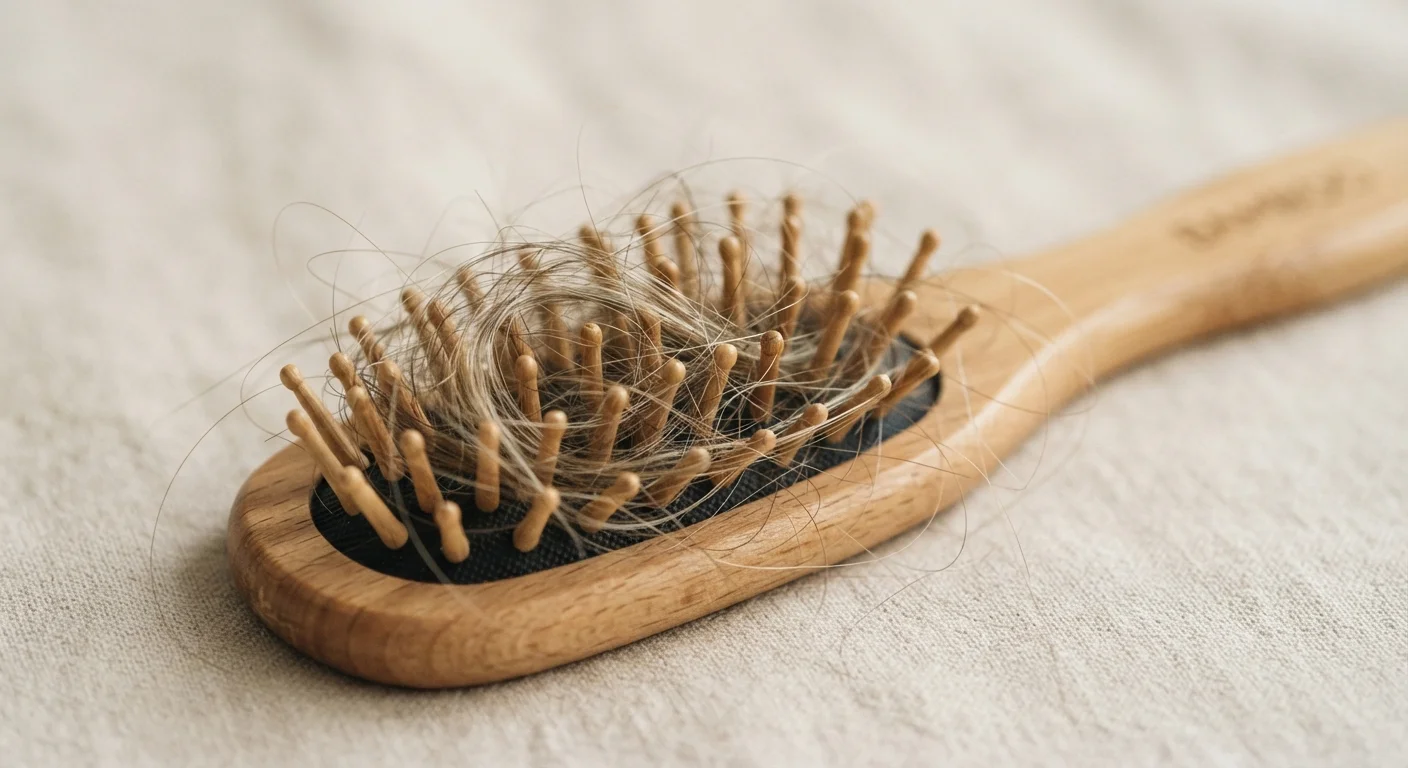
Where you find the hair also offers information. Significant breakage tends to show up on the shoulders, pillow, or as shorter pieces throughout the mid-lengths and ends. Shedding is more concentrated in the drain after washing and in the brush after detangling sessions, where the mechanical action of rinsing or combing dislodges hairs that were already in the telogen phase.
Common Myths — Corrected
Misconceptions about hair loss are widespread, and many persist because shedding and breakage can look similar at first glance. The myth-and-fact pairs below address the most common errors in how people interpret what's happening to their hair.
Myth
Seeing a lot of hair in the shower drain means something is seriously wrong.
Fact
Increased drain shedding after washing is often normal, as water and massage dislodge hairs already in the telogen phase — especially if you wash infrequently.
Hair that accumulates between wash days tends to release all at once when you finally shampoo. People who wash once or twice a week may see what looks like alarming volume in the drain, but the total count spread across the days since their last wash may fall well within the typical daily range. A genuine concern arises when shedding increases noticeably for more than two to three months, or when thinning becomes visible at the scalp.
Myth
Short hairs appearing throughout your hair are new growth coming in.
Fact
Short hairs concentrated in the mid-lengths and ends are more likely breakage than new growth, which typically emerges at the scalp with a fine, tapered tip.
True new growth appears at the hairline and roots — not scattered throughout the length. When short, coarse-ended pieces appear at the shoulders or throughout the body of the hair, that pattern is consistent with mechanical or chemical breakage at points of weakness. This is a common misread that leads people to believe their hair is recovering when it's actually losing length from damage.
Myth
Hair shedding and hair loss are the same thing.
Fact
Shedding is a normal, cyclical process. Hair loss — clinically called alopecia — refers to a disruption in the growth cycle or follicle damage that prevents regrowth.
Shedding produces hairs that are replaced as follicles re-enter the anagen phase. Hair loss involves follicles that have slowed or stopped producing new strands. The distinction matters because the causes, timelines, and interventions differ substantially. Conditions like androgenetic alopecia involve follicle miniaturization over time, which is very different from a temporary shedding increase triggered by a fever or dietary change.
Myth
Deep conditioning treatments fix breakage and shedding equally well.
Fact
Deep conditioning primarily addresses breakage by temporarily reinforcing the hair shaft. It does not affect the follicle-level processes that drive shedding.
Conditioning agents like hydrolyzed proteins and humectants work by coating or penetrating the cuticle layer to improve elasticity and reduce friction — mechanisms that help prevent the strand from snapping. They have no meaningful influence on the telogen cycle, hormonal factors, or nutritional status that govern how many hairs the follicle releases. Applying intensive treatments to a shedding problem is not harmful, but it misses the actual lever.
Myth
Brushing hair distributes oils and is always beneficial for hair health.
Fact
Overbrushing, especially on dry or fragile hair, is a leading cause of mechanical breakage and can worsen an already compromised cuticle.
While gentle brushing can help distribute sebum along the shaft in some hair types, the friction generated — particularly with boar bristle or fine-tooth combs on dry, textured, or chemically processed hair — can chip and lift the cuticle, leading to split ends and breakage. Detangling on damp hair with a wide-tooth comb and a leave-in product reduces mechanical stress considerably. Your shampoo formula also influences how detangling feels post-wash, with moisture retention affecting how much friction occurs during combing.
If you've been relying on rougher detangling methods or high heat as part of your routine, certain everyday grooming habits may be quietly accelerating breakage without obvious warning signs until the damage accumulates.
Addressing Each Pattern Appropriately
Once you've identified which pattern you're dealing with, the response differs significantly. For shedding, the focus shifts inward: nutritional deficiencies — particularly iron, zinc, and biotin — hormonal fluctuations, thyroid changes, and significant physical or emotional stress are all established contributors to telogen effluvium, a temporary increase in shedding. A dermatologist or primary care provider can order the appropriate blood work to rule out underlying causes. Self-diagnosis and supplement loading without testing is not recommended.
Don't Self-Supplement Without Testing
Taking high-dose biotin, iron, or other supplements without confirmed deficiency can be ineffective and, in some cases, may interfere with certain lab test results or create new imbalances. If you suspect a nutritional cause for increased shedding, a blood panel ordered by a healthcare provider will give you actionable data rather than guesswork. Supplement decisions related to hair loss should be made in consultation with a qualified professional.
For breakage, the approach is largely external. Reducing heat tool frequency and using a heat protectant when you do style, loosening tight hairstyles that create chronic tension on the shaft, and switching to gentler detangling tools and techniques are generally effective first steps. Protective styling can support length retention, but as a closer look at protective styling makes clear, it introduces its own risks if done incorrectly. Chemical processes including bleach, color, and relaxers weaken the disulfide bonds in the hair shaft — limiting their frequency and using bonding treatments afterward can reduce ongoing damage.
This article is for general informational purposes only and is not a substitute for medical advice. If you are experiencing significant or sudden hair loss, consult a qualified healthcare professional or board-certified dermatologist.