

Key Takeaways
Why Most Linen Closets Fall Apart Within a Month
Most linen closet organization attempts fail for a predictable reason: they're designed around how the closet looks when empty, not how it actually gets used day-to-day. A beautifully staged closet that requires 90 seconds to return a folded towel to its spot will be abandoned within weeks. The goal isn't a closet that photographs well — it's one that sustains itself with minimal friction.
The same logic applies to any household storage system. Just as zone-based kitchen organization reduces daily frustration by placing items where you actually use them, a well-structured linen closet is built around behavioral patterns, not interior design principles.
The Core Organizing Principles
Before rearranging a single shelf, it helps to establish the rules your system will run on. These principles don't require buying anything new — they require thinking clearly about what you have, how often you reach for it, and what makes returning items easy rather than effortful.
Prioritize the Return Path, Not Just Retrieval
When evaluating your closet setup, ask yourself: how easy is it to put something back? Most organization frustrations happen during return, not retrieval. If folding and replacing a towel takes thought or effort, the system won't hold. Design for the lazy Sunday when the laundry is done and you just want to be finished.
Stocking Depth: How Much Is Actually Enough
A common mistake is treating the linen closet as a buffer against every conceivable household emergency. This leads to overstocking — particularly with towels and extra bedding — which consumes shelf space and makes the closet harder to navigate. A useful rule of thumb is to stock two complete sets per active user for everyday linens, plus one spare set for guests or laundry delays.
Overstocking isn't just a space problem. It creates a rotation problem: items at the back never get used, never get washed, and quietly degrade. The same logic that governs pantry stocking applies here — depth should match consumption rate, not anxiety.
Maintaining the System Over Time
The best-organized closet still needs a light maintenance routine. A quarterly audit — pulling everything out, checking for worn or mismatched items, and refolding anything that's drifted — takes under 20 minutes and prevents slow entropy from becoming a full reset. Build this into an existing habit like seasonal bedding swaps.
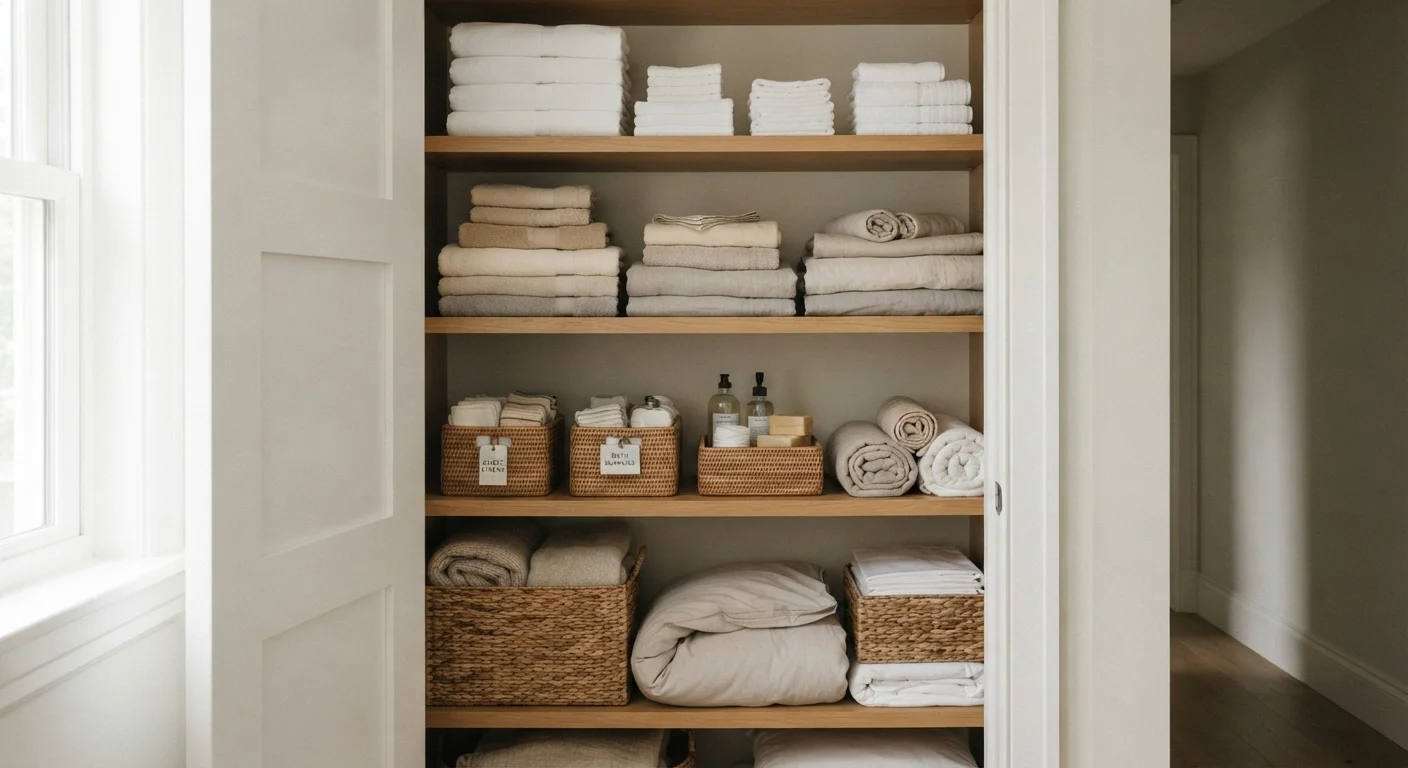
Labels matter more than most people expect. Even in a single-person household, labeled zones remove the cognitive decision of where something goes when you're tired or in a hurry. The closet system should function even on your worst day.
If you're thinking about household organization more broadly — from how clothes are stored to what actually earns its keep — the principles here overlap meaningfully with auditing your wardrobe for what you actually use. Both systems reward honest assessment over accumulation.