

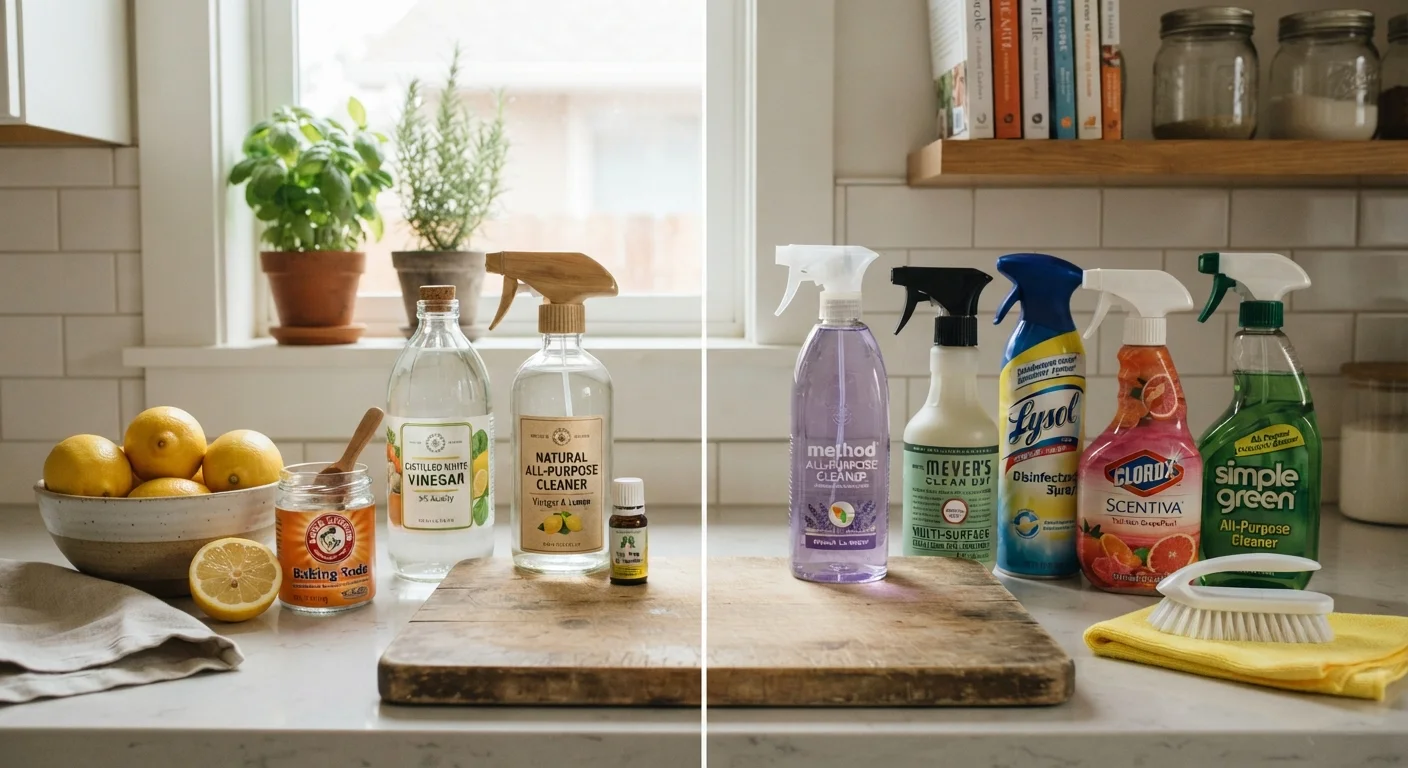
Key Takeaways
Option A
Natural Cleaning Agents
The ingredient-forward, lower-chemical alternative.
Best for: Households wanting to reduce synthetic chemical exposure, particularly with children, pets, or sensitivities present.
Option B
Conventional Cleaners
The formulated, proven-performance standard.
Best for: Situations requiring fast, reliable disinfection or removal of heavy grease, mold, or pathogens.
If you want everyday surface maintenance with fewer synthetic chemicals
Natural Cleaning Agents
For routine wiping of counters, glass, and low-traffic surfaces, diluted vinegar or baking soda paste performs adequately without introducing synthetic surfactants or preservatives.
If you need verified disinfection against pathogens
Conventional Cleaners
EPA-registered disinfectants are tested and labeled for specific kill claims. Natural alternatives lack this regulatory validation for pathogen elimination.
If someone in your home has respiratory sensitivities or chemical allergies
Natural Cleaning Agents
Fragrance compounds and certain preservatives in conventional products are common irritants; simpler ingredient lists reduce exposure risk, though reactions can occur with any substance.
If you're tackling heavy mold, grease, or microbial contamination
Conventional Cleaners
Enzymatic, bleach-based, or quaternary ammonium formulas are specifically engineered for stubborn organic buildup where natural agents often fall short.
If long-term environmental footprint matters most to you
Natural Cleaning Agents
Many natural formulas biodegrade more readily, though packaging and sourcing still matter — concentrated conventional cleaners can also reduce per-use waste meaningfully.
What Each Approach Actually Involves
The term natural cleaning agents typically refers to single-ingredient or minimally processed substances — white vinegar, baking soda, castile soap, hydrogen peroxide, and essential oils — used alone or in DIY combinations. The appeal is transparency: you know exactly what's in the bottle. However, as our guide on what "natural" really signals on packaging explains, the word itself carries no legal definition in the U.S., so commercially marketed "natural" cleaners vary widely in actual formulation.
Conventional cleaners are purpose-formulated products — all-purpose sprays, disinfectants, degreasers, mold removers — where chemists select and combine active ingredients for a specific cleaning outcome. These products are subject to labeling rules and, where disinfection claims are made, EPA registration requirements. That regulatory layer is a meaningful distinction when microbial risk is a genuine concern.
A Note on DIY Formulas and Stability
Homemade cleaning mixtures — vinegar plus dish soap, for instance — are popular but not always chemically stable or more effective than the individual components. Soap is a base; vinegar is an acid. Combined, they largely neutralize each other's cleaning properties. If you're making your own cleaners, single-ingredient solutions typically outperform mixed ones for most household tasks.
Cleaning vs. Disinfecting: The Core Distinction
One of the most common misconceptions is treating cleaning and disinfecting as interchangeable. Cleaning physically removes dirt, grease, and some microbes. Disinfecting kills a defined percentage of specific pathogens on a surface. Natural agents generally accomplish the former; they rarely accomplish the latter to a verified standard.
White vinegar, for example, is mildly acidic and can reduce some bacterial populations, but it is not an EPA-registered disinfectant and should not be relied upon after raw meat contact or during illness in the household. Hydrogen peroxide at 3% concentration does have some disinfecting action, but contact time, concentration, and surface type all affect results. When genuine disinfection matters, conventional products with explicit kill-claim labeling are the more reliable tool.
| Criterion | Natural Cleaning Agents | Conventional Cleaners |
|---|---|---|
| Ingredient transparency | High — typically few, simple ingredients | Variable — complex formulas, full lists on label |
| Disinfection efficacy | Limited — not EPA-registered | Strong — registered products have verified kill claims |
| Surface compatibility | Risk of damage to stone, soft metals | Risk of damage to some plastics, finishes |
| Irritant potential | Generally lower, but not zero | Higher — synthetic fragrances, preservatives common |
| Biodegradability | Generally high | Varies widely by formulation |
| Cost per use | Often lower for DIY options | Concentrated formats can be cost-competitive |
| Regulatory oversight | Minimal for DIY; varies for commercial products | Stronger — EPA registration required for disinfection claims |
Safety, Irritants, and What Labels Don't Tell You
Conventional cleaners often contain synthetic fragrances, preservatives, and surfactants that are associated with skin and respiratory irritation in sensitive individuals. This doesn't make them categorically dangerous, but it's a real consideration for households with asthma, eczema, or young children. Our companion piece on what "non-toxic" labels actually guarantee is worth reading alongside this comparison — label language frequently overpromises.
Natural agents carry their own safety caveats. Undiluted vinegar can damage natural stone surfaces like marble. Baking soda is mildly abrasive and can scratch soft finishes. Mixing vinegar with hydrogen peroxide produces peracetic acid, which is irritating at concentration. And perhaps most critically: mixing any cleaner — natural or conventional — with bleach-containing products risks generating chlorine gas. Surface compatibility and combination risks apply regardless of how "natural" an ingredient sounds.
~62%
U.S. adults concerned about cleaning product chemicals
A 2022 survey by the American Cleaning Institute found roughly 62% of adults expressed concern about ingredient safety in household cleaning products.
3%
Hydrogen peroxide concentration in most consumer products
Over-the-counter hydrogen peroxide is typically sold at 3% concentration; higher concentrations require different handling precautions and are not standard for household use.
500+
Disinfectant products on EPA's List N
The EPA's List N includes over 500 registered disinfectants evaluated for efficacy against specific viruses and bacteria, illustrating the scale of regulatory oversight for conventional products.
Environmental Impact: More Complicated Than It Appears
Natural agents are generally assumed to carry a lighter environmental footprint, and for biodegradability, that's often accurate. Simple organic acids and minerals break down readily without producing persistent aquatic toxins. But environmental impact is a full-system calculation. Plastic packaging, shipping weight, and agricultural sourcing of "natural" ingredients all add to the footprint — sometimes substantially.
Conventional cleaners, meanwhile, have improved significantly in formulation over the past two decades. Many concentrated or refillable formats meaningfully reduce per-use plastic and carbon costs compared to premixed natural alternatives in single-use packaging. The question of which is "greener" depends on the specific product, how it's packaged, and how much gets used per cleaning session. This parallels the kind of tradeoff thinking covered in our look at reusable vs. disposable household items: category-level assumptions often miss product-level realities.
A practical middle ground many households land on is task-based selection: natural agents for routine daily maintenance, conventional products for periodic deep cleaning or verified disinfection needs. Neither approach has to be absolute to be effective.