

Key Takeaways
Our Verdict
Neither reusables nor disposables win outright — the smarter call depends on how often you use an item, your household's storage and maintenance capacity, and whether you'll actually follow through on the upfront investment. A hybrid approach, reusables for high-frequency items and disposables reserved for specific situations, tends to be the most practical strategy for most households.
| Best for | Recommended |
|---|---|
| High-frequency daily tasks like wiping surfaces or packing lunches | Reusable options |
| Illness, travel, or infrequent-use scenarios | Disposable options |
| Households with limited storage or laundry access | Disposable options |
| Long-term cost reduction on predictable recurring purchases | Reusable options |
The Actual Question Isn't Reusable vs. Disposable
The framing of reusable-good, disposable-bad — or the reverse — misses what actually matters: whether a given item fits your household's real usage patterns. A reusable item you never wash and eventually discard isn't a win. A disposable used strategically for a genuinely low-frequency task isn't waste. The useful question is: what does this item cost per use, and am I actually going to maintain it?
This calculation changes dramatically depending on frequency of use, household size, available storage, and the true all-in cost of ownership — including water, energy, and replacement parts. Our guide to hidden costs in everyday purchases covers how these downstream factors frequently get overlooked at the point of purchase.
Where Reusables Genuinely Win
Reusable items earn their keep when three conditions align: you'll use them frequently, they're easy to clean, and the upfront cost is recovered within a reasonable timeframe.
| Reusable Items | Disposable Items | |
|---|---|---|
| Upfront cost | Higher | Lower |
| Long-term cost (high use) | Lower over time | Adds up quickly |
| Maintenance required | Yes — washing, drying, storage | None |
| Best for frequent use | Strong fit | Poor value |
| Best for infrequent use | Rarely justified | Practical choice |
| Environmental impact | Lower if used consistently | Higher per-use footprint |
| Storage needs | Moderate to high | Minimal |
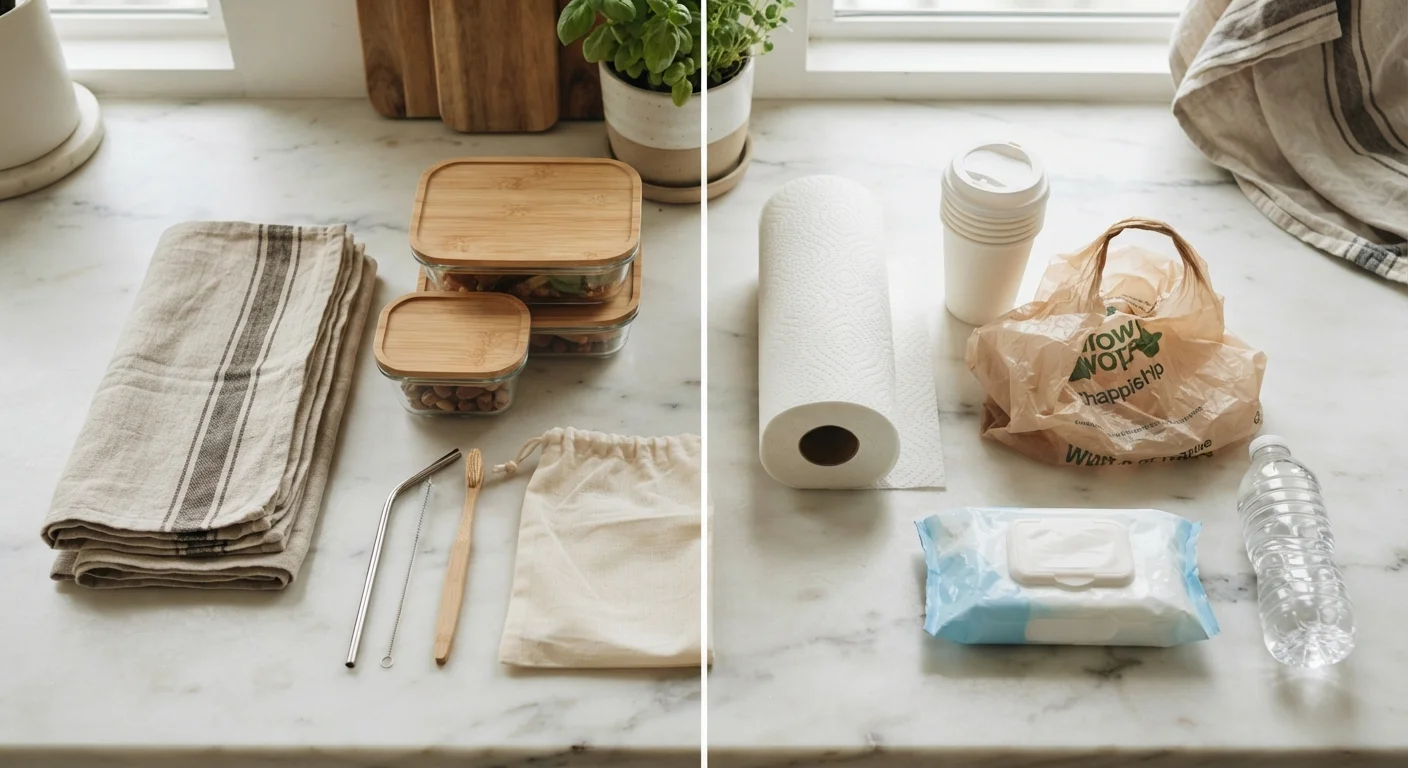
Cloth napkins and rags are a clear example. A household that goes through a roll of paper towels weekly will recover the cost of a set of cloth rags or napkins within a few months. The maintenance burden is minimal — they go in a regular laundry load.
Reusable food storage containers make strong financial sense for households that pack lunches or store leftovers consistently. The per-use cost becomes negligible over a year or two, and glass containers in particular tend to last a decade or more without degradation.
Silicone baking mats, reusable produce bags, and refillable water bottles all follow the same logic: high frequency of use, low maintenance, and a clear payback window. The catch is that these items do require consistent habits. If the container sits in a drawer, the math doesn't work. For more on evaluating whether a product is built to actually last, see our piece on gauging product durability.
Start With One Category, Not a Full Overhaul
Switching everything to reusables at once often leads to abandoned items and wasted money. Pick the one disposable your household uses most often — paper towels, zip-lock bags, or single-use coffee pods — and trial a reusable alternative for 30 days. If the habit sticks, expand from there. If it doesn't, you've learned something useful without a large sunk cost.
Where Disposables Still Make Sense
Disposables aren't inherently the irresponsible choice. There are contexts where they're genuinely the more practical option.
During illness: Paper towels and disposable disinfecting wipes reduce the risk of cross-contamination in ways that cloth alternatives don't, unless you're willing to wash rags at high heat every day. For a one-week illness, the practical tradeoffs favor disposables.
Infrequent-use items: If you host large gatherings twice a year, disposable plates may make more sense than purchasing a dedicated set of tableware that sits unused for months. The environmental cost of manufacturing and storing rarely-used reusables adds up too.
Travel and portability: Disposable toiletry containers and single-use items can be genuinely useful where laundry access or space is limited. A week-long trip doesn't justify the hygiene overhead of maintaining cloth alternatives.
Low-storage households: Reusables require space. If your home has limited storage, adding bulk cloth products, container sets, and accessories may create more friction than they eliminate.
Reusables Can Backfire Without Proper Cleaning
Reusable items that aren't cleaned consistently — sponges, cloth rags, water bottles, and food storage containers — can harbor bacteria and become hygiene liabilities. If your household routine doesn't reliably include washing these items between uses, a disposable alternative may actually be the more sanitary choice. The reusable advantage disappears when maintenance slips.
The Environmental Math Is More Complicated Than It Looks
The environmental case for reusables is real but frequently overstated in simple comparisons. A reusable cotton grocery bag, depending on how it was manufactured, may need to be used dozens or even hundreds of times before its carbon footprint is lower than that of a single-use plastic bag. This doesn't make the reusable bag a bad choice — but it underscores that the benefit is only realized through consistent, long-term use.
Similarly, washing cloth items in hot water with energy-intensive machines has its own environmental footprint. Cold-water washing and air drying significantly reduce that impact. The honest takeaway: reusables are better environmentally if you use them enough and maintain them thoughtfully. The benefit isn't automatic.
Consumers navigating these tradeoffs will find that price is also an unreliable shortcut — as explored in our article on why expensive doesn't always mean better quality. A pricier reusable item isn't necessarily more durable or more sustainable.
A Practical Framework for Making the Call
Rather than committing wholesale to one approach, it helps to run a quick mental checklist for any item you're evaluating:
- How often will I use this? Daily or near-daily use almost always favors reusables. Monthly or less often tilts toward disposable or shared alternatives.
- What's the true maintenance burden? If keeping a reusable item clean requires significant time, specialized cleaning, or adds meaningfully to laundry loads, factor that in.
- Do I have space to store it properly? A reusable that gets crammed into an overflowing cabinet often ends up unused.
- What's the realistic payback window? If the upfront cost takes more than a year or two to recover, consider whether your habits will actually hold.
This kind of systematic thinking applies broadly to household purchasing decisions and connects well with the smart shopping principles that help consumers avoid common purchasing mistakes.
The goal isn't ideological purity in either direction — it's building a household that runs efficiently, fits your actual lifestyle, and doesn't silently drain money through unconsidered purchases.