

| Regulatory body | U.S. Food and Drug Administration (FDA) |
| Label format last updated | 2020 (phased rollout from 2016) (FDA Nutrition Facts Label Update) |
| Daily Value calorie baseline | 2,000 calories per day (FDA reference amount for %DV calculations) |
| Nutrients required on label | 14 mandatory nutrients including calories, fat, sodium, carbs, protein, and key vitamins (FDA 21 CFR §101.9) |
| Added Sugars %DV reference | 50 grams per day (FDA Daily Value for added sugars) |
| Sodium %DV reference | 2,300 mg per day (FDA Daily Value for sodium) |
Why the Label Format Is Standardized
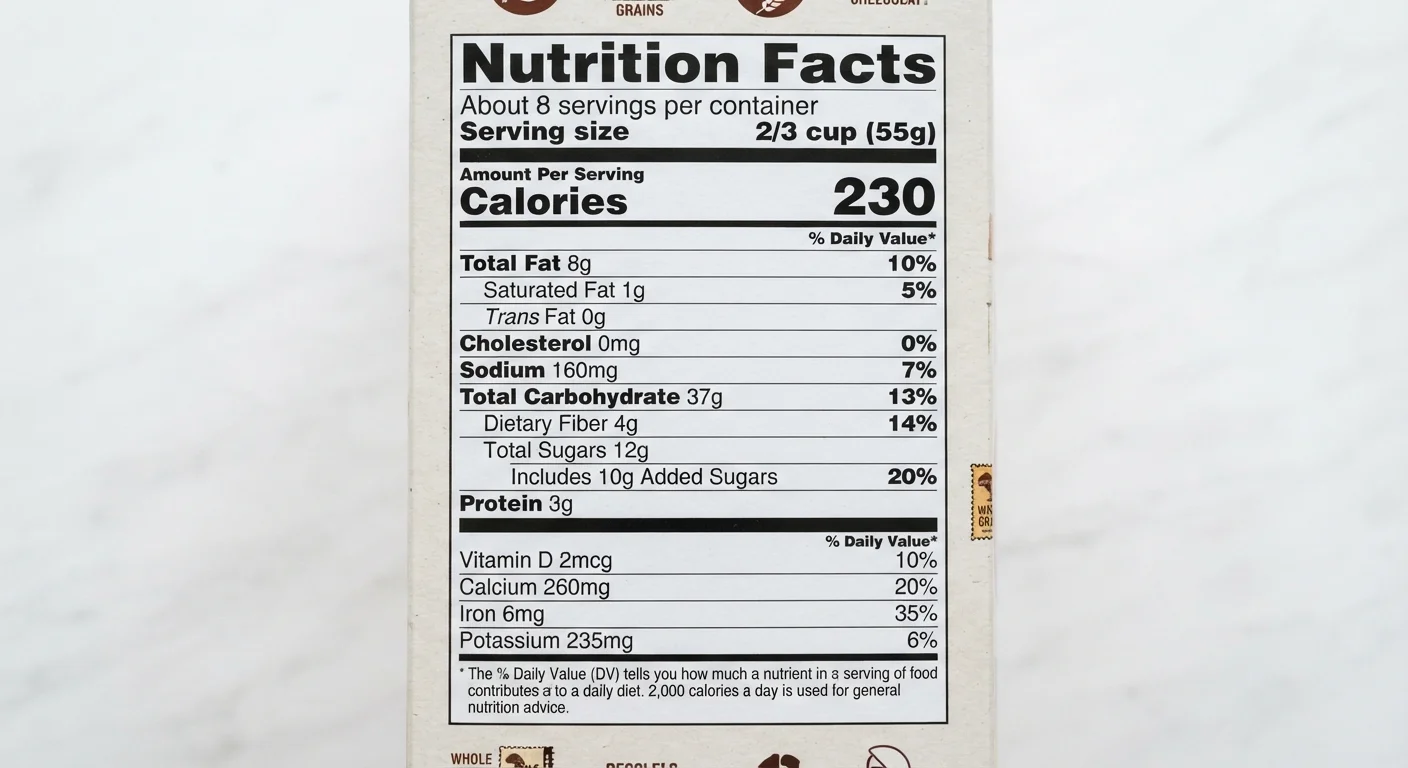
The Nutrition Facts panel is a federally regulated format required on most packaged foods sold in the United States. The FDA standardizes its layout so that every label — regardless of brand or product — presents information in the same order, using the same reference values. That consistency is the point: once you understand the structure, you can decode any label quickly.
The format was last significantly updated in 2020, with changes that include a larger, bolder calorie display, a mandatory "Added Sugars" line, and updated Daily Values reflecting current nutrition science. For a broader look at what else appears on packaged food labels beyond the nutrition panel, see how to read a product label without getting lost.
| Regulatory body | U.S. Food and Drug Administration (FDA) |
| Label format last updated | 2020 (phased rollout from 2016) (FDA Nutrition Facts Label Update) |
| Daily Value calorie baseline | 2,000 calories per day (FDA reference amount for %DV calculations) |
| Nutrients required on label | 14 mandatory nutrients including calories, fat, sodium, carbs, protein, and key vitamins (FDA 21 CFR §101.9) |
| Added Sugars %DV reference | 50 grams per day (FDA Daily Value for added sugars) |
| Sodium %DV reference | 2,300 mg per day (FDA Daily Value for sodium) |
Breaking Down Each Section, Top to Bottom
Serving Size and Servings Per Container
The panel opens with serving size — and this is where many readers stumble. The serving size is a standardized reference unit, not a portion recommendation. All nutrient data below it applies to that amount only. If a bag of chips lists a 1-oz serving but you eat 3 oz, you need to multiply every value by three. The "servings per container" line directly above helps you calculate total package intake.
Calories
Displayed in large bold type, calories per serving reflect total energy from fat, carbohydrates, and protein combined. This line does not distinguish between nutrient-dense and nutrient-poor calories — context from the lines below matters.
Nutrients to Limit
Total Fat, Saturated Fat, Trans Fat, Cholesterol, and Sodium appear next. These are listed because public health guidance generally recommends keeping them in check for most people. Trans fat has no established safe level; a label can legally read "0g" if the amount per serving is under 0.5g, so always check the ingredient list for "partially hydrogenated oils" as a secondary signal.
Total Carbohydrate and Its Sub-items
Dietary Fiber, Total Sugars, and Added Sugars are nested beneath Total Carbohydrate. The distinction between total and added sugars is significant: a plain yogurt may show 12g total sugars from naturally occurring lactose, while a flavored version might show an additional 10g added sugars. Those two products carry very different nutritional profiles despite similar headlines. For a deeper look at how carbohydrates function in the body alongside protein and fat, see macronutrients decoded.
Protein
Protein is listed in grams but has no %DV shown for most foods, because protein needs vary significantly by body weight, age, and activity level.
Vitamins and Minerals
Vitamin D, Calcium, Iron, and Potassium are mandatory because Americans tend to under-consume them. The %DV here tells you how much of the daily reference intake one serving provides.
This Is General Nutrition Information
The guidance in this article explains how to read a Nutrition Facts panel — it is not personalized dietary advice. Individual nutrient needs vary based on age, health status, activity level, and other factors. Consult a registered dietitian or qualified healthcare provider for advice tailored to your situation.
The Percent Daily Value Column
The right-hand column translates raw grams and milligrams into context. A 5%DV or less signals a low amount; 20%DV or more signals a high amount. Use this as a fast-scan tool: high %DV for fiber or Vitamin D is generally favorable; high %DV for sodium or saturated fat warrants a closer look depending on your overall diet. The 2,000-calorie baseline used for %DV calculations is a population reference — not a prescription for any individual.
Common Misreads and How to Avoid Them
The single most common label misread is treating serving size as a recommendation. Manufacturers are required to use FDA-defined reference amounts, but package sizes do not always align neatly with those amounts. A beverage bottle that looks like a single serving may list 2.5 servings — meaning every value must be multiplied accordingly.
A second common error is conflating "low fat" with low calorie or high nutritional value. Products formulated to reduce fat often compensate with added sugars, which you can now check directly on the panel.
Finally, the ingredient list and the Nutrition Facts panel work together — neither tells the full story alone. Decoding the ingredient list gives you the other half of the picture, including how ordering by weight reveals which components actually dominate a product.
Serving Size
The standardized amount of food the label's nutrient data refers to, set by the FDA based on typical consumption amounts. It is not a recommendation of how much to eat.
Daily Value (%DV)
A reference percentage showing how much of a nutrient one serving contributes toward a general 2,000-calorie daily diet. Values of 5% or less are considered low; 20% or more are considered high.
Added Sugars
Sugars introduced during processing or preparation, distinct from sugars naturally present in whole foods like fruit or plain dairy. The FDA requires these to be listed separately.
Saturated Fat
A type of dietary fat found mainly in animal products and some tropical oils. Health authorities generally advise limiting intake, which is why it is highlighted on the label.
Sodium
A mineral and electrolyte found in table salt and many processed foods. The label lists milligrams per serving; the FDA's daily reference value is 2,300 mg.
Total Carbohydrate
An umbrella value covering all carbohydrates in a serving, including dietary fiber, total sugars, and added sugars, which are listed as sub-items beneath it.
This article provides general consumer education about food labeling and is not a substitute for personalized dietary advice. Individual nutritional needs vary. Consult a registered dietitian or qualified healthcare provider for guidance specific to your health circumstances.