

Key Takeaways
Why Saving and Debt Aren't Opposites
Many people treat saving and debt repayment as a binary choice — pay everything toward what you owe, or set money aside for the future. In practice, managing both at once is not only possible but often the smarter path. Households that build even modest savings while paying down debt tend to be more financially resilient, because a small cushion prevents them from taking on more debt when an unexpected expense hits.
Think of saving and debt repayment as two levers on the same financial plan. Pulling one all the way without touching the other often leads to imbalance — either a zero-balance account that leaves you one car repair away from a new credit card charge, or a savings account growing slowly while high-interest debt compounds against you. The goal is calibration, not perfection.
Our guide to paying off debt while saving explores this trade-off in detail. This resource takes a broader view: how to understand the relationship, frame your priorities, and build a durable plan.
77%
Americans carrying some form of debt
According to Federal Reserve survey data, the vast majority of U.S. households hold at least one form of debt, from mortgages to credit cards.
$6,000+
Median credit card balance per indebted household
Federal Reserve data indicates that among households carrying revolving credit card debt, median balances are in the several-thousand-dollar range.
3–6 months
Recommended emergency fund coverage
Most personal finance guidance, including CFPB resources, suggests maintaining three to six months of essential expenses in an accessible savings account.
Understanding the Math: Interest Rates vs. Returns
The single most important concept in balancing saving and debt is the interest rate comparison. Every dollar you direct toward debt repayment earns you a guaranteed "return" equal to the interest rate you avoid paying. Every dollar saved earns whatever your savings vehicle yields. When your debt's interest rate exceeds what your savings can reasonably earn, paying down debt first delivers better net results.
Here's how to apply this thinking in practice:
- High-interest debt (generally above 7–8%): Credit cards and personal loans in this range typically cost more than conservative savings vehicles return. Prioritizing these debts is usually the mathematically stronger move.
- Moderate-interest debt (roughly 4–7%): The comparison is closer. Splitting efforts between saving and repayment is a reasonable approach.
- Low-interest debt (below 4%): Mortgages and some student loans often fall here. In many cases, building savings or contributing to retirement accounts may produce comparable or better long-term outcomes.
Keep in mind that investment returns are never guaranteed, while your debt interest rate is a known cost. See our article on saving vs. investing to understand how these different financial tools serve distinct purposes.
Before deciding where to send extra cash, list every debt with its exact interest rate. That single column of numbers should drive your prioritization — not the size of the balance or the lender.
Emotional reactions to large balances or familiar lenders can lead to suboptimal repayment sequencing. The interest rate is the only mathematically relevant variable for minimizing total cost.
If your employer offers a 401(k) match, contribute at least enough to capture it in full — even while paying down debt. Forgoing the match is, in effect, leaving part of your compensation on the table.
A 50% or 100% employer match represents an immediate guaranteed return that almost no debt interest rate can outpace, making it a near-universal exception to the 'pay debt first' rule.
Building an Emergency Fund While Carrying Debt
Financial planners broadly agree that a starter emergency fund — even just $500 to $1,000 — should be established before aggressively attacking debt. The reasoning is straightforward: without any cash buffer, an unexpected expense forces you to borrow again, often at high interest rates, undoing recent progress.
Once that baseline is in place, most people carrying high-interest debt are better served directing extra cash toward repayment rather than growing savings further. After significant debt is eliminated, rebuilding the emergency fund to cover three to six months of essential expenses becomes the natural next priority.
Start Small With Your Emergency Fund
You don't need three months of expenses saved before you begin paying down debt. A starter fund of $500–$1,000 is enough to handle most minor emergencies without reaching for a credit card. Once high-interest debt is cleared, you can build the fund up to a full buffer. Progress on both fronts matters more than achieving either goal perfectly before touching the other.
For context on how savings targets shift over time, the savings goals by life stage framework offers a useful reference for where an emergency fund fits alongside other financial milestones.
How to Prioritize: A Decision Framework
Rather than a rigid formula, use this stepped approach to allocate each available dollar:
- Cover minimum debt payments first. Missing these damages your credit and triggers fees — they are non-negotiable.
- Capture any employer retirement match. A 401(k) match is effectively a 50–100% immediate return on that contribution, which almost always exceeds the cost of carrying debt.
- Build a starter emergency fund if you don't have one (see above).
- Attack high-interest debt aggressively. Direct extra cash here until high-rate balances are cleared.
- Expand savings and broader investing. Once high-interest debt is gone, redirect those payments toward a fuller emergency fund, retirement contributions, and other goals.
This isn't a one-size-fits-all prescription — your income stability, risk tolerance, and specific debt mix all matter. Consulting a licensed financial adviser can help you adapt this framework to your circumstances.
This Framework Is a Starting Point, Not a Rule
Everyone's financial picture is different. Income volatility, job security, health costs, and family obligations can all shift how you should weight these steps. If your situation is complex — significant student loan debt, variable income, or approaching retirement — a licensed financial adviser can help you tailor this framework to your specific circumstances. General guidance cannot substitute for professional advice applied to your situation.
Choosing a Debt Repayment Strategy
Once you know how much to put toward debt, choosing which debt to target next matters. Two widely used methods are the debt avalanche (targeting the highest-interest balance first to minimize total interest paid) and the debt snowball (targeting the smallest balance first for motivational momentum). Neither is universally superior — the best method is the one you'll actually stick with.
Our dedicated explainer on the debt avalanche and debt snowball methods walks through the mechanics of both and can help you evaluate which fits your situation.
Avoid Pausing Minimum Payments
Whichever repayment strategy you choose, always make at least the minimum payment on every debt. Skipping minimum payments leads to late fees, penalty interest rates, and credit score damage that can increase your total borrowing costs significantly. Minimum payments are the floor, not the ceiling — extra payments go on top.
Building Your Integrated Plan
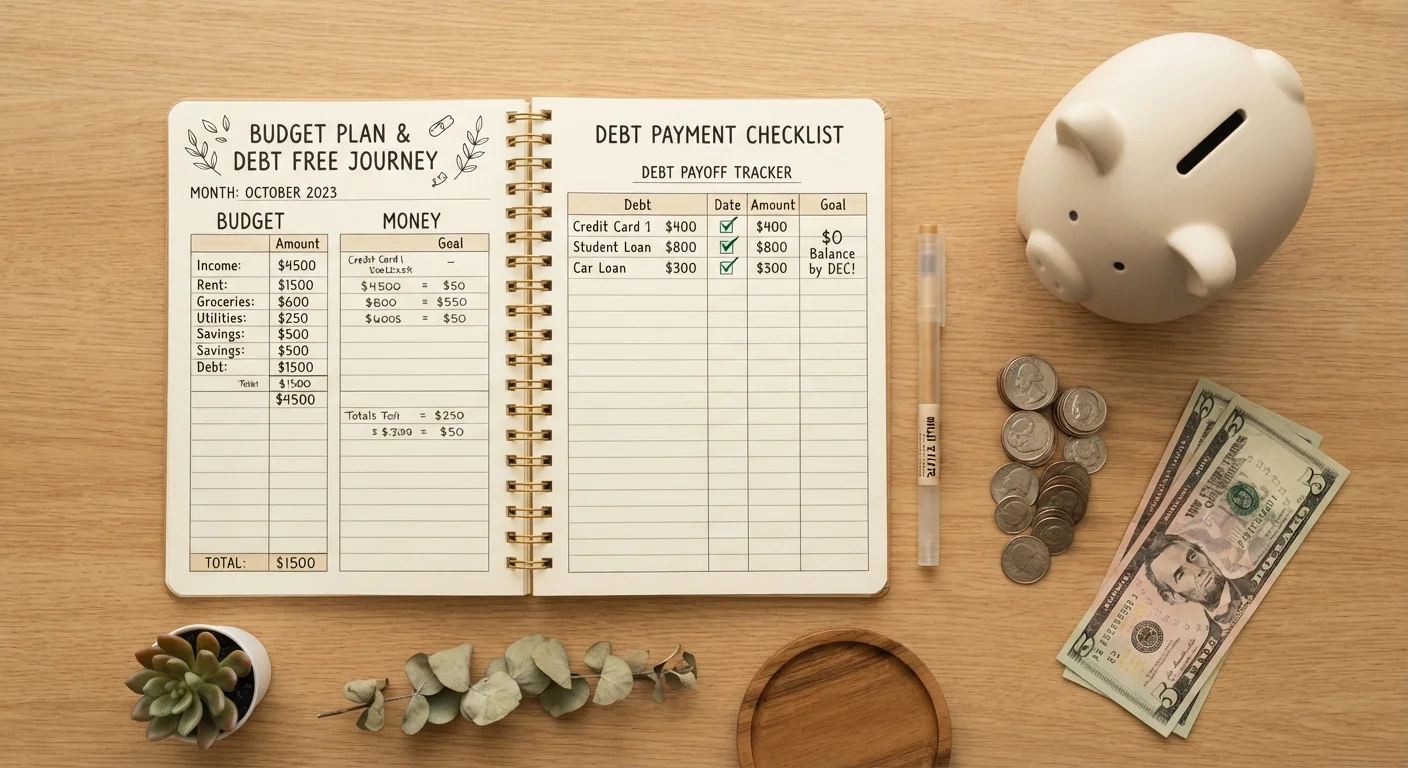
A sustainable plan puts both goals in writing. Start by mapping your monthly cash flow: take-home income minus essential expenses equals your discretionary margin. From there, allocate that margin deliberately — a fixed amount to savings goals, a fixed amount to extra debt payments — rather than directing whatever's left at month's end.
The personal budgeting complete reference and our budgeting basics hub offer practical frameworks for tracking income and expenses. For the savings side, the pay yourself first strategy — automating a savings transfer before discretionary spending — can make building savings more consistent.
Review your plan every three to six months. As debt balances fall, redirect those freed-up payments toward savings. Progress compounds: each eliminated debt payment becomes fuel for the next financial goal.
This article is for general informational and educational purposes only and does not constitute personalized financial, investment, tax, or legal advice. Consult a qualified financial adviser or other licensed professional before making decisions specific to your situation.