

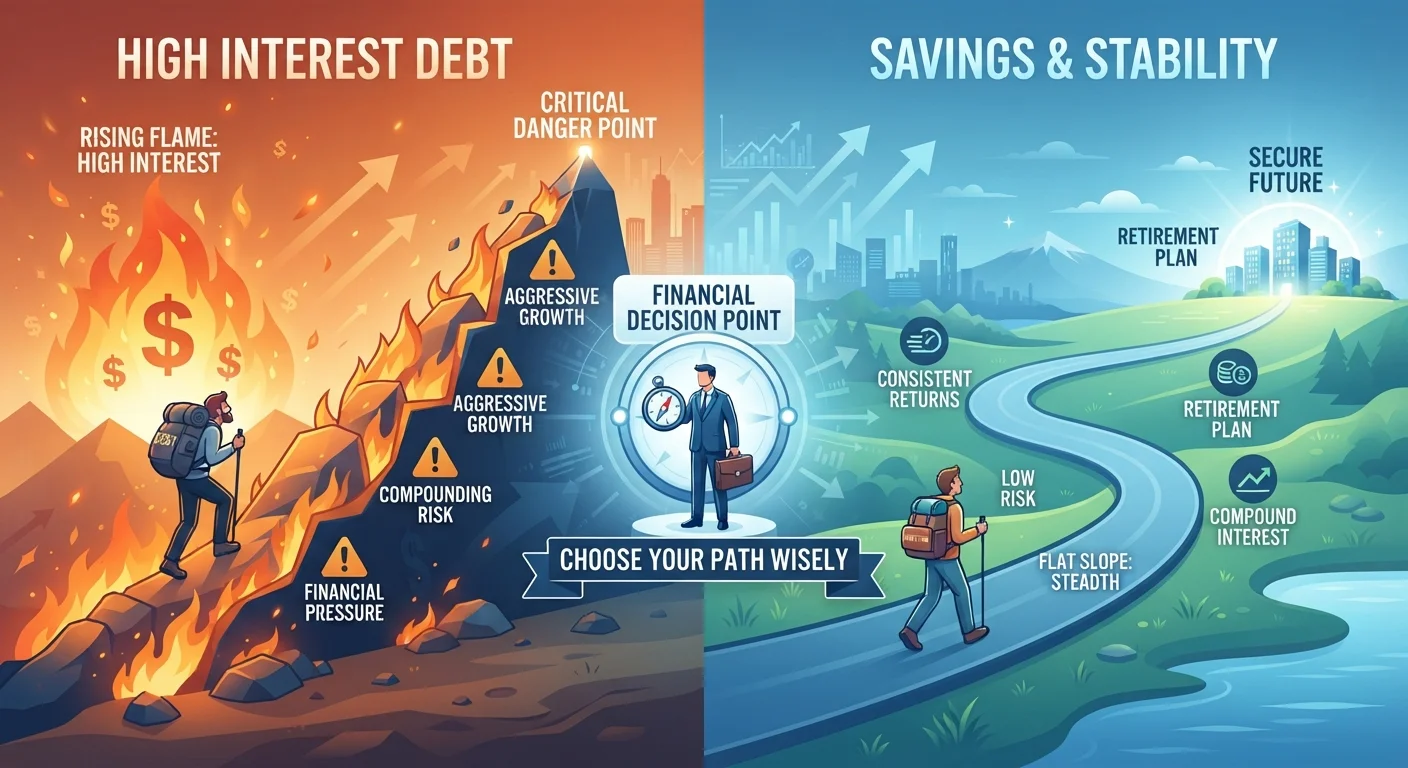
Key Takeaways
Option A
High-Interest Debt
The costly obligation that demands immediate attention.
Best for: Understanding when aggressive, accelerated repayment is the financially sound priority over other goals.
Option B
Low-Interest Debt
The manageable obligation that allows strategic flexibility.
Best for: Understanding when steady, scheduled repayment frees capital for savings or investment alongside debt reduction.
If you carry revolving credit card balances
High-Interest Debt strategy
Credit card APRs frequently exceed 20%, compounding quickly. Prioritizing payoff almost always outweighs other financial moves at those rates.
If your debt is a fixed-rate mortgage or federal student loan at a low rate
Low-Interest Debt strategy
At rates well below typical investment returns, maintaining scheduled payments while building savings or an emergency fund often makes more financial sense.
If you have a mix of both debt types and limited extra cash
High-Interest Debt strategy
Direct any surplus toward the highest-rate balances first; the interest savings typically exceed benefits from split allocation across all debts.
If you have no emergency fund but only low-interest debt
Low-Interest Debt strategy
A small emergency reserve prevents you from taking on new high-interest debt when unexpected expenses arise, making parallel saving worthwhile.
Why the Interest Rate Is the Real Story
When people talk about debt, they often focus on the total balance — the raw dollar figure they owe. But the number that actually determines urgency is the annual percentage rate (APR): the yearly cost of carrying that debt expressed as a percentage of the outstanding balance. Two borrowers owing the same amount can face wildly different financial situations depending on whether their rate is 4% or 24%.
At its core, high-interest debt is expensive to hold. Every month you carry a high-rate balance, interest accrues on top of what you already owe. The true cost of carrying a credit card balance compounds faster than most people anticipate, meaning delays in repayment don't just extend your timeline — they increase the total amount you'll ultimately pay. Low-interest debt, by contrast, grows slowly enough that time is less your enemy.
There's no universal APR threshold that officially separates the two categories. Financial educators commonly treat debts above roughly 6–8% as candidates for accelerated repayment, though the right benchmark shifts with prevailing interest rates, your available savings rate of return, and your personal cash flow. What matters is understanding the relative cost of your debt — and acting accordingly.
The 'Good Debt vs. Bad Debt' Frame Has Limits
You may have heard that some debt is inherently 'good' and other debt is inherently 'bad.' That framing is a rough shortcut, not a rule. What 'good debt' and 'bad debt' really mean is more nuanced than the label suggests. A low-interest mortgage can become a burden if it's oversized for your income; a high-interest personal loan may be the right short-term tool in a specific situation. Interest rate matters — but so does the full picture of your finances.
Head-to-Head: How the Two Types Compare
The table below contrasts the defining characteristics of high-interest and low-interest debt across the dimensions most relevant to everyday decision-making.
| Criterion | High-Interest Debt | Low-Interest Debt |
|---|---|---|
| Typical APR range | Often 10%–30%+ | Typically 2%–7% |
| Common examples | Credit cards, payday loans, some personal loans | Mortgages, federal student loans, some auto loans |
| Secured vs. unsecured | Usually unsecured | Usually secured by an asset |
| Cost of delay | High — compounds quickly | Low — accrues slowly |
| Repayment urgency | Prioritize aggressive payoff | Steady scheduled payments often sufficient |
| Opportunity cost of early payoff | Low — guaranteed rate savings exceed typical returns | Higher — savings or investments may outperform the rate |
| Tax deductibility (varies by situation) | Rarely deductible | Sometimes deductible (e.g., mortgage interest) |
One pattern worth noting: high-interest debt is typically unsecured — not backed by an asset — which is part of why lenders charge more. Low-interest debt is usually secured (tied to a home, a vehicle, or a government-backed education program), reducing lender risk and, in turn, your rate. That structural difference matters when thinking about your overall risk exposure, not just your monthly payment.
When Aggressive Payoff Makes Clear Financial Sense
If your debt carries a rate that consistently exceeds what you could reasonably expect to earn on savings or conservative investments, accelerated payoff is essentially a guaranteed return at that rate. Eliminating a 22% APR credit card balance is functionally equivalent to earning 22% risk-free — a return no savings account or bond currently offers.
This is the logic behind the debt avalanche method: targeting your highest-rate debt first regardless of balance size. The debt avalanche and debt snowball methods both offer structured frameworks for prioritization. The avalanche approach minimizes total interest paid over time, which is particularly powerful when high-rate balances are large.
Delaying action on high-interest debt while directing money elsewhere — even toward savings — generally results in a net financial loss. The impact of paying only the minimum illustrates this clearly: minimum payments are structured by lenders to extend repayment, not accelerate it.
20%+
Average credit card APR in the U.S.
According to Federal Reserve consumer credit data, average credit card interest rates have exceeded 20% APR in recent reporting periods.
~3x
Interest paid on minimum-only vs. accelerated repayment
Consumer Financial Protection Bureau analyses have illustrated how minimum-only payment schedules can result in borrowers paying several times the original balance over time on high-rate revolving debt.
When Steady Repayment — and Parallel Saving — Makes Sense
Low-interest debt changes the math. A federal student loan at 4.5% or a 30-year mortgage at 3.75% carries a cost of borrowing well below the long-run average return on diversified investments or even some high-yield savings accounts during periods of elevated interest rates. In these situations, mechanically throwing every spare dollar at the debt may not be the optimal use of cash.
This doesn't mean ignoring low-interest debt. It means treating it as a manageable, scheduled obligation while directing surplus funds toward goals like an emergency fund, retirement contributions (particularly those with employer matching), or other savings priorities. Balancing debt payoff with saving is a genuine strategic question, not a sign of financial irresponsibility.
Context still matters. Even low-interest debt can become a burden if it consumes so much of your monthly cash flow that you have no financial buffer. The goal is a sustainable plan — not simply the mathematically optimal one on paper.
This article is for general informational and educational purposes only and does not constitute personalised financial, investment, tax, or legal advice. Consult a qualified financial professional before making decisions specific to your situation.