

Key Takeaways
Start here
Why Saving Feels So Hard to Start
Next
Setting a Realistic First Savings Target
Important context
Balancing Savings With Existing Debt
Build the system
Making the Habit Automatic and Durable
When you're ready
When to Expand Beyond Your Starter Fund
Why Saving Feels So Hard to Start
Saving money is simple in theory and genuinely difficult in practice — especially when your income barely covers your obligations. The barrier is rarely laziness. More often, it's a combination of tight cash flow, no clear starting point, and the feeling that small amounts aren't worth the effort.
Research in behavioral economics consistently shows that humans discount future rewards in favor of present needs. When rent, groceries, and utility bills are immediate, a savings goal that pays off in months feels abstract. This isn't a character flaw — it's how most people are wired.
The practical solution is to reframe saving not as deprivation but as paying a future version of yourself first. Even a modest buffer changes how financial stress feels on a day-to-day basis. Before building any savings habit, it helps to have a clear view of your income and spending. If you haven't mapped that out yet, our introduction to personal budgeting is the right place to start.
Emergency fund
A dedicated pool of savings set aside only for genuine, unexpected financial needs — like a sudden medical bill or job loss — not for planned or discretionary expenses.
Automatic transfer
A scheduled, recurring movement of money from one account to another (such as checking to savings) that happens without requiring manual action each time.
High-interest debt
Money owed on accounts that charge a high annual percentage rate (APR) — most commonly credit cards — where the interest charges accumulate quickly if the balance isn't paid down.
Sinking fund
A savings category where you set aside small amounts regularly to cover a known future expense — like car registration or holiday gifts — so it doesn't disrupt your budget when it arrives.
Cash flow
The movement of money in and out of your personal finances — essentially the difference between what comes in (income) and what goes out (expenses) in a given period.
Setting a Realistic First Savings Target
The first milestone for most people starting from zero is a small emergency fund — typically $500 to $1,000. This amount isn't meant to cover every possible crisis. Its job is narrower: to break the cycle where an unexpected car repair or medical co-pay becomes new credit card debt.
Once you know roughly what you can set aside per paycheck, calculate how many pay periods it will take to reach $500. If the answer is six months, that's fine. The timeline matters less than the commitment to not touching the money once it's there.
Make Your Savings Target Visible
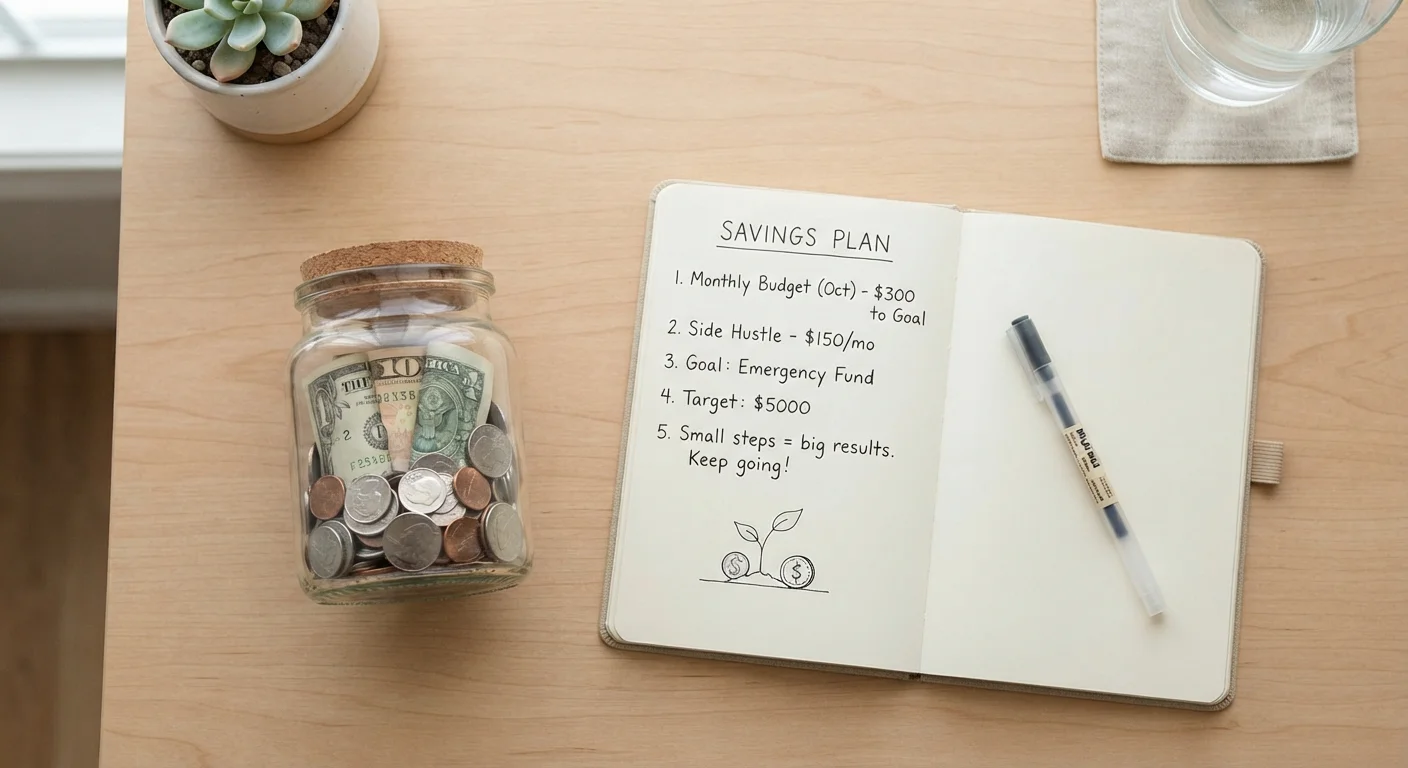
Writing down your savings goal — and tracking progress, even manually — significantly increases follow-through. A simple notebook entry or a notes app works just as well as a dedicated app. Seeing the number grow, even slowly, reinforces the behavior and keeps the goal from feeling abstract.
For planning future predictable costs — things like annual insurance premiums or holiday gifts — a separate sinking fund approach can protect your emergency fund from being drained by expenses that aren't actually emergencies. Keeping these goals in separate buckets, even within the same bank, helps maintain clarity.
Balancing Savings With Existing Debt
One of the most common questions for people starting to save is whether they should redirect every available dollar toward debt first. The answer depends on the type of debt. High-interest debt — particularly credit card balances — does erode financial progress quickly, so prioritizing it makes mathematical sense. But stopping savings entirely creates vulnerability: without any buffer, the next unexpected expense goes straight back onto a credit card.
A practical middle path: build your starter emergency fund first (even at a slow pace), then allocate the bulk of extra cash flow to high-interest debt while maintaining a small, consistent savings contribution. This approach is explored in more depth in our article on paying off debt while saving.
Don't Let Debt Become an Excuse Not to Save
It can feel logical to pause all saving until debt is paid off — but this often backfires. Without any savings buffer, the next unexpected expense creates new debt, restarting the cycle. Maintaining even a small, consistent savings contribution protects the progress you're making on debt repayment.
Low-interest debt — student loans, a car payment, a mortgage — warrants a different calculus. In many cases, the financial benefit of aggressively paying these down early is modest, and maintaining savings progress alongside them is reasonable. A licensed financial adviser can help you think through your specific mix of obligations.
Making the Habit Automatic and Durable
The most reliable savings systems remove human decision-making from the equation. When saving requires a manual transfer each month, it competes with dozens of other financial decisions — and it often loses. Automating a transfer from checking to savings on payday means the money is moved before you have a chance to spend it.
Most banks and credit unions allow you to schedule recurring transfers at no cost. Some employers allow you to split direct deposit between accounts, which is even more effective because the savings never appear in your checking balance at all. Our guide on automating your finances covers the mechanics of setting this up across common financial workflows.
A realistic monthly budget is the foundation that makes automation work — it tells you what amount is genuinely available to automate without overdrawing your account.
When to Expand Beyond Your Starter Fund
Once your emergency fund reaches its initial target and high-interest debt is under control, you're in a position to think about what comes next. Common next steps include expanding your emergency fund to three to six months of essential expenses, saving toward a specific goal (a move, a vehicle repair reserve, or a down payment), or beginning to contribute to a tax-advantaged retirement account if one is available through your employer.
These decisions involve trade-offs that depend on your income, expenses, risk tolerance, and time horizon — factors that vary significantly between individuals. A qualified financial adviser can help you prioritize based on your full picture. In the meantime, our investing essentials hub offers a grounded introduction to how investing works once a financial foundation is in place.
The most important thing is that reaching your starter goal is itself a milestone worth recognizing. It means the habit is real — and habits, once established, are far easier to build on than to create from scratch.
This article is for general informational purposes only and does not constitute personalized financial, investment, tax, or legal advice. Consult a licensed financial professional before making decisions based on your individual circumstances.