

Key Takeaways
Why Tracking Matters More Than Any Budget Formula
You can write a beautiful budget on a Sunday afternoon and completely ignore it by Wednesday. That's not a willpower problem — it's a visibility problem. When you don't know where your money went, you can't make meaningful choices about where it goes next.
Spending tracking closes that gap. It turns vague financial anxiety into concrete numbers you can actually act on. Research in behavioral economics consistently shows that people who monitor their spending tend to spend less, not because they restrict themselves harshly, but because awareness alone changes behavior. If you're serious about building savings or tackling debt, tracking is the foundation everything else rests on.
65%
Americans without a monthly budget
A Gallup survey found that roughly two-thirds of U.S. adults report not maintaining a detailed household budget.
~$1,500
Average annual subscription spend per household
Research by C+R Research found that consumers often significantly underestimate their monthly subscription costs, with averages far exceeding self-reported figures.
Choosing the Right Method for Your Life
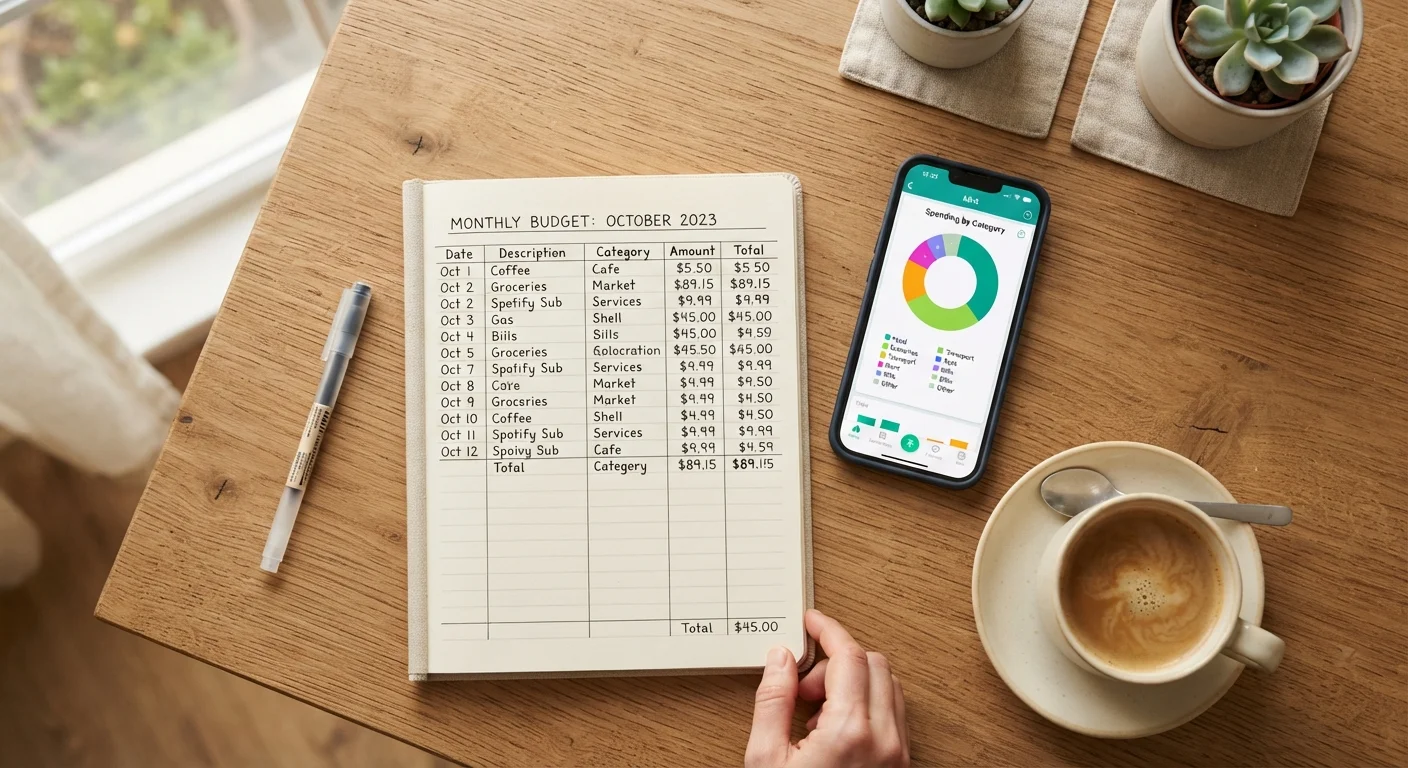
There is no universally superior tracking method. The right one is whichever you'll use consistently for more than two weeks. Here's an honest look at three main approaches:
- Pen and paper: Slow and deliberate. Writing an expense by hand creates a small moment of friction that many people find useful — it makes spending feel more real. Works well for people who already journal or prefer keeping screens out of certain parts of their day. See how journaling habits form and where they break down for insight into building any handwritten routine.
- Spreadsheets: Highly customizable, free, and private. A simple spreadsheet with date, category, amount, and notes columns is enough to get started. The trade-off is manual entry — you have to input every transaction yourself, which is a feature for some and a dealbreaker for others. Weigh spreadsheets against budgeting apps to see which approach fits your style.
- Budgeting apps: Connect to your bank accounts and categorize transactions automatically. Low daily effort, but they require trusting a third party with your financial data and accepting their category definitions — which don't always match how you actually think about money.
Record every transaction within 24 hours of making it.
Memory fades fast, and even small purchases add up to significant amounts over a month. Delayed logging leads to gaps that undermine the whole picture. A daily habit of logging — even if it's just a quick phone note — keeps your data accurate.
Use no more than eight to ten spending categories.
Overly granular categories — splitting 'groceries' from 'household supplies' from 'pharmacy' into three separate buckets — create so much friction that most people quit. Broader categories are easier to maintain and still reveal meaningful patterns.
Set a specific day and time for your weekly money check-in.
Ad hoc reviews rarely happen consistently. Anchoring your review to a specific slot — Sunday evenings, Friday mornings — turns it into a routine rather than a task you defer indefinitely.
Track your income alongside your expenses, not just outflows.
Without the income side of the ledger, you can't calculate your actual surplus or deficit. This is especially important for freelancers, gig workers, or anyone with variable monthly income.
Review and prune recurring charges every quarter.
Subscriptions and automatic renewals are the most common source of 'invisible' spending. A quarterly audit catches services you've stopped using before another year's charge hits.
The Weekly Review: Your Most Valuable Habit
Whichever method you choose, the weekly review is what transforms raw data into useful insight. Set aside 10–15 minutes — same day, same time each week — to look back at what you spent. Ask three questions: Where did I overshoot? Where did I underspend without trying? What surprised me?
Make Your Review Session Enjoyable
Pair your weekly money check-in with something you look forward to — a cup of good coffee, a favorite playlist, or a comfortable spot in your home. Small positive associations make it easier to show up for the habit week after week. Dreary routines get skipped; pleasant ones stick.
You don't need to react to every finding immediately. The goal of the weekly review is pattern recognition over time, not real-time policing of every latte. After four to six weeks, patterns emerge that are nearly impossible to see transaction by transaction.
For categories that routinely surprise people — annual subscriptions, irregular bills, slow-creeping memberships — see our guide to spending categories most budgets miss. These hidden expenses are where even disciplined trackers get caught off guard.
Adapting Your System as Life Changes
A tracking system that worked when you were single may buckle when you add a partner, a child, or a new job with variable income. Build adaptation into your expectations from the start. Every few months, ask whether your current method still fits your life — not whether you're disciplined enough to make it work.
If you're drawn to the structured simplicity of category-based spending limits, the envelope budgeting method pairs naturally with any tracking approach and adds a layer of built-in guardrails. And if your challenge is less about money and more about staying organized digitally, practical digital tools for everyday organization can help round out your system.
Privacy Varies by Tracking Tool
App-based trackers that link to your bank accounts typically share data with third parties under their privacy policies. If data privacy is a concern, a spreadsheet or paper log keeps your financial information entirely under your control. Always review an app's privacy policy before connecting financial accounts.
This article is for general informational and educational purposes only and does not constitute personalized financial advice. For guidance tailored to your specific financial situation, consider consulting a licensed financial professional.