

Key Takeaways
Envelope Budgeting
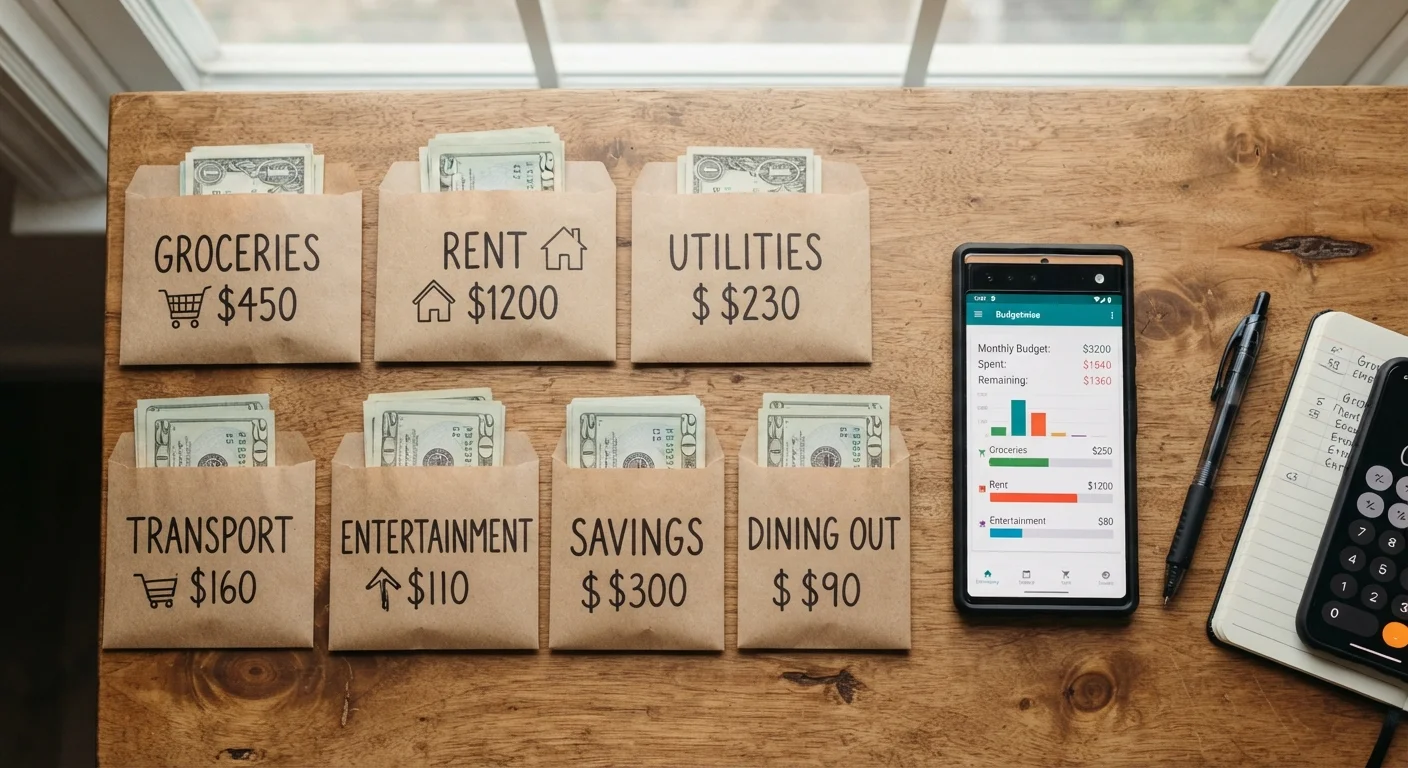
Envelope budgeting is a cash-based spending system where you divide your monthly income into labeled physical envelopes, each representing a spending category such as groceries, gas, or dining out. Once an envelope is empty, spending in that category stops for the month. The method creates hard, visible limits that make overspending immediately apparent.
In its digital form, envelope budgeting uses virtual 'buckets' or sub-accounts that function identically to physical envelopes, tracking allocated versus spent amounts in real time without requiring physical cash.
How Envelope Budgeting Works
The mechanics are straightforward. At the start of each month, you calculate your take-home income, then allocate set amounts to different spending categories. Traditionally, you'd withdraw those amounts in cash and sort the bills into labeled envelopes. Grocery money goes in one. Gas in another. Entertainment in a third.
During the month, you spend only from the relevant envelope. Buying dinner out? The dining envelope funds it. When an envelope hits zero, that category is closed for the month. No exceptions — unless you consciously move money from another envelope, which forces a deliberate trade-off.
If you're new to structuring a spending plan at all, see our introduction to personal budgeting before layering in the envelope system.
36%
Americans who overspend their monthly budget regularly
According to a Bankrate survey, more than one in three Americans report spending more than they earn in a given month at least occasionally.
83%
Of people who use cash spend less than card users
Multiple studies in consumer psychology, including work published in the Journal of Consumer Research, find that cash payment increases the psychological 'pain' of spending, reducing amounts spent.
Why the System Works — and Where It Struggles
Envelope budgeting is effective because it makes limits tangible. When you can physically see how much is left in a grocery envelope, spending decisions shift. Research in behavioral economics consistently shows that people spend more freely with cards than with cash precisely because the psychological friction of handing over bills is absent.
The system's limits are also real constraints. Reaching into an empty envelope and finding nothing is a more visceral signal than seeing a negative number on an app dashboard.
That said, the traditional cash-only approach has friction of its own. Carrying exact categories of cash is cumbersome. It doesn't integrate with direct deposit. Online purchases complicate things considerably. And if an envelope is lost or stolen, that money is gone.
“The envelope system forces you to have a conversation with yourself before you spend, not after. That moment of friction is where financial discipline actually lives.”
— Jesse Mecham, Founder of a popular envelope-based personal budgeting methodology and author on the subject of intentional spending
For people with irregular income — freelancers, gig workers, seasonal earners — the rigid monthly allocation can feel unworkable. Our guide to budgeting on an irregular income covers adapted strategies for variable cash flow.
Adapting Envelope Budgeting for the Digital World
You don't need paper envelopes to apply this logic. Several approaches bring envelope budgeting into everyday digital life:
- Budgeting apps with virtual envelopes: Some personal finance apps are built specifically around the envelope concept, letting you create digital categories, set limits, and track spending in real time as transactions sync from your accounts.
- Bank sub-accounts: Some banks allow customers to create multiple savings or checking sub-accounts — one per category — so physical money is actually partitioned, not just tracked on paper.
- Spreadsheets: A manually updated spreadsheet can mirror envelope logic with a simple table of categories, allocated amounts, and running totals. It requires discipline to update consistently, but it works.
Choosing a tracking tool is itself an important decision. Our comparison of spreadsheets versus budgeting apps can help you weigh the options.
Start With Just Three or Four Envelopes
Beginners often try to create a category for every conceivable expense, which quickly becomes unmanageable. Start with the three or four categories where your spending is most variable and least controlled — often groceries, dining, entertainment, and personal spending. Once those feel stable, add more categories gradually.
Putting It Into Practice
Setting up the envelope system takes one focused session. Begin by listing every variable expense category where you want to control spending. Then review two or three months of past statements to set realistic limits — not aspirational ones. Underfunding an envelope and constantly raiding others undermines the whole system.
For a structured walkthrough of mapping income to categories, building a monthly budget that reflects your life provides a step-by-step framework that pairs well with the envelope approach.
Finally, build in a monthly review. Envelopes that are always empty by the 15th need larger allocations; envelopes that are never touched might be candidates for reallocation toward savings or debt payoff. The Saving & Debt hub offers further guidance on directing freed-up funds purposefully.
The envelope method won't suit every household. But for anyone who finds that money disappears without a clear trail, it offers something most budgets don't: a hard stop, not just a soft suggestion.
This article is for general informational and educational purposes only and does not constitute personalized financial advice. Consult a qualified financial professional for guidance specific to your situation.