

Key Takeaways
Auto Coverage Types
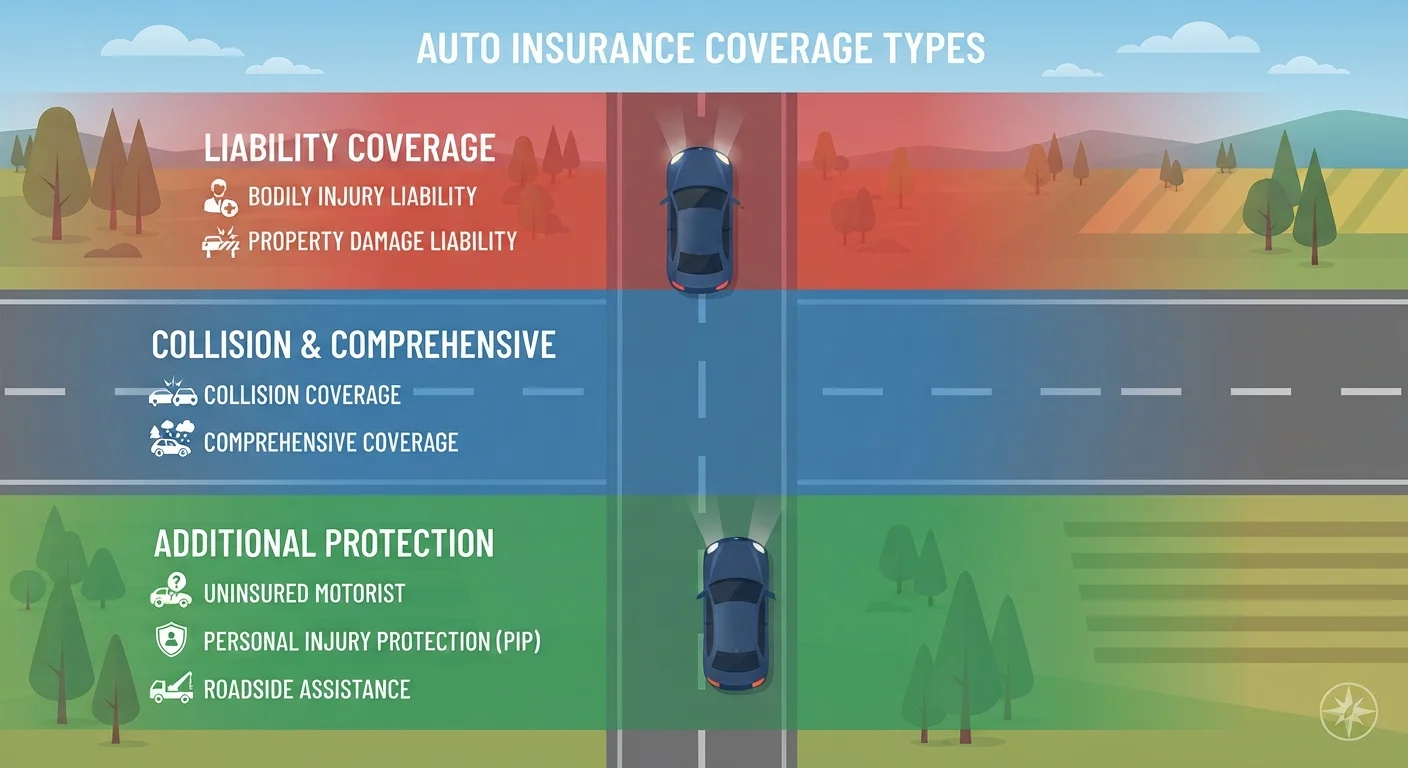
An auto insurance policy is typically made up of several separate coverage components, each designed to protect against a specific category of loss. Liability coverage pays for harm you cause to others. Collision coverage pays to repair your own vehicle after a crash. Comprehensive coverage handles damage from non-crash events like theft, weather, or animals. Understanding how they differ is the first step to knowing what protection you actually have.
Lenders and lessors generally require both collision and comprehensive coverage (often called 'physical damage' coverage) as a condition of financing or leasing a vehicle.
Liability Coverage: Protecting Others From Your Mistakes
Liability coverage is the foundational layer of any auto insurance policy — and the only type mandated by law in nearly every U.S. state. It kicks in when you are found at fault for an accident and covers two distinct buckets of loss: bodily injury liability (medical bills, lost wages, and legal costs for the other party) and property damage liability (repairs to the other driver's vehicle or other property you damaged).
What liability does not cover is your own vehicle or your own medical expenses. If you rear-end another driver and damage your own car in the process, liability pays for their repairs — your car's damage is your problem unless you also carry collision coverage.
States set minimum liability limits, but those minimums are often low enough that a serious accident could leave you personally responsible for costs beyond your policy's cap. Policyholders frequently choose limits above the state minimum to reduce that exposure, though the right level depends on individual circumstances. Consulting a licensed insurance agent can help you assess what limits are appropriate for your situation.
Check Your State's Minimum Requirements
Every state sets its own minimum liability limits, and they vary considerably. Before purchasing or renewing a policy, look up your state's current requirements through your state's department of insurance website. Keep in mind that meeting the minimum is rarely the same as having adequate protection for a serious accident.
Collision Coverage: When Your Car Takes the Hit
Collision coverage pays to repair or replace your vehicle when it is damaged in a crash — whether you hit another car, a guardrail, a parked vehicle, or a pothole-induced rollover. Importantly, collision applies regardless of fault: even if you caused the accident, your insurer will pay to fix your car (minus your deductible).
This coverage is optional if you own your vehicle outright, but lenders and leasing companies almost always require it when a loan or lease is active, since the vehicle serves as collateral. Once a car is paid off and its market value drops significantly, some owners decide the cost of maintaining collision coverage outweighs the potential payout — a judgment that depends on the vehicle's current value and the owner's financial cushion.
Payouts under collision are typically based on either actual cash value or replacement cost, depending on the policy. Understanding those two payout methods matters: actual cash value vs. replacement cost coverage can mean thousands of dollars of difference after a loss.
~85%
U.S. drivers carrying more than liability-only coverage
According to the Insurance Research Council, a substantial majority of insured drivers opt for physical damage coverage beyond the state-required liability minimum.
1 in 4
Drivers involved in a collision every 17.9 years on average
The National Safety Council estimates the average licensed driver will be involved in a collision roughly once every 18 years, underscoring the statistical relevance of collision coverage over a driving lifetime.
$3.4B+
Estimated annual auto theft losses in the U.S.
The FBI's Uniform Crime Reports have historically documented multi-billion-dollar annual losses from motor vehicle theft, reinforcing the financial relevance of comprehensive coverage.
Comprehensive Coverage: Everything Else
Despite its name, comprehensive coverage is not all-encompassing — it specifically covers physical damage to your vehicle from events that are not a collision. Common covered perils include theft, vandalism, fire, flooding, hail, falling trees or debris, and striking an animal (such as a deer). If your car is totaled in a flash flood or stolen from your driveway, comprehensive is the coverage that responds.
Like collision, comprehensive comes with a deductible — the amount you pay before the insurer covers the remainder. Choosing a higher deductible lowers your premium but increases your out-of-pocket exposure per claim. How you set your deductible shapes both your annual cost and your financial risk in any given claim scenario.
Comprehensive is also typically required by lenders and lessors alongside collision. Drivers in areas prone to severe weather, high vehicle theft, or heavy wildlife activity may find comprehensive coverage especially valuable relative to its cost — though coverage decisions should reflect your own situation and be discussed with a licensed agent.
Comprehensive Doesn't Mean 'Everything'
The word 'comprehensive' can be misleading. It does not cover collision damage, mechanical breakdowns, normal wear and tear, or personal belongings stolen from inside the vehicle (those may fall under a renters or homeowners policy). Always read your policy's declarations page and exclusions to understand exactly what is and isn't covered.
Putting It All Together: How the Three Types Work as a System
Most drivers who carry full coverage have all three types — liability, collision, and comprehensive — bundled into a single auto policy. Each addresses a different risk layer: liability protects others from you, collision protects your vehicle from crash damage, and comprehensive protects your vehicle from the rest of the world. A gap in any one area leaves a specific category of loss uncovered.
The decision of which coverages to carry — and at what limits and deductibles — involves balancing your vehicle's value, your state's requirements, any lender requirements, and your own financial situation. These are personal financial decisions, and general information like this article is no substitute for guidance from a licensed insurance professional who can evaluate your specific circumstances.
For a broader view of how property coverage decisions apply across different policy types, the Life & Other Coverage hub covers additional insurance categories worth understanding. If you currently bundle your auto and home insurance, it's also worth reviewing what bundling actually means for your coverage and flexibility.
This article is for general informational and educational purposes only and does not constitute personalized insurance, financial, or legal advice. Coverage terms, exclusions, and availability vary by insurer and by state. Always read your actual policy documents and consult a licensed insurance agent or adviser for guidance tailored to your situation.