

Key Takeaways
Unit Price vs. Sale Price
A unit price is the cost of a single standard measure of a product — one ounce, one count, one liter — regardless of package size. A sale price is simply the total price a retailer displays, which may or may not represent genuine savings. Knowing both lets you compare products fairly and verify whether a discount is real.
Unit price is calculated by dividing the total price by the quantity in the package (e.g., $4.80 ÷ 16 oz = $0.30/oz). Retailers in many U.S. states are required by law to display unit prices on shelf tags for packaged goods.
Why Two Prices Matter More Than One
Every product in a store carries at least two prices: what you pay at checkout and what you're paying per unit of the thing inside. Most shoppers focus entirely on the first number and miss the second — which is exactly where retailers have room to obscure real value.
The sale price tells you what a retailer is charging today. The unit price tells you what you're actually getting for that money. Without both numbers, you can't judge a deal — you can only react to one.
This matters because package sizes, promotions, and bundling are all variables retailers control. The unit price strips those variables away. It puts a $1.99 can and a $4.50 can on exactly the same footing so a real comparison is possible.
Unit Pricing Laws Vary by State
Most U.S. grocery retailers are required to display unit prices on shelf tags, but requirements differ by state and product category. If you don't see a unit price on the shelf, you can always calculate it yourself using the package weight or count and the listed price. Online retailers are not uniformly required to show unit prices, so manual calculation is often necessary. The full picture on unit pricing shelf labels covers what retailers are required to show and where the gaps are.
The Math Is Simpler Than It Looks
Calculating a unit price takes about five seconds. Divide the total price by the quantity in the package:
- Price ÷ Quantity = Unit Price
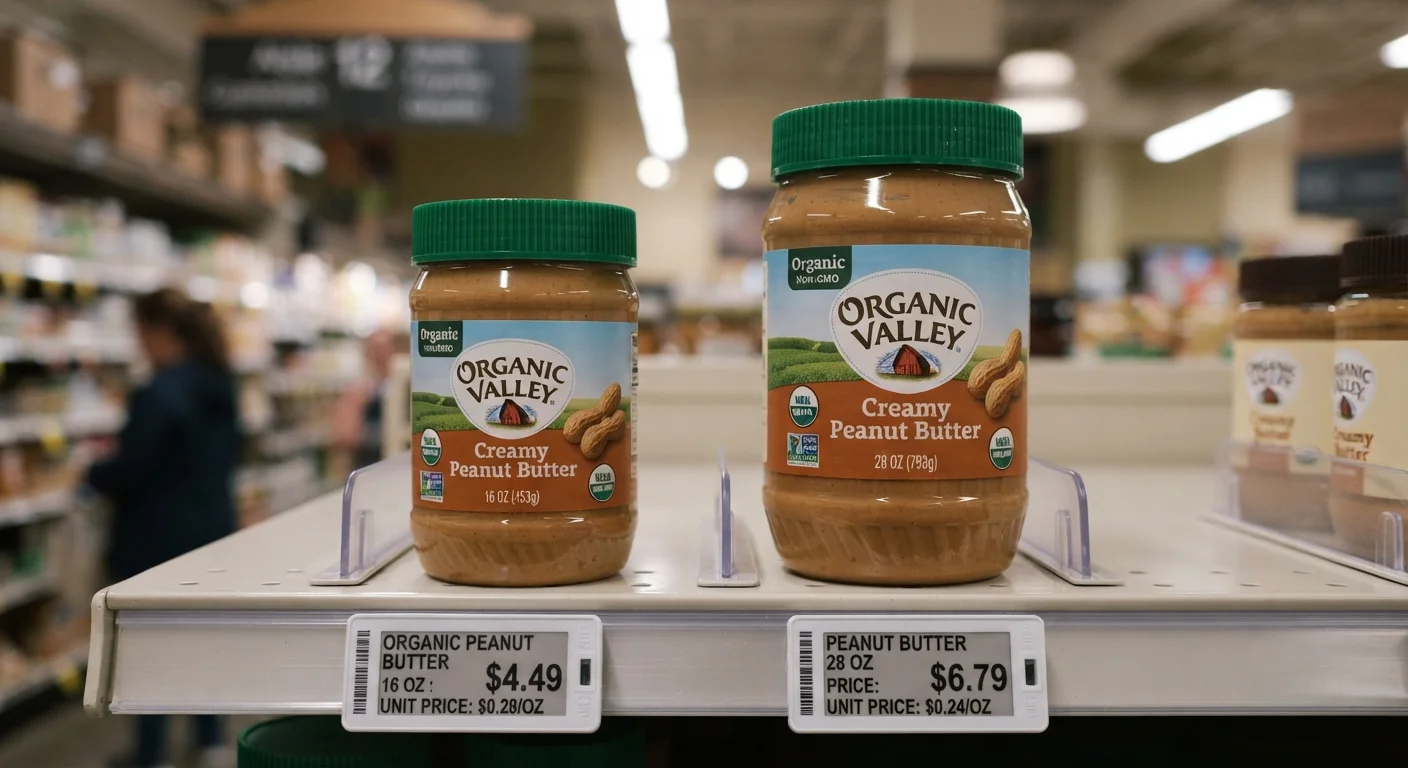
A 20 oz jar of peanut butter priced at $3.60 costs $0.18 per ounce. A 40 oz jar priced at $6.40 costs $0.16 per ounce. The larger jar is the better value — but only by two cents per ounce. If you'd waste half of it before the use-by date, the savings evaporate.
The same logic applies to multi-packs, club-store quantities, and bundle deals. Calculate the unit price for each option, then factor in whether you'll actually use all of it. A deal you overbuy isn't a deal — it's a cost you distributed across waste.
Factor In How Much You'll Actually Use
A lower unit price on a bulk package only saves money if you use the entire quantity before it expires or degrades. For perishables especially, calculate the effective cost by estimating waste. Half a package thrown out means the unit price you paid was double what the tag showed.
How Sale Prices Can Mislead
A sale price earns its label when a retailer temporarily reduces the price below what it normally charges. That's the theory. In practice, several common tactics blur the line between a real discount and the appearance of one.
Reference pricing — the crossed-out "was $X" — is only meaningful if that original price was genuinely charged for a meaningful period. Some items carry inflated reference prices that were never the actual market price. Others cycle in and out of "sale" so frequently that the sale price is effectively the regular price.
To see through this, compare the unit price of the sale item against a comparable product at its normal price. If the unit price is lower, the deal is real. If it's the same or higher, you're paying for the feeling of a bargain rather than the substance of one. The mechanics behind reference pricing are worth understanding in detail.
~30%
Shoppers who regularly check unit prices
Consumer research has consistently found that a minority of shoppers actively use unit price labels at the shelf, despite their widespread availability in U.S. grocery stores.
40+ states
U.S. states with unit pricing requirements
Most U.S. states have regulations requiring retailers to display unit prices on shelf tags for packaged grocery products, though enforcement and format vary.
Putting It Together at the Shelf
A practical habit: before putting anything in your cart that's marketed as a deal, glance at the unit price tag below it on the shelf. Compare it to the unit price of the alternative size or brand next to it. That single comparison does more work than any promotional tag.
For items without a visible unit price tag — common at some discount or specialty stores — use your phone's calculator. Price divided by ounces, count, or whatever measure the package lists. It takes less time than reading the nutrition label.
Keep in mind that unit price isn't the only dimension of value. Quality differences between products are real, and downstream costs like durability and replacement frequency matter too. A lower unit price on a product you'll replace twice as often isn't savings. Use unit pricing as your baseline comparison tool, then layer in those other factors. For a deeper look at how in-store and online price transparency differ, see shopping online vs. in-store.