

Key Takeaways
Tap Water Testing
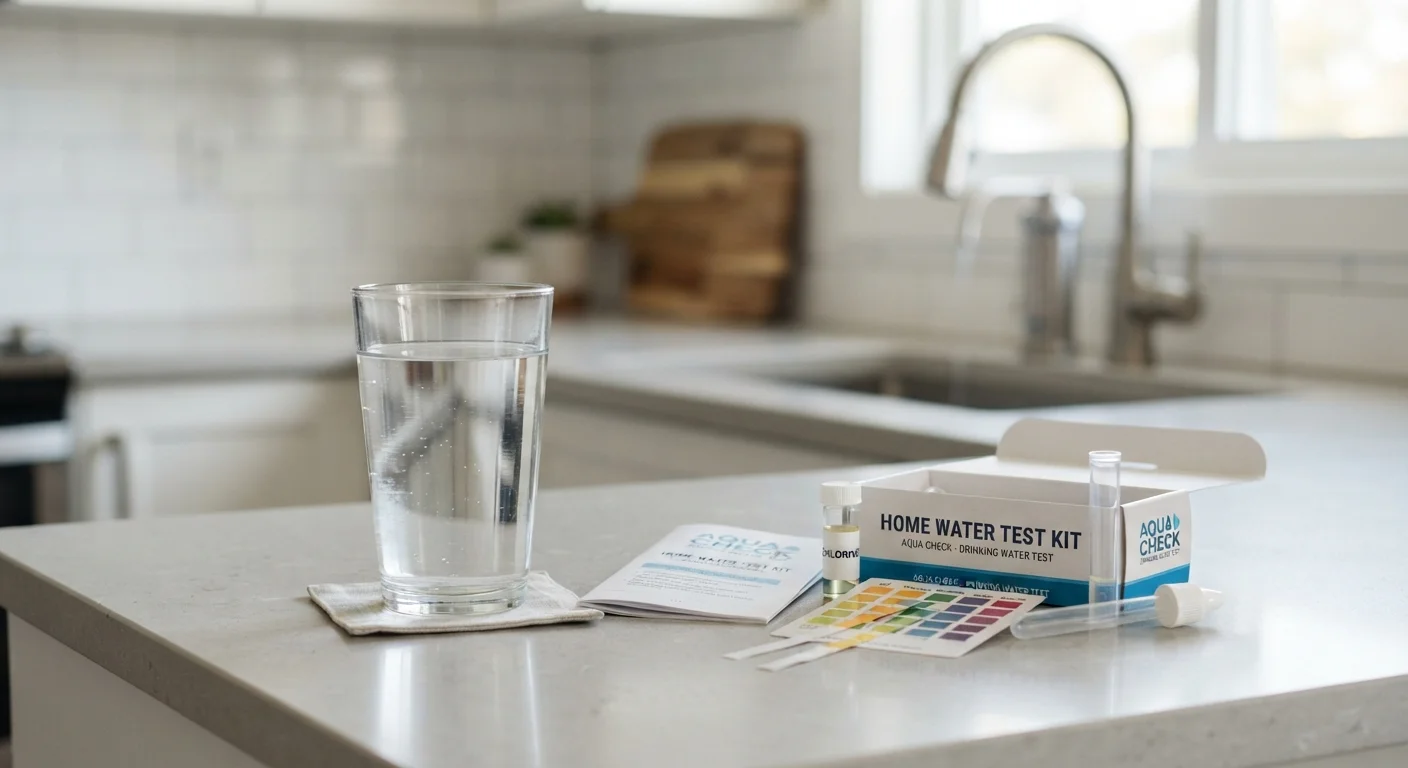
Tap water testing is the process of collecting a water sample from your home's faucet and analyzing it for the presence of specific contaminants, minerals, or chemical compounds. Tests range from simple at-home strip kits to comprehensive lab analyses. The goal is to understand what, if anything, is present in your water beyond acceptable limits set by public health standards.
The U.S. Environmental Protection Agency (EPA) regulates over 90 contaminants in public water systems under the Safe Drinking Water Act (SDWA). Private well owners are not covered by these regulations and are solely responsible for their own water quality monitoring.
What Water Testing Actually Measures
A water test is only as useful as its scope. Every test is designed to detect a defined list of substances — it will not flag anything outside that list, no matter how high the concentration. This is the most important limitation to understand before you buy a kit or send a sample to a lab.
Common contaminants that home and lab tests screen for include:
- Biological contaminants — coliform bacteria and E. coli, which indicate possible sewage or animal waste intrusion
- Heavy metals — lead, arsenic, copper, and mercury, often introduced by pipes, solder, or natural geology
- Nitrates and nitrites — linked to fertilizer runoff, a particular concern for infant health
- Disinfection byproducts — compounds like trihalomethanes that form when chlorine reacts with organic matter
- Per- and polyfluoroalkyl substances (PFAS) — a class of synthetic chemicals that require specialized lab testing to detect
- pH and hardness — not health hazards at typical levels, but relevant for plumbing and appliance longevity
Understanding which contaminants are plausible in your area before testing helps you choose the right panel. Your state health department or local extension service can often point you toward the most locally relevant risks.
PFAS Testing Requires a Specialized Lab
Per- and polyfluoroalkyl substances (PFAS) — sometimes called 'forever chemicals' — cannot be detected by standard home test kits. Testing for PFAS requires a laboratory that uses EPA Method 533 or 537.1. The EPA finalized enforceable limits for several PFAS compounds in 2024, making this an evolving area of water quality regulation. Check your utility's latest report and your state health department's guidance for current local information.
At-Home Kits vs. Certified Lab Testing
The gap between strip-based home kits and certified laboratory analysis is significant. At-home strips give you a directional signal — a rough indication of whether a substance is detectable — but they lack the sensitivity to measure low-level contamination accurately. A strip might show "no lead detected" while a lab could identify a concentration below the strip's threshold but above the EPA's action level.
Certified labs, which are accredited by state programs or the EPA, use standardized methods and can detect contaminants at parts-per-billion or even parts-per-trillion concentrations. They also provide documented, reportable results — important if you're buying or selling a home, or need to demonstrate water quality to a landlord or regulator.
Start With Your Utility's Annual Report
Before purchasing any test, download your water utility's Consumer Confidence Report — you're legally entitled to it and it's usually free online. It tells you what was detected in your municipal supply, at what levels, and how those compare to EPA limits. Use it to narrow down which contaminants are worth testing for at the tap level.
The cost difference is real: a basic strip kit costs a few dollars, while a comprehensive lab panel can run $100–$400 depending on what's included. The right choice depends on why you're testing. If you're curious about general water character, a strip may be enough. If you have a specific health concern, an infant in the household, or a private well, a lab test is worth the investment.
The Lead Problem: Why Your Source Report Isn't the Whole Story
Municipal water utilities test water at the treatment plant and at selected distribution points — not inside your home. Lead contamination most commonly occurs after the water leaves the main supply line, leaching from lead service lines, brass fixtures, or lead-based solder in older plumbing. Homes built before 1986 are at greatest risk, since that's when federal law restricted lead in plumbing materials.
This is why a utility's Consumer Confidence Report showing low lead levels doesn't guarantee lead-free water at your tap. The only way to know what's coming out of your faucet is to test the water there. The EPA recommends a "first draw" sample — collected from a faucet that has been unused for at least six hours — as the most informative method for detecting lead from household plumbing.
This gap between supply and tap is analogous to the difference between a label's claims and a product's actual performance — much like the challenges discussed in reading a product label without getting lost in the fine print. The official record and your household reality can diverge.
90+
Contaminants regulated in U.S. public water systems
The EPA sets enforceable standards for more than 90 contaminants under the Safe Drinking Water Act, though thousands of chemical compounds exist that are not currently regulated.
~15%
U.S. households relying on private wells
According to U.S. Census and EPA estimates, roughly 15 percent of Americans get their drinking water from private wells, which are not subject to federal water quality regulations.
Pre-1986
Era of highest lead plumbing risk in homes
Federal law restricted lead in plumbing materials starting in 1986; homes built before that date are significantly more likely to have lead solder or lead-containing fixtures.
Interpreting Results: What 'Detected' Really Means
Finding a contaminant in your water doesn't automatically mean your water is unsafe. Regulatory limits — called Maximum Contaminant Levels (MCLs) — are set based on the concentration at which a substance poses a health risk over a lifetime of exposure, not at any detectable trace. A result below the MCL is within the range the EPA considers acceptable.
That said, MCLs represent a regulatory floor, not a guarantee of zero risk. Some researchers and health advocates argue that certain limits — particularly for lead, arsenic, and PFAS — are set higher than ideal given newer toxicological evidence. The EPA periodically reviews and updates these standards, but the process is slow. Being an informed reader of your results means understanding both what the numbers mean and what they don't promise.
If you receive a result that concerns you, a state-certified water quality professional or your local health department can help you interpret it in the context of your specific household situation. This kind of ongoing household vigilance fits naturally into a broader approach to home maintenance — one covered in our seasonal home maintenance guide.
This article is for general informational purposes only and does not constitute medical, legal, or regulatory advice. Consult a qualified professional and your local health department for guidance specific to your household's water quality situation.