

| Deepest penetrating common oil | Coconut oil (lauric acid dominant) (Journal of Cosmetic Science, 2003) |
| Lightest texture for fine hair | Grapeseed oil |
| Most scalp-similar structure | Jojoba (liquid wax ester) |
| Thickest viscosity — requires dilution | Castor oil |
| Primary benefit of argan oil | Frizz smoothing, shine, antioxidant protection |
Why Oil Choice Actually Matters for Hair
Natural oils have been used in hair care across cultures for centuries, but "natural" doesn't mean interchangeable. Each oil has a distinct molecular structure, fatty acid profile, and weight that determines whether it penetrates the hair shaft, sits on top of it, or primarily serves the scalp. Using the wrong oil for your hair's needs can lead to buildup, greasiness, or no benefit at all.
The most important distinction is between penetrating oils — those whose molecules are small enough to move through the cuticle into the cortex — and sealing oils, which coat the cuticle to lock in moisture already present. Understanding your hair's porosity and structure is the clearest starting point for knowing which category you need most.
| Deepest penetrating common oil | Coconut oil (lauric acid dominant) (Journal of Cosmetic Science, 2003) |
| Lightest texture for fine hair | Grapeseed oil |
| Most scalp-similar structure | Jojoba (liquid wax ester) |
| Thickest viscosity — requires dilution | Castor oil |
| Primary benefit of argan oil | Frizz smoothing, shine, antioxidant protection |
A Reference Guide to Common Natural Oils
Below is a breakdown of the most widely used natural oils in hair care, what each one is scientifically suited for, and where it tends to fall short.
Penetrating oil
An oil whose molecular size is small enough to pass through the hair cuticle and reach the cortex. Penetrating oils can help reduce protein loss and improve internal moisture balance.
Sealing oil
An oil that coats the outer cuticle layer to slow moisture evaporation. Sealing oils work on top of the hair shaft rather than inside it, and are best applied over a hydrating product.
Hygral fatigue
Repeated stress on the hair fiber caused by cycles of swelling (when wet) and contracting (when dry). Hair prone to hygral fatigue may benefit from oils that limit water absorption.
Fatty acid profile
The composition of fat molecules in an oil, including types such as lauric, oleic, and linoleic acids. This profile largely determines an oil's weight, penetration ability, and best-suited application.
Liquid wax ester
A substance that resembles an oil in texture but has a chemical structure closer to wax. Jojoba is a well-known example and is notably similar in composition to human scalp sebum.
Coconut Oil
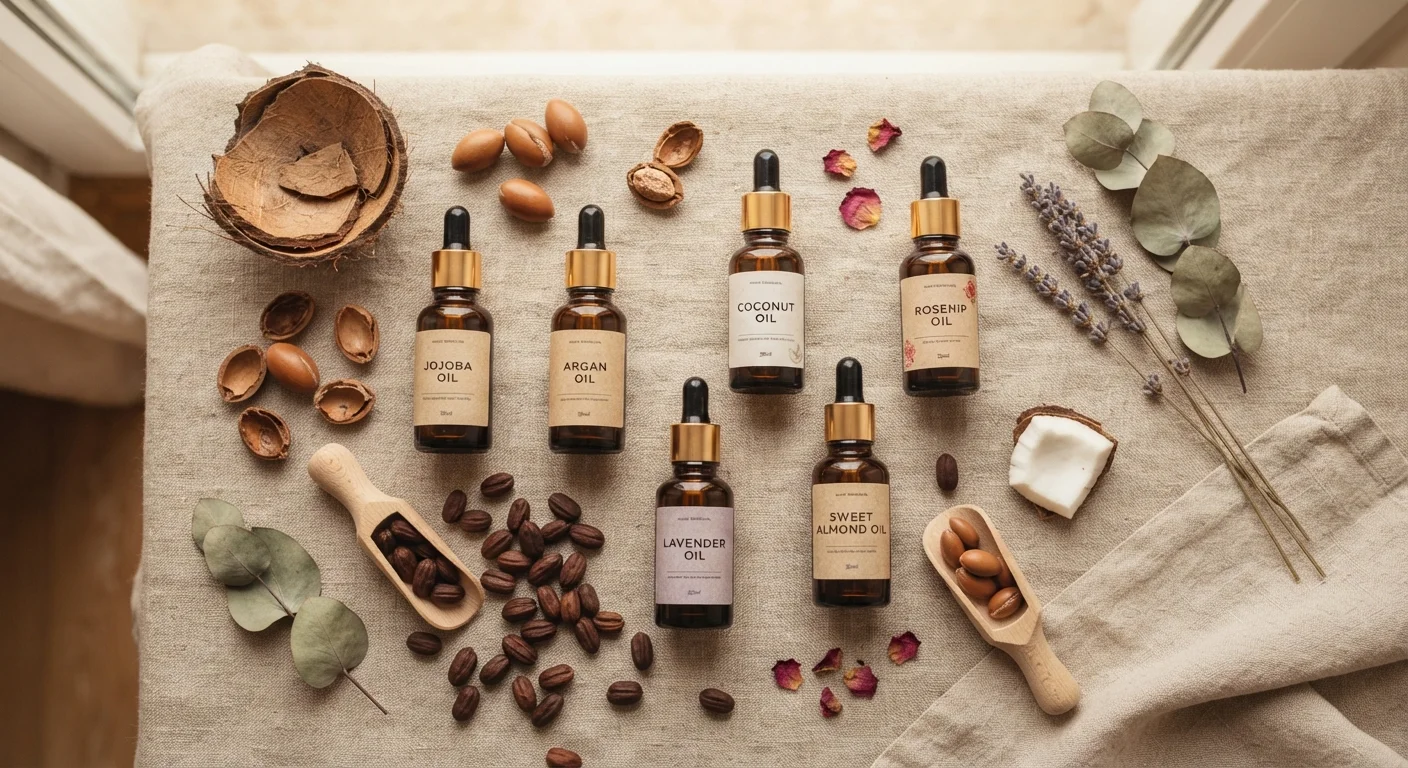
Coconut oil is one of the few oils shown in published research to measurably reduce protein loss in hair — both before and after washing. Its primary component, lauric acid, has a small molecular structure that allows it to penetrate below the cuticle. This makes it particularly useful for hair that is prone to hygral fatigue (repeated swelling from water absorption). However, for very high-porosity or protein-sensitive hair, the protein-binding effect can feel stiffening rather than softening.
Argan Oil
Argan oil is high in oleic and linoleic acids and vitamin E, giving it a lightweight texture and notable antioxidant properties. It functions primarily as a sealing and smoothing agent rather than a deep penetrant, making it well suited for taming frizz, adding shine, and protecting against environmental stress and heat. It works across a wide range of hair types without heavy residue.
Jojoba Oil
Jojoba is technically a liquid wax ester, not an oil — its structure closely resembles the scalp's naturally produced sebum. This makes it one of the most scalp-compatible options available: it can help balance scalp oiliness without stripping or over-moisturizing. On the hair shaft, it sits more on the surface but does so without clogging or feeling heavy, making it a good choice for fine hair that needs light conditioning.
Castor Oil
Castor oil is exceptionally thick, high in ricinoleic acid, and primarily functions as a coating agent. It is often used on the scalp with the aim of supporting a healthy scalp environment. Due to its viscosity, it is typically blended with a lighter carrier oil before application — used alone, it can be difficult to distribute evenly and may contribute to buildup if not washed out thoroughly.
Sweet Almond and Grapeseed Oil
Both are lightweight, high in linoleic acid, and primarily sealants. Sweet almond oil has a slightly richer texture and suits medium-to-coarse hair looking for shine without heaviness. Grapeseed oil is among the lightest available and is a common choice for fine or low-porosity hair that needs a finishing touch without weighing strands down.
Oil Application Timing Affects Results
Oils generally work best on damp hair rather than fully dry strands — water molecules are already present for the oil to seal in. Applying oil to bone-dry hair without prior hydration mostly coats the surface without addressing internal moisture needs. For scalp applications, clean skin free of product buildup allows for better absorption and avoids congestion.
Matching Oil to Hair Need
No single oil does everything. A practical approach is to identify your primary hair concern — moisture retention, frizz, scalp health, or shine — and match accordingly. If moisture retention is the goal, focus on penetrating oils like coconut applied before washing (a technique sometimes called pre-pooing). If frizz control is the priority, lightweight sealants like argan or grapeseed applied to damp hair post-wash tend to perform better.
If you're building a hair care routine from the ground up, oils are typically a supportive step — applied after cleansing and conditioning — rather than a replacement for either. How often you introduce them also depends on how frequently you wash: see how wash frequency varies by hair type for context on timing. And if you use a sulfate-based shampoo, it will remove most oils efficiently; sulfate-free formulas may require a second wash to clear heavy oils like castor fully.
This article is for general informational purposes only. Individual hair and scalp conditions vary; consult a licensed dermatologist or trichologist if you have persistent scalp concerns.