

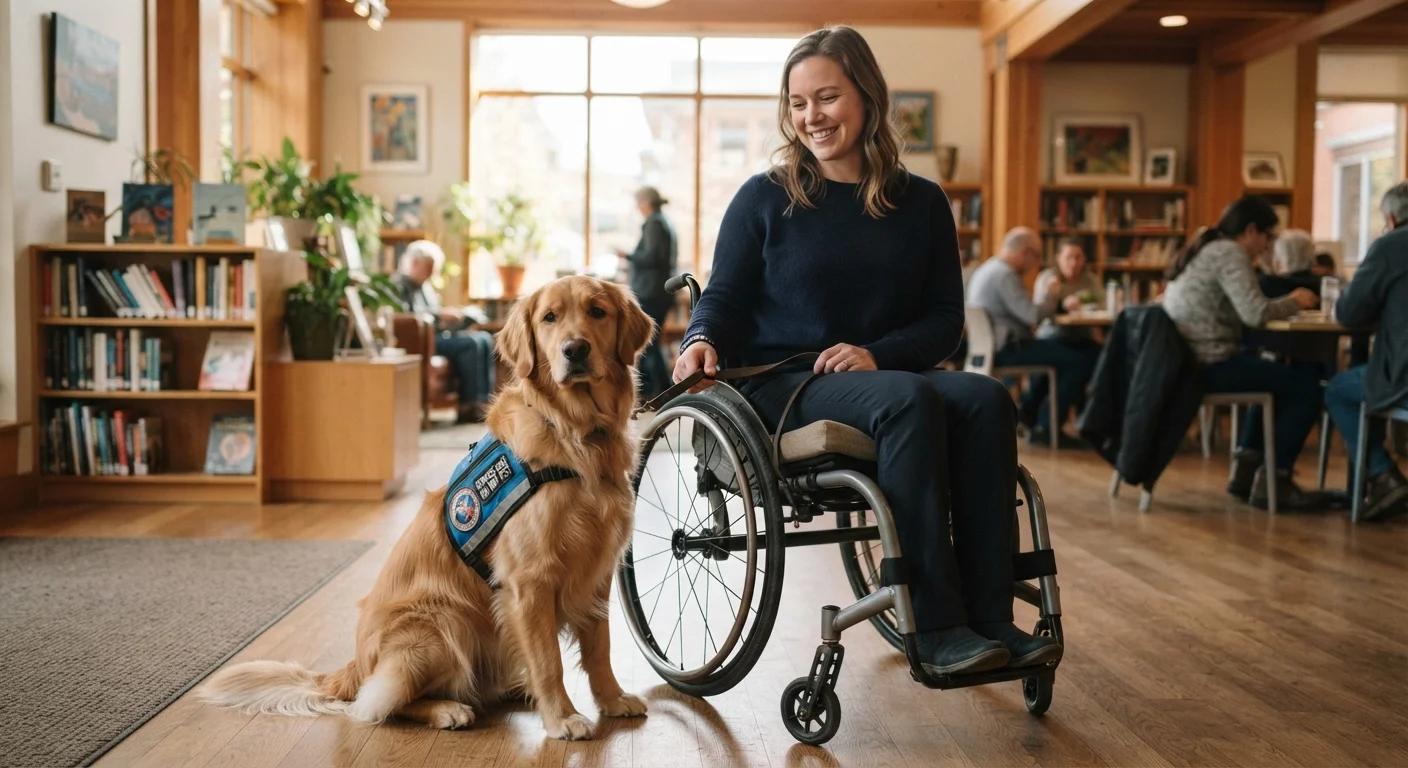
Key Takeaways
Option A
Service Animals
Legally protected working animals trained to perform specific disability-related tasks.
Best for: Individuals with physical, sensory, psychiatric, or neurological disabilities who require a trained animal to perform specific tasks that mitigate their disability.
Option B
Emotional Support Animals (ESAs)
Companion animals prescribed to provide therapeutic comfort for mental health conditions.
Best for: Individuals with diagnosed mental health conditions who benefit from an animal's presence for emotional comfort, as documented by a licensed mental health professional.
If you need an animal to perform specific physical or psychiatric tasks in daily life
Service Animals
Only service animals carry ADA-backed public access rights. A trained service dog can accompany its handler into restaurants, stores, and public transportation where pets are otherwise prohibited.
If a mental health professional has determined that an animal's companionship supports your treatment
Emotional Support Animals (ESAs)
An ESA designation, backed by proper documentation, may still provide housing accommodations under the Fair Housing Act, allowing you to keep your animal in otherwise pet-restricted housing.
If you're a landlord or housing provider navigating accommodation requests
Service Animals
Service animal requests require minimal verification under the ADA; ESA requests require documented need from a healthcare provider. Consulting a legal professional on your specific obligations is strongly advised.
How U.S. Law Defines Each Designation
The terms service animal and emotional support animal (ESA) are often used interchangeably in public conversation, but U.S. law treats them as distinct categories with meaningfully different protections.
Under the ADA, a service animal is defined as a dog — or in limited cases, a miniature horse — that has been individually trained to perform tasks directly related to a person's disability. Examples include guiding someone who is blind, alerting a deaf person to sounds, detecting the onset of a seizure, or interrupting a self-harming behavior in someone with a psychiatric condition. The key requirement is that the animal performs a specific, trainable task — not simply providing comfort.
Emotional support animals, by contrast, provide therapeutic benefit through their presence and companionship. They are not required to perform any specific trained task. The designation is established through documentation from a licensed mental health or medical professional who determines that the animal is part of a treatment plan for a diagnosed condition.
| Criterion | Service Animals | Emotional Support Animals |
|---|---|---|
| Legal framework | Americans with Disabilities Act (ADA) | Fair Housing Act (FHA); limited air travel rules |
| Task requirement | Must perform specific trained tasks | No task training required |
| Species permitted | Dogs (miniature horses in limited cases) | Any domestic animal (subject to housing rules) |
| Public access rights | Broad ADA-protected access | No public access protections |
| Housing protections | FHA reasonable accommodation | FHA reasonable accommodation (with documentation) |
| Air travel | Psychiatric service dogs protected; others may vary | Treated as pets by most U.S. airlines |
| Documentation needed | None federally required | Letter from licensed mental health or medical professional |
| Certification/registration | No official federal registry | No official federal registry |
For a broader view of how animal-related designations intersect with local and state law, see Pet Ownership Laws Every American Should Know.
Public Access, Housing, and Air Travel Rights
The practical difference between these two designations becomes most evident in three contexts: public spaces, housing, and air travel.
Public Access
The ADA grants service animals the right to accompany their handlers in virtually all public spaces — restaurants, retail stores, hospitals, hotels, and government buildings. Businesses may only ask two questions: whether the animal is required due to a disability, and what task the animal has been trained to perform. ESAs carry no equivalent public access rights under the ADA. They may be excluded from public spaces where pets are not permitted.
Housing
The FHA requires housing providers to make reasonable accommodations for both service animals and ESAs, provided the resident has a documented disability-related need. However, the U.S. Department of Housing and Urban Development issued updated guidance clarifying that housing providers may request reliable documentation for ESA requests and may deny requests that are not substantiated. Neither an online certificate nor a registration ID constitutes sufficient documentation on its own.
Air Travel
The Department of Transportation revised its rules under the Air Carrier Access Act, and as of recent policy changes, airlines are no longer required to accommodate ESAs as service animals. Most major U.S. carriers now treat ESAs as standard pets, subject to applicable fees and restrictions. Psychiatric service dogs — animals trained to perform specific tasks for psychiatric disabilities — retain protected status under these rules.
State Laws May Add Protections or Penalties
Several states have enacted laws that expand protections beyond the federal baseline — for example, extending ESA housing rights more broadly — while others have introduced penalties for fraudulent ESA or service animal misrepresentation. Because rules vary significantly by jurisdiction, it's worth reviewing the laws in your state before making decisions based on federal standards alone.
This article is for general informational purposes only and does not constitute legal advice. Laws and regulations are subject to change; consult a qualified attorney or disability rights organization for guidance specific to your situation.
Getting a Legitimate Designation
For a service animal, there is no official federal certification or registration process. The ADA does not require service animals to be certified, registered, or wear identifying vests. Training standards matter — the animal must reliably perform its tasks — but the training may be completed by the handler or a professional trainer.
For an ESA, legitimacy rests on a genuine therapeutic relationship with a licensed professional. A psychologist, psychiatrist, licensed clinical social worker, or other qualified clinician must determine that an emotional support animal meaningfully supports your mental health treatment. The proliferation of online services offering instant ESA letters in exchange for a fee — with no real clinical assessment — has prompted increased scrutiny from housing providers and airlines alike, and some states have enacted laws targeting fraudulent documentation.
~500,000
Estimated service dogs working in the U.S.
Assistance Dogs International estimates approximately half a million service dogs are working in the United States at any given time.
17%
U.S. adults with a mental health condition
According to the National Institute of Mental Health, roughly 1 in 5 U.S. adults experiences a mental illness in a given year, reflecting the broad population that may seek ESA support.
Misrepresenting a pet as a service animal or ESA to gain access or housing accommodations is not only ethically problematic — it can undermine the credibility of people with genuine needs and, in several states, carries legal penalties. Responsible ownership means understanding and respecting the legal frameworks that exist to protect people with disabilities.