

Key Takeaways
Good Intentions Aren't Enough
Most pet owners who struggle with training aren't doing anything malicious — they're doing things that feel natural, loving, or logical to a human but that work against how animals actually learn. The gap between intent and impact is where training quietly breaks down.
Understanding the behavioral mechanics behind common missteps can help owners course-correct without guilt. Whether you're working with a new puppy or an adult dog who keeps reverting to old habits, these patterns are worth examining honestly. For those just getting started, our guide to new pet ownership fundamentals covers the broader foundation owners need before diving deep into training.
Inconsistent Rules Across the Household
If one family member allows the dog on the couch while another enforces an off-limits rule, the pet isn't being stubborn — it's responding logically to two different rule sets. Animals learn from patterns, and conflicting signals from different people create genuine confusion rather than selective disobedience.
Before training begins in earnest, every person in the household should agree on the core rules: which areas are off-limits, which behaviors earn rewards, and which cues will be used. Revisit responsible ownership principles for guidance on aligning household expectations long-term.
Conflicting household rules teach pets that rules are negotiable — consistency is non-negotiable.
Rewarding Too Late
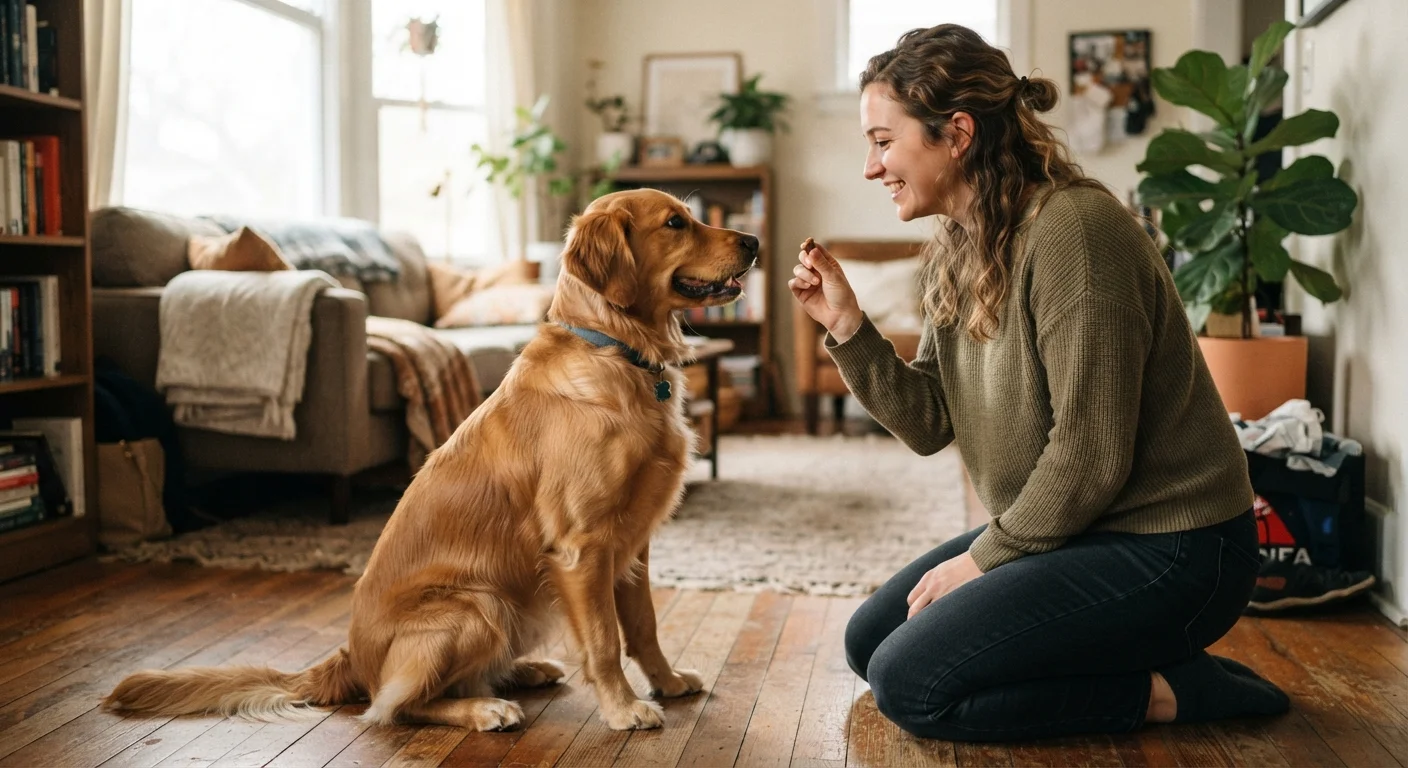
Timing is arguably the most technically demanding aspect of training. Research in animal learning consistently shows that a reward needs to follow the desired behavior within roughly one to two seconds to be meaningfully associated with it. A treat delivered five seconds after a dog sits — during which it may have stood back up and sniffed the floor — reinforces whatever it was doing at the moment of reward, not the original command.
This is why many trainers advocate using a marker, such as a clicker or a sharp verbal cue like "yes," to bridge the gap between behavior and reward. The marker signals instantly; the treat can follow.
A reward delivered seconds too late teaches the wrong behavior with the same enthusiasm as the right one.
Repeating Commands Multiple Times
Saying "sit, sit, sit, SIT" before a dog complies doesn't reinforce persistence — it teaches the dog that the first three repetitions don't count. Over time, the pet learns to wait for the louder, more urgent version rather than responding to the initial calm cue.
A more effective approach is to say the cue once, wait several seconds for a response, and if none comes, either prompt the behavior physically (such as gently guiding the dog into a sit) or reset and try again in a calmer environment. One cue, one opportunity, one response expectation.
Repeating commands trains pets to tune out the first cue — give it once and mean it.
Training Only in Low-Distraction Environments
A dog that sits perfectly in the living room but falls apart at the park hasn't learned "sit" — it's learned "sit when there's nothing more interesting happening." Generalizing a behavior to different environments and distraction levels is a separate skill that must be explicitly practiced.
Owners should gradually introduce new settings — the front yard, then the sidewalk, then a quiet park corner — while temporarily lowering their expectations and increasing reward value to match the increased difficulty. Leash behavior is a common place this breaks down; understanding why dogs pull and what's behind the behavior can help owners approach public training more effectively.
A command mastered at home hasn't been mastered — generalization across environments must be trained deliberately.
Using the Crate as Punishment
Owners who send a pet to its crate specifically after misbehavior — especially with visible frustration — risk turning a potentially calming space into something the pet associates with conflict and isolation. A crate should function as a neutral or positive environment, not a consequence.
When crates carry negative associations, dogs may resist entering voluntarily, bark or whine while confined, and develop broader anxiety around confinement. Building a positive crate relationship takes patience and consistency from day one. Our crate training guide covers how to introduce and use the crate humanely and effectively.
Using the crate as punishment undermines its value as a safe, calming space for your pet.
Training While Frustrated or Rushed
Pets are highly attuned to human emotional states. An owner who is tense, rushed, or frustrated will often produce a pet that is anxious, distracted, or shut down — not because the animal is being difficult, but because it is responding to the emotional climate of the interaction.
Short, upbeat sessions — typically five to ten minutes for dogs — produce better outcomes than long, exhausting drills. If frustration is rising, ending the session on any small success and returning later is a more productive move than pushing through. Owners struggling with the overall adjustment of pet ownership may find relevant perspective in our article on why new pet owners feel overwhelmed.
Pets mirror their owner's emotional state — train calm, get calm.
Small Adjustments, Meaningful Results
None of the habits listed above are impossible to break — and identifying them is genuinely half the battle. Consistent, clear communication is the cornerstone of every training approach that works, whether you're relying on rewards, structured correction, or a hybrid method. Our comparison of training philosophies can help you find the right fit for your pet's temperament and your own style.
It's also worth noting that sudden or unexplained behavior changes aren't always a training problem. Behavioral shifts can sometimes signal underlying medical issues, so it's wise to rule out health factors before doubling down on training adjustments.
Keep Training Sessions Short and Frequent
Research in animal cognition suggests that shorter, more frequent training sessions tend to produce better retention than occasional long drills. Aim for five-to-ten-minute sessions several times a day rather than a single thirty-minute block. Ending each session while the pet is still engaged — before boredom or fatigue sets in — helps keep the experience positive and reinforces a willingness to return to training.
This article is for general informational and educational purposes. For guidance tailored to your specific pet, consult a certified professional trainer or your veterinarian.