

Key Takeaways
Why Enrichment Is Non-Negotiable for Indoor Cats
Domestic cats retain the behavioral and physiological drives of their wild ancestors — the need to stalk, hunt, climb, scratch, and survey their territory. An indoor-only lifestyle, while associated with longer lifespans and reduced injury risk, removes the environmental complexity that meets those drives naturally.
Without adequate outlets, cats commonly develop what veterinary behaviorists call redirected behavior: excessive vocalization, destructive scratching, aggression toward housemates, or compulsive grooming. These aren't personality flaws — they're signals that fundamental needs are unmet.
Enrichment is the deliberate design of a cat's environment and daily routine to satisfy those needs. It encompasses physical activity, sensory stimulation, feeding behavior, social interaction, and control over personal space. Done consistently, it supports not just behavior but immune function, healthy weight maintenance, and the human-animal bond itself.
~74M
Pet cats in the U.S.
According to the American Pet Products Association's National Pet Owners Survey, tens of millions of U.S. households include at least one cat.
Up to 30%
Indoor cats showing boredom-related behavior issues
Veterinary behaviorists estimate that a significant proportion of indoor cats exhibit stress or boredom-linked behaviors such as excessive vocalization or over-grooming.
10–15 min
Recommended interactive play per session
The American Association of Feline Practitioners recommends multiple short interactive play sessions daily rather than one long session.
Vertical Space and Territory Design
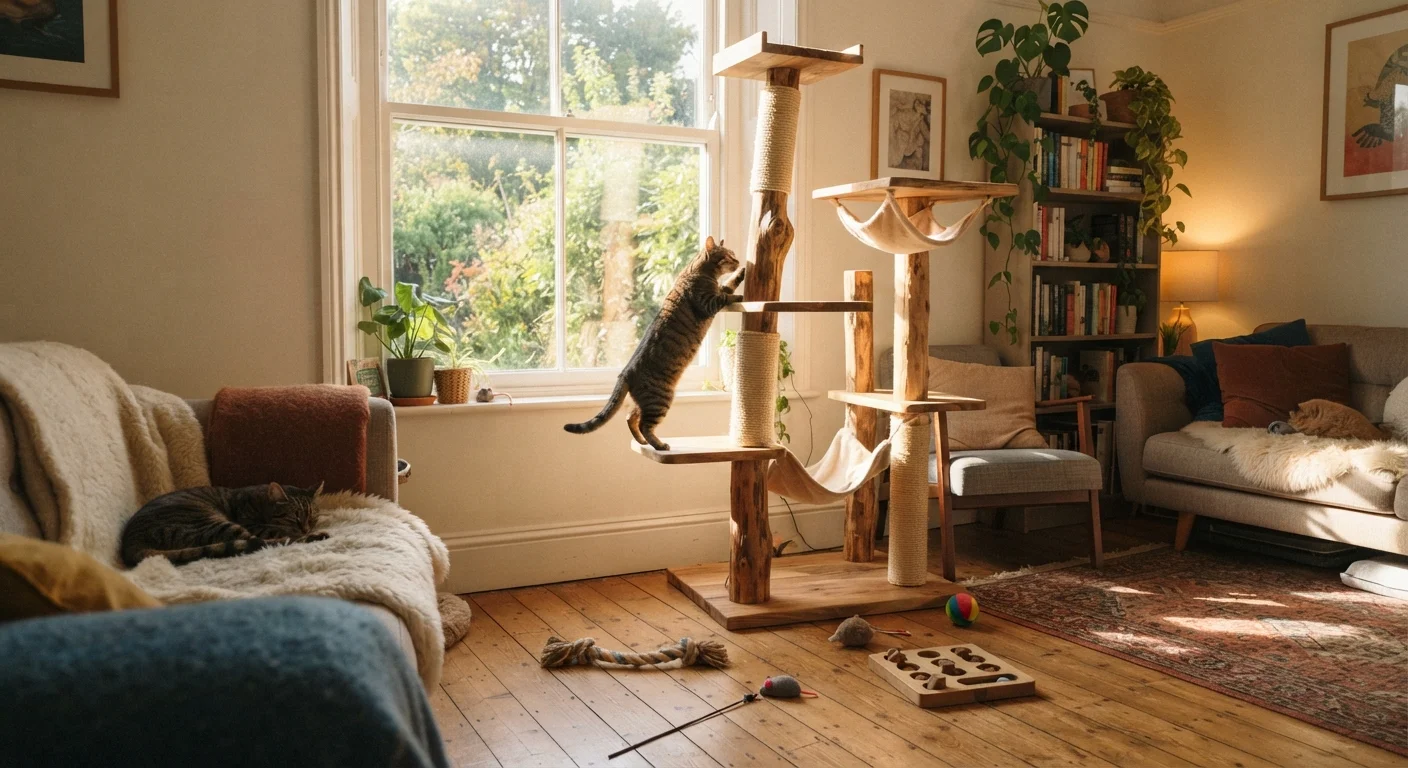
Cats are verticality-seeking animals. Height provides security, hunting vantage points, and a way to assert social position in multi-cat homes. A flat, ground-level environment is cognitively impoverished for most cats regardless of square footage.
Key vertical elements to incorporate
- Cat trees and wall-mounted shelving: Provide multiple platforms at varying heights. Ensure stability — wobbly structures erode a cat's confidence in the setup.
- Window perches: Access to window views functions as passive enrichment, offering visual and auditory stimulation throughout the day. Bird feeders placed outside a preferred window significantly increase engagement.
- Hiding spots at multiple levels: Covered beds, boxes, and enclosed perches give cats a sense of control. This is particularly important for anxious cats or homes with multiple pets.
- Scratching surfaces: Both vertical (posts) and horizontal (pads or mats) scratching surfaces are needed — individual cats have strong preferences. Scratching is territorial communication and claw maintenance, not misbehavior.
For new owners setting up a cat-friendly space for the first time, our first-time owner's health checklist covers additional environmental setup fundamentals during those early weeks.
Start Simple, Then Layer Complexity
You don't need to overhaul your home all at once. Begin with one cat tree, a wand toy for daily play, and a single puzzle feeder. Observe what your cat gravitates toward and expand from there. A gradual, observation-driven approach prevents wasted spending and respects your cat's individual temperament.
Sensory and Hunting-Based Play
Interactive play is the single highest-impact enrichment activity most owners can provide. It replicates the predatory sequence — stalk, chase, pounce, catch — and delivers both physical exercise and psychological satisfaction.
Effective play principles
- Wand toys that mimic prey movement are more engaging than toys the cat bats alone. Move them erratically, pause, retreat — simulate how real prey behaves rather than waving in predictable circles.
- Multiple short sessions (10–15 minutes, two to three times daily) outperform one long session in sustaining interest and avoiding overstimulation.
- Rotate toys on a cycle to prevent habituation. Items removed from circulation for a week often elicit renewed curiosity when reintroduced.
Introduce new enrichment items one at a time and observe your cat's response before adding more — novelty overload can cause anxiety rather than curiosity.
Cats are neophilic but also neophobic; incremental exposure allows them to investigate at their own pace and builds positive associations with environmental change.
Rotate your cat's toy selection every few days by storing some out of reach — reintroduced 'old' toys are often treated with fresh excitement.
Habituation reduces a cat's interest in familiar objects quickly; rotation simulates the unpredictability of natural prey encounters.
End interactive play sessions with a small treat or kibble portion to complete the hunt-catch-eat cycle and reduce post-play frustration.
Feline behavioral research supports the sequence of stalk, pounce, catch, and eat as psychologically satisfying; stopping at pounce leaves the cycle incomplete.
Solo enrichment toys
Battery-operated moving toys, crinkle balls, and tunnels extend stimulation between interactive sessions. These should supplement — not replace — owner-led play, which uniquely reinforces the social bond between cat and owner.
Catnip and silver vine (an alternative for cats who don't respond to catnip) can intensify play engagement when used in moderation. Not all cats respond to catnip — sensitivity is genetic and approximately 30–50% of cats show no reaction.
Not All Enrichment Is Risk-Free
Some common enrichment items carry hidden hazards. Strings, ribbons, and feather attachments should only be used during supervised play — unsupervised access risks ingestion and intestinal obstruction. Similarly, certain plants marketed as cat-safe (such as some varieties sold near catnip displays) may actually be toxic. Always verify plant safety with your veterinarian before adding greenery to your cat's environment.
Food Enrichment and Puzzle Feeders
In the wild, cats spend a significant portion of their day in food-seeking behavior. Free-feeding from a static bowl condenses that effort into seconds, leaving hours of behavioral capacity unfulfilled. Food enrichment restores the cognitive and physical engagement that foraging provides.
Practical food enrichment approaches
- Puzzle feeders
- Devices that require cats to manipulate levers, balls, or compartments to release kibble. Start with low-difficulty designs and increase complexity gradually — frustration without progress discourages participation.
- Scatter feeding
- Distributing dry food across a textured mat, snuffle mat, or even a clean patch of carpet engages a cat's nose and slows eating. Useful for cats prone to rapid ingestion and vomiting.
- Divided meals across locations
- Placing food portions in different spots around the home requires light physical activity and mimics the patchy distribution of real prey.
- Food-stuffed toys
- Rubber or hollow toys filled with wet food or treats that require licking and manipulation to access. Freezing wet food in these toys extends engagement significantly.
Food enrichment is not appropriate as a weight-loss strategy in isolation; total caloric intake must be managed separately. Consult your veterinarian before making significant changes to your cat's feeding routine, particularly for cats with metabolic or dental conditions.
Social and Environmental Variety
Enrichment isn't purely about objects and structures — relationship quality and environmental novelty matter equally. Cats are often mischaracterized as solitary animals, but most form genuine social bonds with their owners and benefit from consistent, positive human interaction.
“Environmental enrichment is one of the most powerful tools we have for improving the welfare of indoor cats. A stimulating environment doesn't just prevent boredom — it actively supports physical health and reduces stress-related disease.”
— American Association of Feline Practitioners, Veterinary organization publishing feline welfare and care guidelines
Social enrichment strategies
- Predictable daily routines reduce baseline anxiety and make cats more receptive to stimulation. Feeding, play, and grooming at consistent times builds behavioral security.
- Positive training: Cats can learn a range of behaviors through positive reinforcement (reward-based) methods. Short training sessions — teaching sit, target touching, or recall — provide cognitive challenge and strengthen the human-cat bond.
- Safe outdoor access: For owners considering expanded outdoor exposure, a secured catio (enclosed outdoor enclosure) or leash-and-harness walks offer environmental complexity without free-roaming risks.
Environmental novelty
Periodically rearranging furniture, introducing new scents (dried herbs, natural wood items), or adding a cardboard box can reset a cat's environmental curiosity. Even small changes provide novel investigative opportunities that indoor environments otherwise lack.
Owners interested in a broader foundation for responsible, relationship-centered cat ownership will find our comprehensive first-time owner's guide a useful companion resource.
Enrichment Needs Change With Age
Kittens and young adult cats typically have higher activity drives and benefit from high-intensity play and climbing opportunities. Senior cats may prefer gentler stimulation — lower platforms, scent-based enrichment, and shorter play sessions. Work with your veterinarian to adapt enrichment strategies as your cat ages, particularly if mobility or sensory changes emerge.
Recognizing When Enrichment Is Working
Effective enrichment produces observable, measurable changes in a cat's daily behavior. Owners who track these signs can adjust strategies with confidence rather than guessing.
Positive indicators
- Spontaneous play behavior (pouncing, chasing, carrying toys) without prompting
- Relaxed body posture and regular, undisturbed sleep cycles
- Healthy appetite and stable weight
- Engagement with environmental features — using cat trees, scratching posts, and puzzle feeders regularly
- Calm interaction with household members, including other pets
Signs enrichment needs adjustment
- Persistent destructive scratching of furniture despite adequate scratching surfaces
- Excessive vocalization, particularly at night
- Over-grooming leading to thinning fur or skin irritation
- Withdrawal, hiding beyond usual resting preferences, or dramatic changes in social behavior
- Redirected aggression during or after play sessions
Behavioral Changes Warrant a Vet Visit
Sudden shifts in behavior — including increased aggression, hiding, excessive grooming leading to hair loss, or dramatic appetite changes — are not always enrichment problems. These can signal underlying medical conditions. Always rule out health causes with a veterinarian before attributing behavior changes solely to environmental factors.
Enrichment is an ongoing practice, not a one-time setup. The most successful owners treat it as iterative — observing their cat's responses, removing what isn't used, and introducing new challenges as their cat's needs and capabilities evolve. For a broader framework of foundational pet health practices, including veterinary care and nutrition, explore our dedicated guide for new owners.
AAFP Feline Environmental Needs Guidelines
The American Association of Feline Practitioners publishes evidence-based guidelines on indoor cat environmental needs, covering space, resources, and social interaction — a foundational reference for owners.
Indoor Pet Initiative (Ohio State University CVM)
A research-backed resource from Ohio State University's College of Veterinary Medicine offering practical enrichment assessments and printable checklists for indoor cat households.
ASPCA Animal Poison Control Center
An essential safety reference for verifying whether plants, materials, or foods used in enrichment setups are toxic to cats before introducing them to your home.