

Key Takeaways
Our Verdict
Group classes and private training each serve distinct purposes, and neither is universally the right answer. Group settings offer socialization, affordability, and a realistic distraction environment, while private sessions deliver customized, focused guidance for complex or sensitive behavioral needs. Most dogs benefit from a thoughtful combination of both over time.
| Best for | Recommended |
|---|---|
| Dogs with no significant behavioral issues looking to learn basic obedience | Group Classes |
| Dogs with reactivity, fear, aggression, or complex behavioral challenges | One-on-One Training |
| Owners on a tighter budget seeking foundational skills | Group Classes |
| Owners needing personalized coaching on technique and handling skills | One-on-One Training |
Why the Format You Choose Actually Matters
Dog training isn't one-size-fits-all. A high-energy puppy who just needs basic manners has very different needs than a rescue with a history of fear-based reactivity. Choosing between group classes and private, one-on-one sessions isn't simply a matter of convenience or cost — it directly affects how effectively your dog learns and how confident you become as a handler.
Understanding how each format is structured, and what kinds of dogs and goals each serves best, helps you invest your time and energy in the right place from the start. For a deeper look at the principles that underpin modern training methods, see how positive reinforcement works neurologically in dogs.
| Group Classes | One-on-One Training | |
|---|---|---|
| Cost | Generally lower per session | Higher per session |
| Distraction environment | Built-in, realistic | Controlled by trainer |
| Socialization opportunity | High — multiple dogs present | Low — limited exposure |
| Customization | Limited — follows set curriculum | High — tailored to your dog |
| Best for reactivity/fear | Not ideal — may overwhelm | Strongly recommended |
| Owner skill development | General guidance shared with group | Direct, personalized coaching |
| Scheduling flexibility | Fixed class schedule | More flexible, session-by-session |
What Group Classes Offer
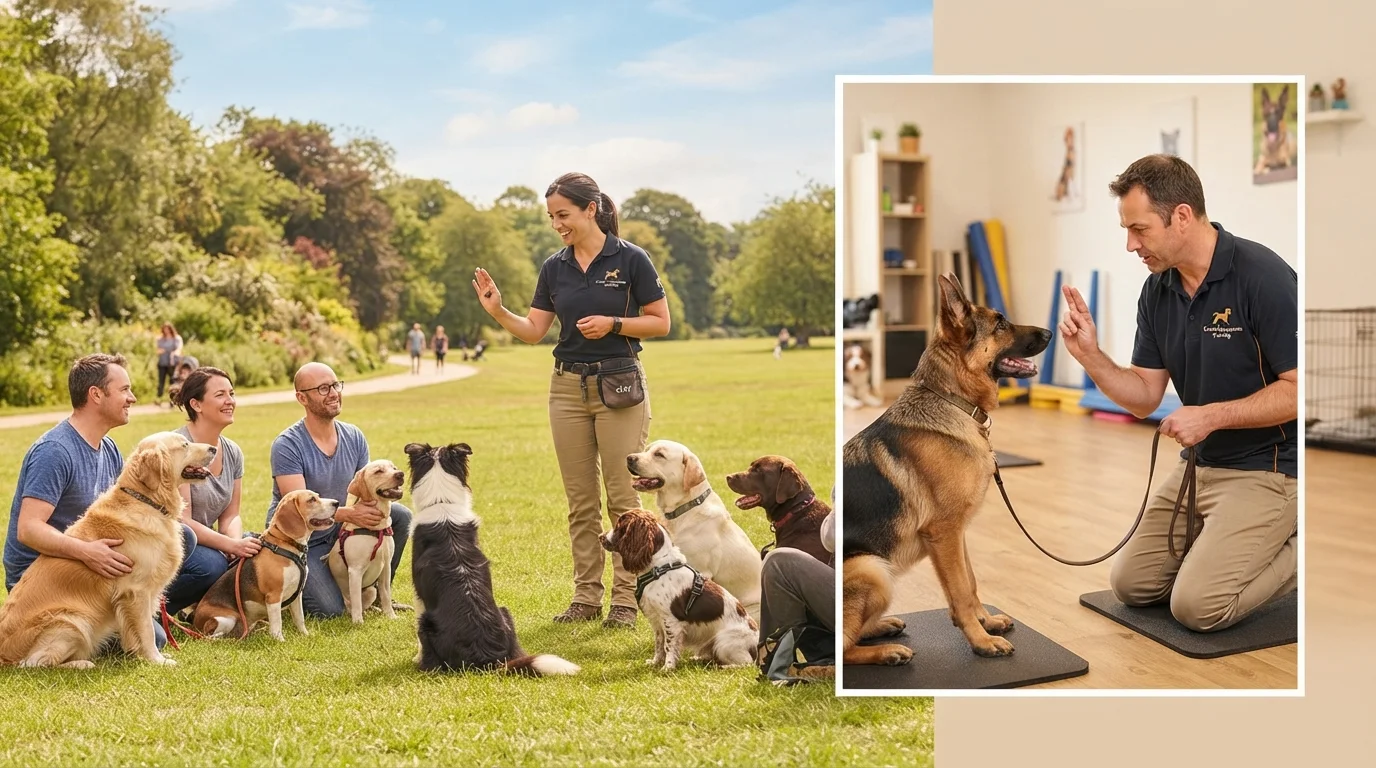
Group classes typically bring together several dog-owner pairs under the guidance of one or two trainers. Sessions are often structured around a curriculum — covering foundational cues like sit, stay, leash manners, and recall — and progress week by week.
One of the most underappreciated benefits of group training is the built-in distraction environment. Dogs that can perform a reliable sit at home often struggle to focus when other dogs are nearby. Practicing in a room full of distractions is genuine preparation for the real world. Group settings also offer natural socialization opportunities, which matter especially for puppies during their developmental window.
From a practical standpoint, group classes are generally more accessible in terms of scheduling and cost. They work well for:
- Puppies and adolescent dogs learning foundational skills
- Dogs with no significant behavioral concerns
- Owners who benefit from community support and observing others
- Dogs that need structured exposure to other animals and people
Ask to Observe Before You Enroll
Most reputable group class instructors welcome prospective students to sit in on a session before committing. This lets you evaluate the trainer's methods, the class size, how dogs are managed, and whether the pace feels right for your dog. A class where dogs are frequently overwhelmed or instructors use forceful handling is a red flag worth heeding.
When One-on-One Training Makes More Sense
Private training places a professional's full attention on your dog and on you. Sessions can be held at home, in public, or at a training facility — wherever the relevant behavior actually occurs. This flexibility is significant: a trainer who can observe your dog's leash reactivity on your actual walking route offers far more targeted guidance than a classroom setting ever could.
For dogs dealing with fear, aggression, separation anxiety, or intense reactivity toward other dogs or people, a group environment can be overwhelming or even counterproductive. Flooding a reactive dog with proximity to other dogs before they have the coping skills to manage that stress doesn't build confidence — it can reinforce anxiety. Private sessions allow a trainer to set the dog up for success incrementally.
One-on-one training also benefits owners significantly. Handling technique matters enormously in dog training, and personalized coaching on leash mechanics, timing of rewards, and reading your dog's body language is difficult to deliver in a group setting. This connects well with the broader idea of building structure into daily life — consistent handling habits matter just as much as formal training sessions. Establishing a predictable daily routine reinforces what your dog learns in any training format.
Don't Place Reactive Dogs in Group Settings Too Soon
Enrolling a dog with significant reactivity or fear in a group class before they have basic coping skills can worsen the behavior over time. Exposure without the ability to cope is not desensitization — it's stress. Work with a qualified professional privately first, and only transition to group environments once a trainer confirms your dog is ready.
How to Choose — and When to Combine Both
Start by honestly assessing your dog's current behavioral baseline. Is your dog generally social and curious, or does it show signs of fear or reactivity around people, dogs, or novel environments? Have you worked with a trainer before, or is this your first time? These answers matter more than price or convenience.
If your dog is well-socialized and you're working on foundational obedience, group classes are a strong starting point. If your dog has specific issues that need individualized attention, begin with private sessions and consider transitioning to group work once those foundations are established.
Many experienced trainers recommend a hybrid approach: use one-on-one sessions to address specific behavioral challenges and build your handling skills, then graduate to group classes for generalization and socialization. This mirrors how trainers think about building any complex skill — understanding how different training philosophies compare can also help you evaluate a trainer's methods before committing.
Whichever format you choose, consistency between sessions is what drives lasting results. What happens during the other 23 hours of the day matters as much as the hour spent in class.
This article is for general informational purposes only and does not constitute professional veterinary behavioral advice. If your dog shows signs of aggression or severe anxiety, consult a licensed veterinary behaviorist or certified applied animal behaviorist for individualized guidance.