

Key Takeaways
Compound Interest
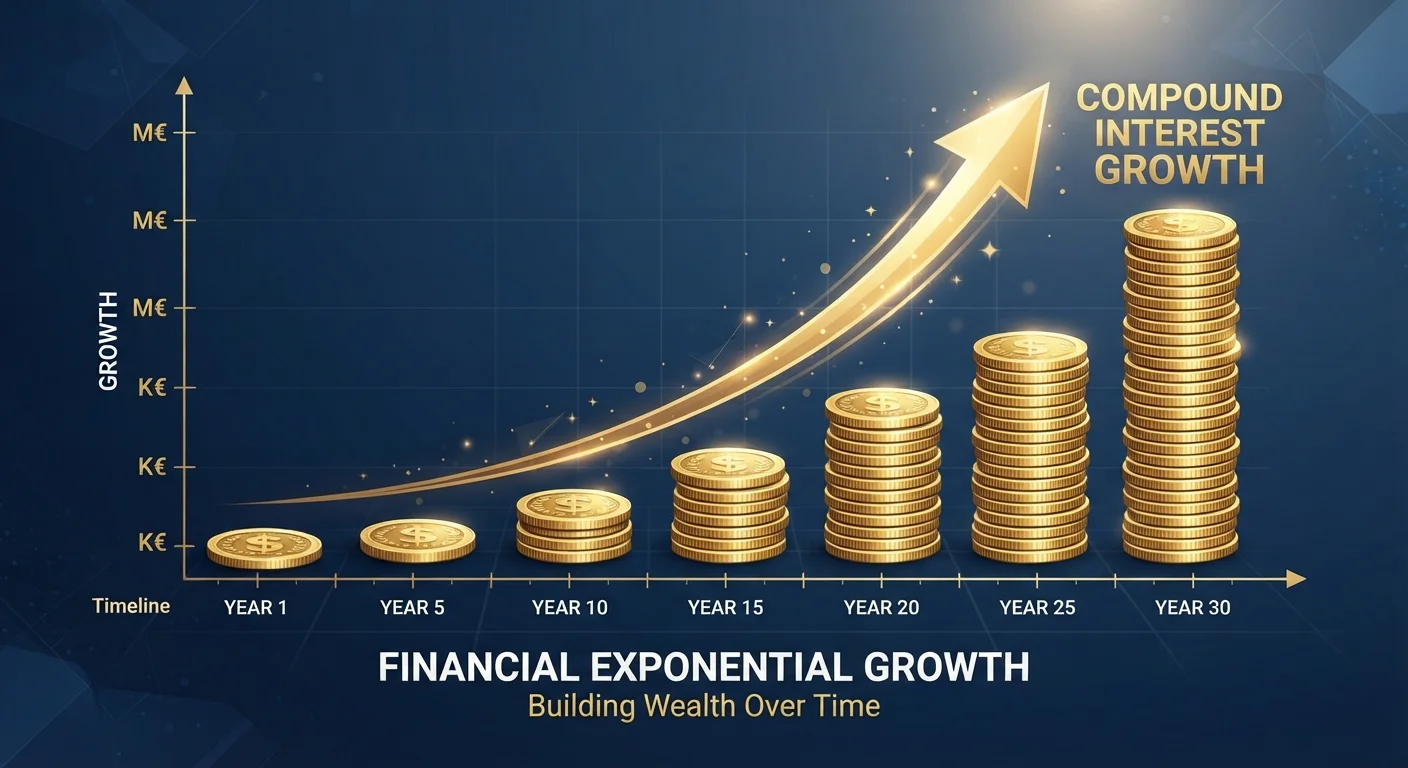
Compound interest is the process of earning returns not just on your original principal, but also on all the interest or gains you've already accumulated. In other words, your money earns money — and then that earned money earns even more money. Over long periods, this cycle of reinvestment creates growth that accelerates over time rather than growing in a straight line.
Compounding frequency matters: interest can compound daily, monthly, quarterly, or annually. More frequent compounding results in slightly higher effective annual returns, captured in the formula A = P(1 + r/n)^(nt), where n represents compounding periods per year.
How Compounding Actually Works
Most people understand that saving money earns interest. What's less intuitive is that compounding means your interest itself starts earning interest — and that distinction changes everything about long-term wealth building.
Consider a simple illustration. If you invest $10,000 at a 7% annual return and never add another dollar, after one year you have $10,700. In year two, you earn 7% on $10,700 — not the original $10,000 — giving you $11,449. By year 20, that single $10,000 has grown to approximately $38,700 without a single additional contribution. The growth didn't come from magic; it came from reinvested returns stacking on top of each other, year after year.
This is why compounding is often described as exponential rather than linear. The longer the timeline, the steeper the curve becomes. It's a concept covered in depth in core investing fundamentals that every new investor should grasp early.
$38,700+
Growth of $10,000 at 7% over 20 years
Illustrates compounding without additional contributions; actual results depend on realized returns, which are not guaranteed.
72
The Rule of 72 — years to double at 1% return
The Rule of 72 estimates years to double an investment by dividing 72 by the annual rate of return (e.g., 72 ÷ 7 ≈ 10.3 years at 7%).
10+ years
Head start that can outweigh larger later contributions
Financial research consistently shows earlier investors may accumulate more wealth than later investors with larger contributions, given equal rates of return.
Why Time Is the Critical Variable
Of all the inputs in the compounding equation — rate of return, contribution size, compounding frequency — time is the one that most dramatically shifts outcomes. This is counterintuitive because most people think the amount they invest matters most.
Consider two hypothetical investors. The first invests $5,000 per year for 10 years starting at age 25, then stops entirely, allowing the balance to compound until age 65. The second waits until age 35 and invests $5,000 per year for 30 consecutive years. Assuming an identical 7% annual return, the investor who started earlier and contributed less total money often ends up with a larger balance — simply because their money had more time to compound. These outcomes vary based on actual returns, but the principle is well-supported by financial research.
This dynamic is why financial educators consistently encourage people to start investing as early as possible, even in small amounts. Understanding what it means to invest your money is the natural first step before putting compounding to work.
Start Small, But Start Now
If you're waiting until you can invest a significant amount, reconsider. Contributing even $50 or $100 per month in a tax-advantaged account begins building the compounding runway that time alone can create. A smaller amount started today will often outperform a larger amount started five years from now. For a practical framework on building that habit, consider the beginner's investing roadmap.
Compounding Works Against You in Debt
It's important to recognize that compound interest is not exclusively a wealth-building tool. When applied to debt — particularly high-interest credit cards — it works just as powerfully in the opposite direction.
A credit card balance left unpaid compounds monthly. Miss a payment or carry a balance, and interest accrues on top of interest, causing debt to grow faster than most people expect. A $3,000 balance at 24% APR can balloon significantly over a few years if only minimum payments are made.
This is why managing high-interest debt and building savings are often treated as parallel priorities. Paying down a 20% APR credit card balance is the financial equivalent of earning a 20% guaranteed return — something no investment can reliably promise. For a framework that balances both goals, saving and debt strategies offer practical starting points.
Compounding Frequency Varies by Account Type
High-yield savings accounts and money market accounts typically compound daily or monthly. Investment accounts compound in a different sense — through reinvested returns that generate further returns over time. The mechanics differ, but the underlying principle is the same: returns generating further returns. Always review the terms of any account to understand how interest or returns are calculated and credited.
How to Put Compounding to Work
Understanding compounding intellectually is one thing; structuring your finances to benefit from it is another. A few practical principles help translate the concept into action.
Start before you feel ready. The biggest compounding mistake is waiting for the "right" time or the "right" amount. Even modest, consistent contributions in tax-advantaged accounts like a 401(k) or IRA give compounding the runway it needs. The pay yourself first approach is a behavioral strategy that makes consistent investing more automatic.
Reinvest returns. In investment accounts, dividends and capital gains that get reinvested rather than withdrawn keep compounding in motion. Withdrawing gains interrupts the cycle.
Minimize fees and taxes. High expense ratios or unnecessary taxes erode the base on which future compounding builds. Lower-cost structures give compounding more to work with over time. For a broader look at investment principles backed by research, see decades of investing research.
Be consistent. Market volatility tempts investors to pause contributions during downturns, but doing so breaks the compounding chain at the moment when shares are often least expensive. Consistency, even through uncertain markets, is what keeps long-term compounding on track.
This article is for general informational and educational purposes only and does not constitute personalised financial or investment advice. Consult a qualified financial adviser before making investment decisions specific to your situation. Past performance does not guarantee future results.