

Key Takeaways
Our Verdict
Employer-sponsored insurance is generally the more affordable option when your employer contributes substantially to premiums, but marketplace plans offer broader choice and income-based subsidies that can make them competitive — or even superior — for some workers. Neither option is universally better; the right fit depends on your income, health needs, family situation, and what your employer (if applicable) actually offers.
| Best for | Recommended |
|---|---|
| Employees whose employers cover a large share of premiums | Employer-Sponsored Insurance |
| Self-employed individuals or those between jobs | Marketplace Plans |
| Moderate-income households eligible for premium tax credits | Marketplace Plans |
| Workers who want simplicity and automatic payroll deductions | Employer-Sponsored Insurance |
How Each Coverage Path Works
Understanding the structural difference between these two options is the foundation for comparing them. For a broader grounding in insurance terminology, see Health Insurance Decoded.
Employer-Sponsored Insurance (ESI)
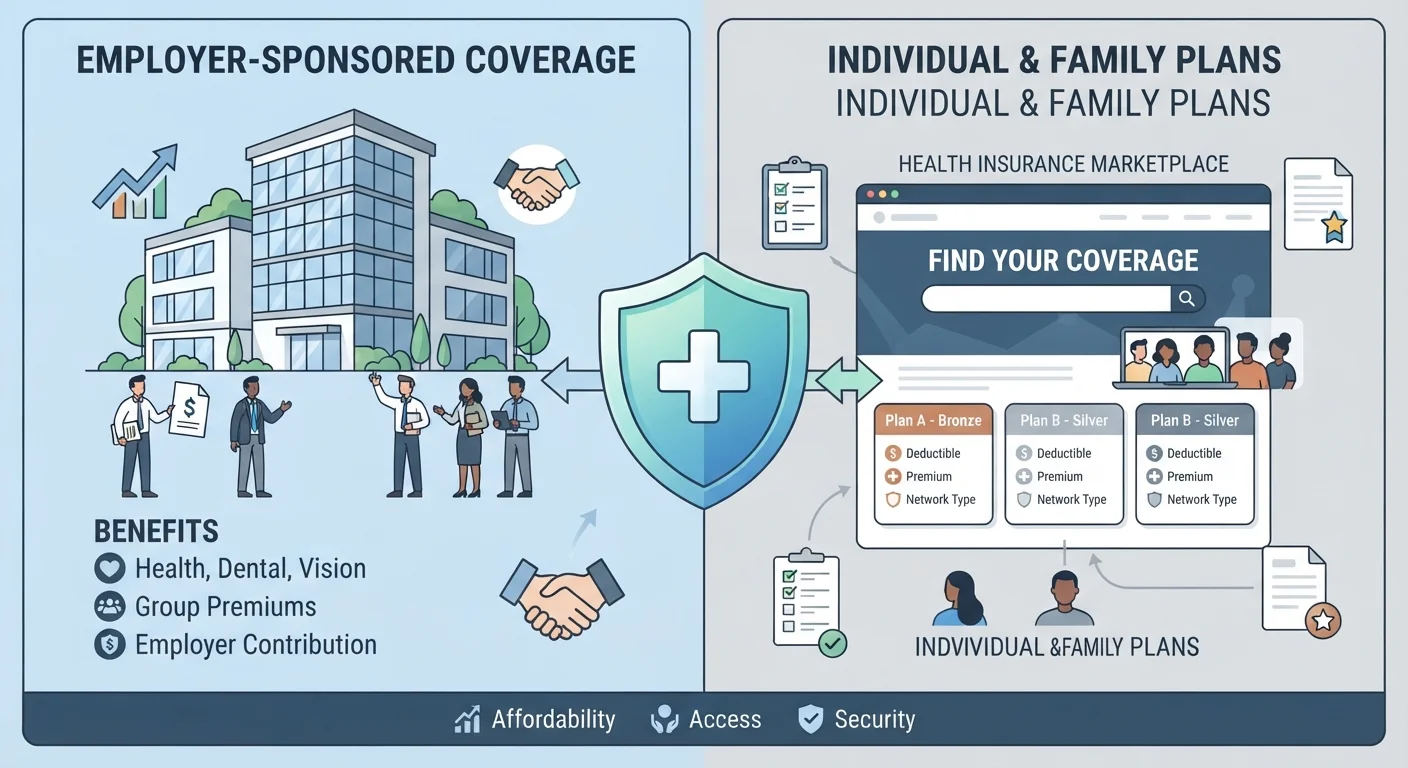
When a company offers health benefits, it negotiates directly with an insurer (or administers a self-funded plan) on behalf of its workforce. You enroll through your HR department, pay your share of the premium via pre-tax payroll deductions, and gain access to a plan the employer selected. Employers are not required by federal law to offer coverage unless they have 50 or more full-time-equivalent employees — those large employers face penalties under the ACA's employer mandate if they don't offer affordable, minimum-value coverage.
Marketplace Plans
The ACA marketplaces (HealthCare.gov for most states, or a state-run exchange) allow individuals and families to purchase regulated private insurance. You apply directly, choose from available plan tiers (Bronze, Silver, Gold, Platinum), and pay premiums monthly. Income-based premium tax credits — formally called the Premium Tax Credit (PTC) — can reduce what you owe, but only if you're not offered affordable employer coverage that meets minimum value standards.
Cost: Premiums, Subsidies, and the Employer Contribution
Cost is usually the deciding factor, and it works differently on each path.
~83%
Large employers offering health benefits
According to KFF's annual Employer Health Benefits Survey, the vast majority of large employers (200+ workers) offer health insurance to employees.
~73%
Average employer share of employee-only premium
KFF survey data indicate employers historically cover roughly 73% of the employee-only premium on average, though this varies widely by employer.
Employer-Sponsored Costs
Employers typically pay a substantial portion of employee premiums. When an employer covers a large share, even a relatively rich plan can cost the employee less out-of-pocket per month than a comparable marketplace plan purchased alone. Employee contributions are also paid pre-tax through payroll, which lowers your taxable income.
Marketplace Costs and Tax Credits
On the marketplace, you pay the full premium unless you qualify for the Premium Tax Credit. Eligibility is based on household income relative to the Federal Poverty Level (FPL). Critically, if your employer offers coverage considered "affordable" and of "minimum value" under ACA rules, you generally cannot claim the PTC — even if you'd prefer a marketplace plan. "Affordable" has a specific legal definition tied to a percentage of your household income, which the IRS adjusts annually.
Check Affordability Before Assuming You're Subsidy-Eligible
Even if your employer's plan feels expensive, it may still count as "affordable" under the ACA's legal definition — which disqualifies you from marketplace tax credits. Before assuming you qualify for a subsidy, use HealthCare.gov's screening tools or speak with a certified marketplace navigator. Getting this wrong could mean repaying credits at tax time.
Plan Choice, Networks, and Portability
Beyond premiums, plan design and flexibility separate these two options in important ways.
| Employer-Sponsored Insurance | Marketplace Plans | |
|---|---|---|
| Who selects the plan | Employer selects; employee chooses among offered options | Individual selects from all available plans in their area |
| Premium cost structure | Employer + employee share; pre-tax payroll deduction | Individual pays full premium; tax credits may reduce cost |
| Subsidy / tax credit availability | Not applicable; employer contribution replaces subsidy | Premium Tax Credit available based on income and eligibility |
| Portability | Tied to employment; COBRA available short-term | Portable; continues regardless of job status |
| Plan variety | Limited to employer's offered options | Wide selection across multiple insurers and tiers |
| Enrollment timing | Set by employer's annual open enrollment window | ACA marketplace open enrollment (typically Nov–Jan) |
Plan Selection
With employer coverage, you choose from whatever plans HR has arranged — often just one to three options. Marketplace shoppers can compare dozens of plans from multiple insurers, giving more control over the network, deductible structure, and insurer. Before accepting a workplace plan, it's worth reviewing key questions to ask your employer to make sure the plan genuinely fits your needs.
Portability
Employer coverage is tied to your job. If you leave, are laid off, or your employer stops offering benefits, you lose coverage — though COBRA allows you to keep the same plan temporarily at full cost (employee and employer share combined), which can be expensive. Losing job-based coverage is a qualifying life event that opens a Special Enrollment Period (SEP) on the marketplace, giving you 60 days to enroll in a new plan.
Marketplace plans, by contrast, are portable. They follow you regardless of employment status, as long as you continue paying premiums.
What Both Plans Must Cover
A common misconception is that one path delivers "better" coverage by definition. In reality, both employer-sponsored and marketplace plans sold to individuals and small groups must cover the ACA's ten essential health benefits, which include hospitalization, emergency services, prescription drugs, mental health and substance use disorder services, preventive care, and more. Large self-insured employer plans are partially exempt from some state-level mandates but must still comply with core federal requirements.
Where plans differ is in cost-sharing structure — deductibles, copays, coinsurance, and out-of-pocket maximums — and in how broad or narrow the provider network is. If you're weighing a high-deductible plan on either path, understanding the HSA trade-offs is essential before you commit.
When open enrollment arrives — whether through your employer or the marketplace — use a structured approach to compare plans rather than defaulting to last year's choice. Our guide on comparing plans during open enrollment walks through that process step by step.
This article provides general information about health insurance options and is not personalized financial, legal, or insurance advice. Coverage terms, subsidy eligibility, and plan availability vary by state, employer, and individual circumstances. Consult a licensed insurance agent or a certified navigator for guidance specific to your situation.