

Key Takeaways
What Is a Declarations Page and Why Does It Matter?
Your home insurance declarations page — commonly called the "dec page" — is a condensed summary of your entire policy, typically one to two pages long. It is the first document your insurer sends when coverage begins and again at each annual renewal. Think of it as the policy's table of contents and scorecard in one: every key number, date, and coverage category appears here without requiring you to read dozens of pages of fine print.
Because the dec page drives how a claim is evaluated, understanding it is one of the most practical things a homeowner can do. Errors here — a wrong address, a missing endorsement, an outdated dwelling limit — can directly affect how a claim is paid. For a broader orientation to home and auto coverage before diving into the line items, this starter's guide to auto and home policies provides useful context.
What you will need
Walking Through Each Section Step by Step
The sections below correspond to the standard structure most US home insurance declarations pages follow. While formatting varies by insurer, the underlying categories are consistent across the industry. Gather your dec page now and work through each step.
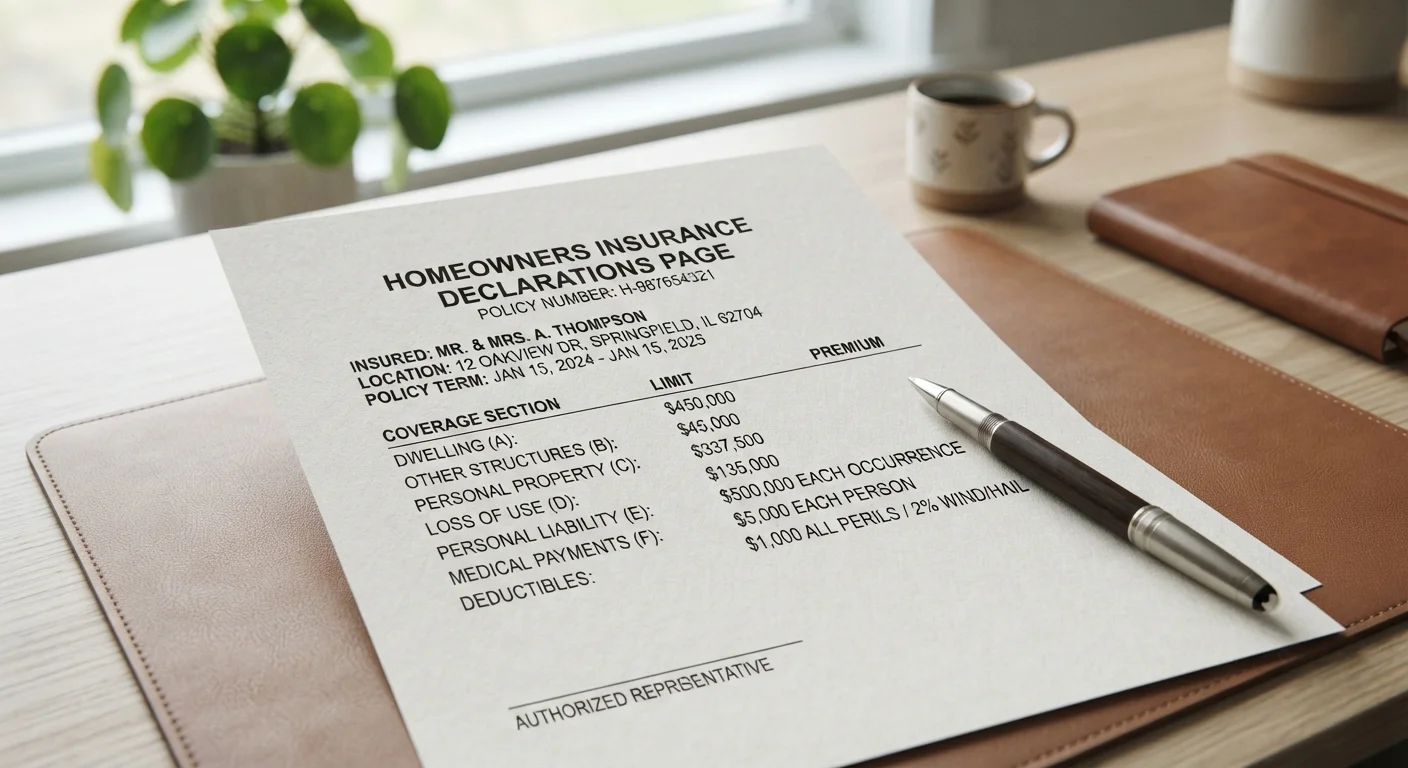
Declarations Page
The document you will read and verify throughout this walkthrough — issued by your insurer at policy inception and renewal.
Home Inventory List
A record of your personal property and estimated values, used to cross-check whether your personal property limit is adequate.
Local Building Cost Estimate
An estimate of per-square-foot construction costs in your area, helpful for evaluating whether your dwelling limit is realistic.
Locate the Policy Information Block
At the very top of your declarations page you will find the policy number, your name as the named insured, the property address, and your insurer's name and contact information. Verify that the address matches your home exactly — a discrepancy can complicate a claim. Also confirm the policy period: the start and end dates that define when coverage is active.
Review Dwelling Coverage (Coverage A)
Coverage A is the most consequential line on the page. It states the maximum the insurer will pay to repair or rebuild the physical structure of your home after a covered loss. Check whether this limit reflects replacement cost value (what it actually costs to rebuild) rather than actual cash value (replacement cost minus depreciation). Replacement cost coverage is generally the stronger protection. Compare this number against local construction cost estimates to judge whether it is adequate.
Check Other Structures, Personal Property, and Loss of Use
Coverage B (Other Structures) covers detached garages, fences, and sheds — typically set at 10% of Coverage A by default. Coverage C (Personal Property) covers your belongings: furniture, electronics, clothing. Note whether it pays replacement cost or actual cash value. Coverage D (Loss of Use or Additional Living Expenses) pays for temporary housing if your home becomes uninhabitable after a covered event — a limit that is easy to underestimate until you actually need it.
Examine Liability and Medical Payments Coverage
Coverage E (Personal Liability) protects you if someone is injured on your property or you are found legally responsible for damage to someone else's property. Standard limits often start at $100,000, but many policyholders choose higher limits given the potential cost of litigation. Coverage F (Medical Payments to Others) is a smaller, no-fault payment for minor injuries to guests — typically $1,000–$5,000 — and does not require a lawsuit to trigger.
Note Your Deductible(s)
The deductible is the amount you pay out of pocket before the insurer pays a claim. Many policies carry separate deductibles for different perils: a standard dollar deductible for most losses and a percentage-based deductible — often 1%–5% of Coverage A — for wind, hail, or hurricane damage. Knowing both figures before a storm helps you decide whether a smaller claim is worth filing.
Review Endorsements and Exclusions Listed
Endorsements (sometimes called riders) are modifications to the standard policy — they can add coverage (e.g., water backup, earthquake, scheduled valuables) or occasionally restrict it. The dec page lists active endorsements and their associated limits or premiums. Equally important: note any explicit exclusions referenced. Standard policies typically exclude flood and earthquake damage; separate policies or endorsements are required for those perils. See what home policies actually cover for a fuller breakdown of inclusions and exclusions.
Rebuild Cost ≠ Market Value
Your dwelling coverage limit should reflect what it would cost to rebuild your home from the ground up — not what you paid for it or its current real-estate market value. These figures can differ substantially. If your limit is based on market value rather than replacement cost, you may be significantly underinsured after a total loss. Ask your insurer or a licensed agent how your limit was calculated.
Keep a Digital Copy Accessible
Store a PDF of your current declarations page in a cloud folder or email it to yourself. If your home is damaged or destroyed, you will need to reference coverage limits and contact your insurer quickly — and paper copies stored inside the house may be gone. A digital copy accessible from your phone removes that barrier at exactly the wrong moment.
Review Your Dec Page at Every Renewal
Insurers can change coverage terms, limits, or deductibles at renewal. A typo in your address, a dropped endorsement, or a changed deductible can affect whether a future claim is paid — and how much. Set a reminder to read the updated declarations page each time your policy renews, and contact your insurer immediately if anything looks wrong.
This article provides general insurance information for educational purposes only and does not constitute personalized insurance, financial, or legal advice. Coverage terms, limits, exclusions, and pricing vary by insurer, policy, and state. Always read your actual policy documents carefully and consult a licensed insurance agent or adviser for guidance specific to your situation.