

Key Takeaways
Indoor Air Quality (IAQ)
Indoor air quality refers to the condition of the air inside a building — including what pollutants are present, how much moisture the air holds, and how well fresh air circulates. Poor IAQ can mean elevated levels of dust, mold spores, volatile organic compounds (VOCs), or carbon dioxide that accumulate when a space isn't properly ventilated or maintained. Unlike outdoor air, indoor air has no natural dilution mechanism, so what enters or is generated inside tends to stay there unless actively managed.
The EPA has noted that indoor air can be two to five times more polluted than outdoor air in some conditions, largely because modern homes are built to be airtight for energy efficiency, reducing natural air exchange.
Why Indoor Air Quality Is Worth Understanding
Most households focus on what they can see — dust on surfaces, visible mold, or smoke. But indoor air quality is largely invisible, and that's what makes it easy to overlook until a problem becomes obvious. The air inside a home accumulates whatever is generated or brought in: cooking byproducts, off-gassing from furniture and finishes, moisture from showers and cooking, pet dander, and outdoor pollutants that enter through gaps and HVAC systems.
Three mechanisms determine whether that air stays manageable: how well the space is ventilated, how well humidity is controlled, and what filtration is removing. These are not interchangeable — each addresses a different category of problem. Understanding that distinction helps homeowners make practical decisions rather than buying equipment that doesn't match what their space actually needs.
For a broader look at what genuinely earns its place in a home, see our room-by-room home essentials guide.
Ventilation: The Foundation of Fresh Air
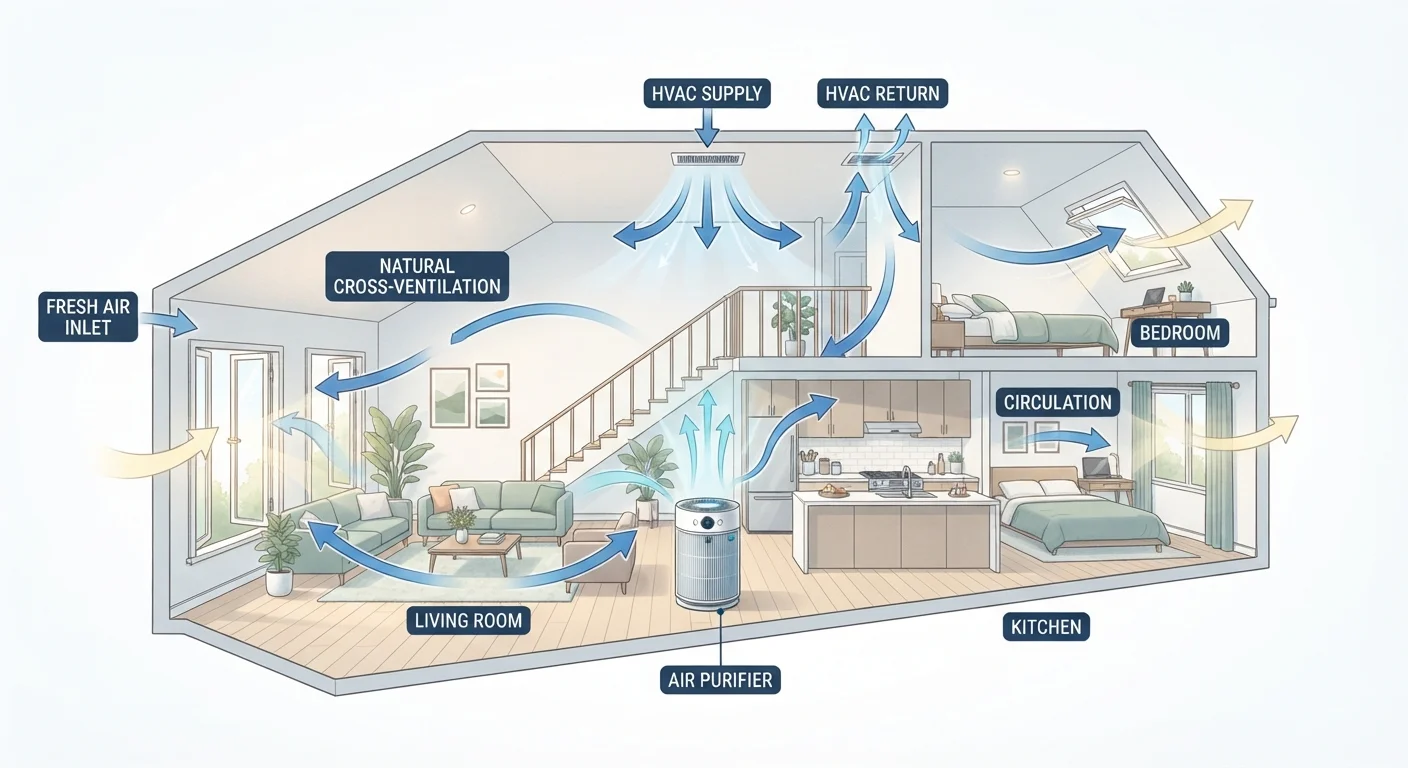
Ventilation is the exchange of indoor air with outdoor air. Its primary purpose is dilution — reducing the concentration of pollutants, CO₂, and moisture that build up in occupied spaces. Without adequate ventilation, even a clean-looking home can accumulate levels of CO₂ that cause fatigue, or VOC concentrations from common household products that exceed outdoor levels.
There are three types of ventilation in most homes:
- Natural ventilation: Air movement through open windows, doors, and building gaps. Simple and free, but dependent on weather and building orientation.
- Spot ventilation: Exhaust fans in bathrooms and kitchens that remove pollutants and moisture at the source. Highly effective and underused — running a bathroom fan for 20 minutes after showering meaningfully reduces humidity load.
- Whole-house ventilation: Systems integrated with HVAC — including heat recovery ventilators (HRVs) and energy recovery ventilators (ERVs) — that bring in fresh air while recovering heat or coolness from outgoing air.
For older or moderately airtight homes, opening windows remains one of the most effective and lowest-cost interventions. Reviewing your home's ventilation needs fits naturally into seasonal maintenance planning.
Use Exhaust Fans More Than You Think Necessary
Most bathroom exhaust fans are undersized or underused. Running one for at least 20 minutes after a shower removes the majority of the moisture load that would otherwise contribute to mold growth. In kitchens, using the range hood every time you cook — not just when something is smoking — significantly reduces particulate and VOC buildup from cooking combustion.
Humidity: The Variable Most People Underestimate
Humidity affects both the air you breathe and the structure of your home. Relative humidity — the percentage of moisture the air holds relative to its maximum capacity at a given temperature — is the key metric. Most health and building science guidelines suggest keeping it between 30% and 50%.
Too low (common in heated homes during winter): nasal passages and skin dry out, static electricity increases, and wood floors or furniture can crack over time. Too high (common in humid climates or poorly ventilated bathrooms): mold and mildew find favorable conditions, dust mite populations grow, and structural materials can degrade.
2–5×
Indoor vs. outdoor air pollution concentration
The U.S. Environmental Protection Agency has noted that indoor air pollutant levels can be two to five times higher than outdoor levels in some homes.
30–50%
Recommended indoor relative humidity range
Most building science and health guidelines place the comfortable, low-risk humidity range between 30% and 50% relative humidity year-round.
90%
Of time Americans spend indoors
EPA estimates suggest Americans spend roughly 90% of their time indoors, making indoor air quality a significant everyday exposure factor.
The tools are straightforward: a humidifier adds moisture when air is too dry; a dehumidifier removes it when too damp. Whole-home units can be integrated with HVAC systems, while portable models work for individual rooms. A basic hygrometer — an inexpensive device that reads relative humidity — is the starting point for knowing whether you even have a problem.
Filtration: What Filters Actually Capture
Air filters — whether in an HVAC system or a standalone air purifier — trap airborne particles: dust, pollen, pet dander, mold spores, and some bacteria. Their effectiveness is rated by MERV (Minimum Efficiency Reporting Value) for HVAC filters, and by CADR (Clean Air Delivery Rate) for portable purifiers, which measures how quickly a unit cleans air in a given room size.
Filters do not address gases, VOCs, odors, or humidity. A HEPA filter will capture very fine particles (0.3 microns and larger at 99.97% efficiency) but will not remove formaldehyde off-gassing from pressed wood furniture. Some air purifiers include activated carbon stages specifically for gases and odors — these are separate filter media with different replacement schedules.
MERV Ratings and System Compatibility
A higher MERV rating captures smaller particles but also increases airflow resistance. Using a filter rated beyond what your HVAC system is designed for can reduce airflow, decrease efficiency, and stress the blower motor. Check your system's specifications or consult an HVAC technician before upgrading to a significantly higher-rated filter. The right filter is the highest-rated one your system can handle without airflow problems — not simply the highest number available.
The most important filter-related decision most households make is consistency of replacement. A clogged HVAC filter restricts airflow, strains the system, and eventually performs worse than a lower-rated clean filter. Check filters monthly and replace on the manufacturer's schedule at minimum — more often if you have pets, allergies, or run the system heavily.
For context on how air quality connects to physical health more broadly, the Physical Health hub covers respiratory and cardiovascular topics worth understanding alongside IAQ basics.
This article is for general informational purposes only. If you have respiratory conditions or health concerns related to air quality, consult a qualified healthcare professional.