

Key Takeaways
Body Composition
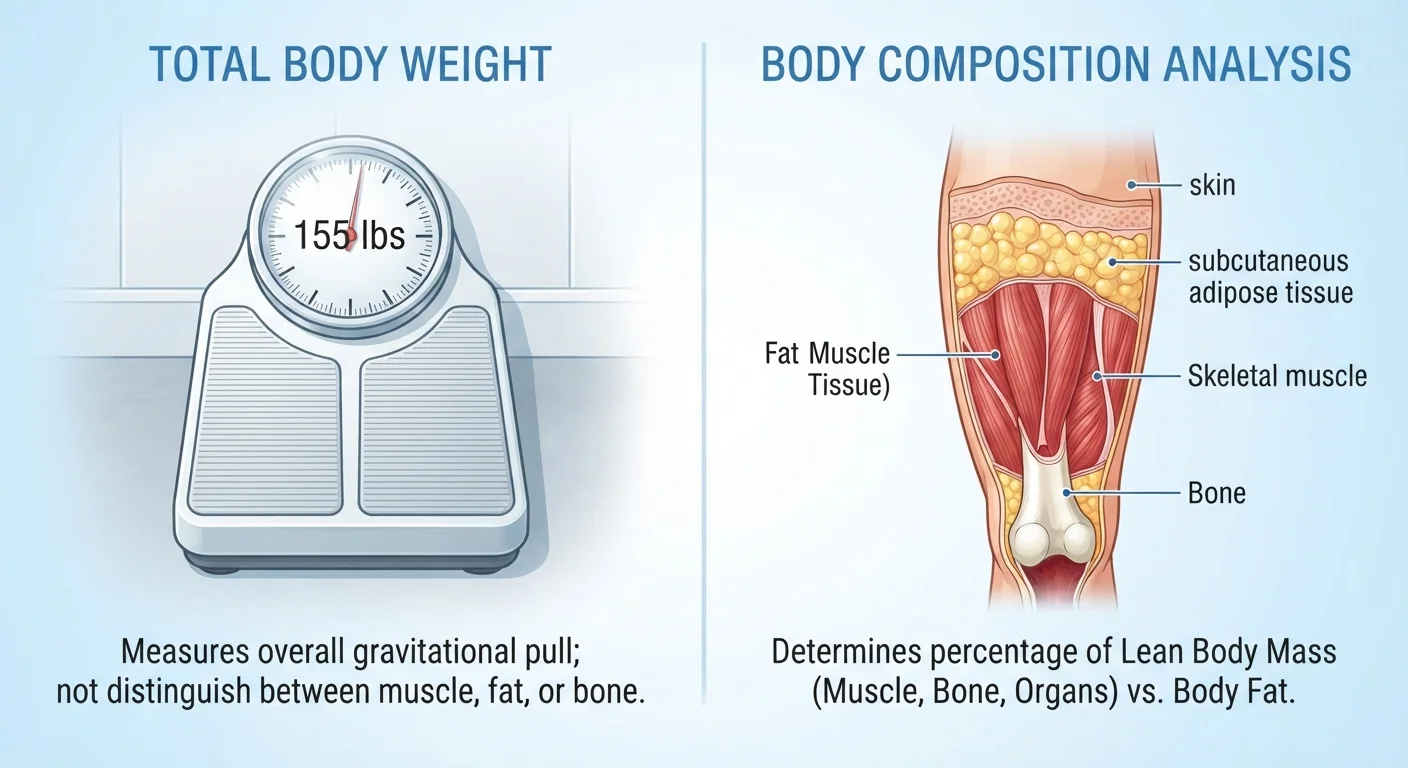
Body composition refers to the proportions of fat mass, muscle mass, bone, and water that together make up your total body weight. Unlike the scale, which only measures how much you weigh in total, body composition breaks that number down into its meaningful parts. Understanding these proportions gives a far clearer picture of physical health than weight alone.
In clinical and research settings, body composition is commonly expressed as fat mass versus fat-free mass (FFM), with FFM encompassing skeletal muscle, bone mineral density, organ tissue, and body water. Methods of measurement range from bioelectrical impedance analysis (BIA) to dual-energy X-ray absorptiometry (DEXA).
Why the Scale Alone Doesn't Tell the Whole Story
Step on a scale and you get a number - total mass, nothing more. That number doesn't reveal how much of your weight is metabolically active muscle, how much is stored fat, or how much is bone and water. Two people of identical height and weight can have dramatically different health profiles depending on what their weight is made of.
Consider a 170-pound person who carries a high proportion of lean muscle versus a 170-pound person whose weight is composed largely of fat mass. Their risks for metabolic conditions, their physical capacity, and their long-term health trajectories may be entirely different - yet both receive the same number on the scale.
This is the central problem with using scale weight as a health proxy: it flattens meaningful biological differences into a single, context-free digit. Body composition, by contrast, disaggregates those components so the picture becomes actionable.
Body Composition Is One Piece of the Picture
Body composition data is a useful health indicator, but it is not a comprehensive measure of wellness on its own. Cardiovascular fitness, blood markers, mental health, sleep quality, and functional strength all contribute to overall well-being in ways that no single measurement can fully capture. Use body composition as one informative data point, not a definitive health verdict.
The Key Components of Body Composition
Body composition is typically described in terms of two broad categories: fat mass and fat-free mass. Fat-free mass includes skeletal muscle, bone mineral density, organ tissue, and body water - everything that isn't stored fat.
Within fat mass, a clinically important distinction exists between subcutaneous fat (stored just beneath the skin) and visceral fat (stored deeper in the abdominal cavity, surrounding vital organs). Research consistently associates elevated visceral fat with greater metabolic risk, even in individuals whose total body weight falls within a normal range. You cannot feel or see visceral fat from the outside, and a bathroom scale cannot measure it.
Muscle mass deserves particular attention. Skeletal muscle is metabolically active tissue - it burns calories at rest, supports insulin sensitivity, and underpins the physical strength and mobility that matter significantly as people age. Preserving and building muscle through resistance exercise is one of the most well-supported strategies for long-term functional health. See our guide to balancing cardio and strength training for evidence-based ways to approach both.
~30%
Approximate body fat threshold associated with increased metabolic risk in men
Research published in clinical nutrition journals generally associates body fat percentages above approximately 25-30% in men with elevated markers of metabolic risk, though thresholds vary by age and population studied.
2x
Approximate difference in metabolic rate between muscle and fat tissue
Skeletal muscle burns significantly more calories at rest than fat tissue does, contributing to why higher muscle mass is associated with a more active baseline metabolism, according to exercise physiology research.
40%
Adults with normal BMI but excess body fat ("normal-weight obesity")
Studies have estimated that a meaningful proportion of adults with a BMI in the normal range nonetheless carry excess fat mass - a condition sometimes called normal-weight obesity - highlighting the limits of BMI as a standalone health metric.
How Body Composition Can Change - Even When Weight Doesn't
One of the most important and often surprising insights from body composition research is that the scale can remain completely static while meaningful health improvements occur underneath it. When someone engages in resistance training and adjusts their diet, they may simultaneously gain muscle and lose fat in roughly equal measure - a process sometimes called body recomposition. The scale reads the same; the body has changed substantially.
The reverse is also possible and worth recognizing. Someone who loses weight rapidly through severe caloric restriction without adequate protein intake or exercise may shed muscle alongside fat, leaving them lighter on the scale but with a less favorable fat-to-muscle ratio than before. Weight loss and health improvement are not always synonymous.
Tracking body composition periodically - rather than checking the scale daily - provides more signal and less noise. A structured weekly activity framework can help you build the consistent movement habits that support favorable body composition over time. Hydration also plays a role worth understanding: see how water affects your body's daily function, including its influence on muscle performance and body fluid balance.
Track Trends, Not Daily Fluctuations
Body weight and composition estimates can shift by several pounds within a single day due to hydration, food volume, and hormonal cycles. Rather than reacting to daily scale numbers, consider measuring body composition monthly under consistent conditions - same time of day, same hydration state, same device. Patterns over weeks and months carry far more meaning than any individual reading.
Measurement Methods and Their Limitations
Several tools exist for estimating body composition, and understanding their trade-offs helps set realistic expectations.
- DEXA scan: Dual-energy X-ray absorptiometry provides highly detailed data on fat mass, lean mass, and bone density across different body regions. It is generally considered the most accurate non-invasive method but requires clinical access and involves minimal radiation exposure.
- Bioelectrical impedance analysis (BIA): Consumer-grade smart scales and handheld devices use BIA to estimate body composition by passing a low electrical current through the body. Results can vary with hydration levels, time of day, and recent physical activity, so consistency in testing conditions matters more than any single reading.
- Hydrostatic weighing: This method estimates body density by comparing weight on land versus submerged in water. It is accurate but largely confined to research or clinical settings.
- Skinfold calipers: A trained practitioner measures fat thickness at standardized sites to estimate total body fat. Accuracy depends heavily on technique and the skill of the person performing the measurement.
No method is perfect. Trends over time, measured consistently with the same method, are far more informative than any individual reading. Discuss measurement options with a healthcare provider to determine what level of tracking makes sense for your situation.
For a complementary lens on physical fitness, understanding aerobic fitness metrics like VO2 max offers another dimension of health data that body composition alone doesn't capture.
This article is for general informational and educational purposes only and does not constitute medical advice. Consult a qualified healthcare professional before making decisions about your health, diet, or exercise routine.